Decorative Stucco Finishes in Port St. Lucie, FL
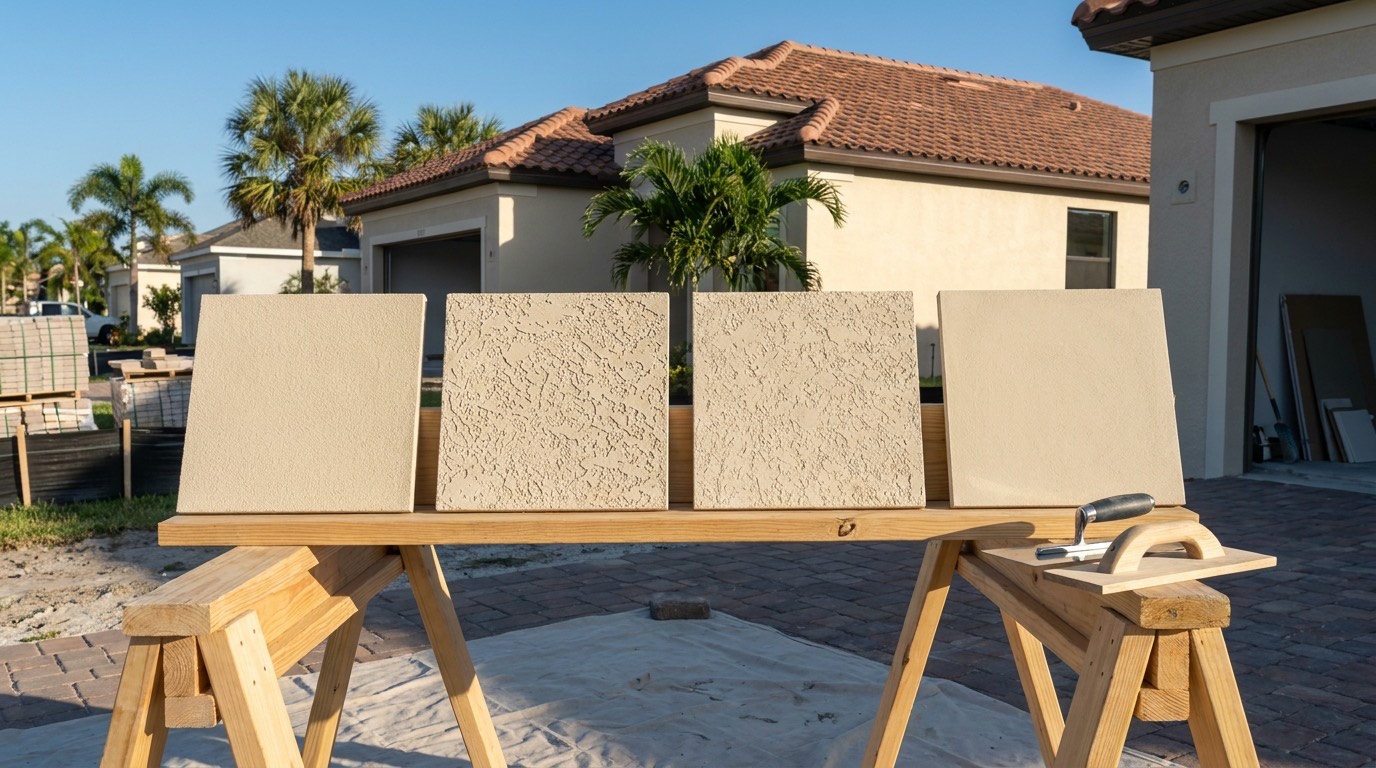
The finish coat is the only layer of your stucco anyone ever sees. We apply sand, lace, knockdown, smooth troweled and Santa Barbara finishes on homes across Port St. Lucie and the Treasure Coast.
Request a quote
Four questions, about a minute. We'll call you back.
What the Finish Coat Is Doing
Under the texture there is a base coat that carries the load and takes the shrinkage. The finish coat is thin, usually an eighth of an inch or less, and it does two jobs. It gives the wall its color and pattern, and it takes the first hit from sun, salt and rain.
Because it is thin, the finish coat follows whatever is underneath it. A wavy brown coat gives you a wavy lace finish. A base coat with a hard trowel burn on it gives you bond problems. Most finish complaints we get called out for on Treasure Coast homes trace back to the layer nobody looks at.
Textures You See Around Port St. Lucie
Florida block homes lean heavily on a handful of textures. Each one is applied differently and each one ages differently.
Sand and lace are the workhorses here because they hide small movement well. Smooth finishes look sharper but they show every hairline crack, so they belong on walls that are stable and detailed properly.
- Sand finish: float or sponge applied, uniform grain, comes in fine, medium and coarse. Forgiving and easy to patch.
- Lace: material is sprayed or hand thrown, then knocked down in a pattern. The classic Florida look, heavy or light depending on how much you flatten.
- Knockdown: sprayed on and flattened with a wide blade so the high spots go flat and the low spots stay. Softer and more even than lace.
- Dash: sprayed and left alone. Rough, very durable, common on older Treasure Coast walls and garden walls.
- Smooth troweled: steel troweled flat. Modern look, no place to hide anything.
- Santa Barbara: a thin smooth coat worked by hand so it carries subtle undulation and trowel marks. Reads soft and old world, not flat.
Smooth and Santa Barbara Work
Smooth finishes take more labor than anything else on this list. The material is applied thin, troweled tight, and worked while it is still open. There is no texture to hide a bad joint, so the wall has to be laid out and stopped at natural breaks like corners, control joints and door lines. Stopping mid wall leaves a cold joint you will see in raking sunlight forever.
Santa Barbara is a smooth finish with the hand work left visible. It is applied in thin passes and burnished so the surface picks up soft shadowing. Homeowners like it because it does not read as flat or plastic. Be aware that hairline crazing shows more on any smooth wall, so we usually pair it with an acrylic finish material that flexes rather than a straight cement finish.
Integral Color or Paint
Integral color means the pigment is mixed into the finish material, so the color goes all the way through the coat. Chip it and the chip is the same color as the wall. There is no paint film to peel, and the wall keeps breathing.
Painted finish means the wall is finished in gray or white and then coated. You get a wider color range, an easier color change later, and a repaintable surface. The tradeoff is a maintenance cycle you now own for the life of the house.
Neither one is automatically right. Integral color suits homeowners who want low upkeep and are settled on a color. Paint suits anyone who wants a specific color match, a dark color, or plans to change it in ten years. Integral color also has a limit worth knowing: batch to batch variation is real, so we mix in volume and keep a wet edge on each elevation.
Acrylic Finish or Cement Finish
Cement based finish coats are sand, portland cement and lime. They are hard, breathable, cheap, and they hold up for decades. They also shrink as they cure, which is where hairline crazing comes from, and their color depth is limited to what mineral pigments can do.
Acrylic finishes carry polymer binders. They flex a little, they bridge hairlines that would show through a cement finish, they hold deep and bright colors, and they resist dirt pickup better in humid air. They cost more per square foot and they are less breathable, which matters on a block wall that is already holding moisture.
On Port St. Lucie homes we generally use acrylic on smooth and Santa Barbara walls, and either one on sand, lace and knockdown. If a wall has an active moisture problem, no finish material fixes it, and putting a tight acrylic over it just moves the blistering somewhere else.
Matching an Existing Wall
Matching is a craft problem, not a product problem. Two walls with the same material and the same trowel can still look different because of how hard the applicator knocked it down, how wet the mix was, and how fast it set that day.
We match by making sample boards on site, in the same conditions, and holding them against the existing wall in daylight. Aged texture also fills in slightly from years of dirt and coating, so a fresh patch usually needs to be knocked down a touch lighter to read the same once it dries.
For a repair in the middle of an elevation, the honest answer is that the safest match runs corner to corner or joint to joint. A patch that stops in the middle of a flat wall will usually show at some angle of light, even when the texture is right. When the budget will not stretch to a full elevation, a uniform coating over the whole wall afterward evens out most of the difference.
What Drives the Price
Texture choice is the first lever. Sand and lace are quick. Knockdown is a little slower. Smooth and Santa Barbara can run several times the labor of a sand finish on the same wall because of the trowel time and the tight scheduling.
After that it is access, wall condition, and detail count. Two story elevations need staging. Old walls need repair and a leveling pass before any finish goes on. Walls broken up by bands, arches, columns and window trim have a lot of edge work, and edges are where the hours go.
- Texture and trowel time
- Acrylic versus cement finish material
- Integral color versus finish plus coating
- Height, access and staging
- Prep, patching and leveling on an existing wall
- Linear feet of bands, corners, arches and reveals
What a new stucco finish costs in Port St. Lucie
A finish coat on its own is priced the same way as a resurface, by the square foot of wall, because that is the work: prepare what is already there, then run new material corner to corner. Texture is the lever that moves the number, since smooth and Santa Barbara take several times the trowel time of a sand finish on the same wall.
| New sand, lace or knockdown over sound existing stucco | $3 to $6 per square foot of wall |
|---|---|
| Smooth or Santa Barbara, or leveling a heavy lace out first | Resurface rate plus the extra trowel time |
| Finish included in new stucco over block, wall installed | $6 to $11 per square foot of wall |
| Finish included in new three coat stucco over frame and lath | $9 to $15 per square foot of wall |
What moves the number
- Texture chosen and the trowel time it takes
- Acrylic or cement finish material
- Integral color, or a finish coat plus a coating over it
- Height, access and staging on two story elevations
- Prep, patching and leveling needed on the existing wall
- Linear feet of bands, corners, arches and reveals
These are ranges and not a quote, since the price only firms up after we see the wall and put a sample board on the house. Call (772) 251-6654 or send the form and we will put it in writing.
Decorative Stucco Finishes across our area
All areas →Questions about decorative stucco finishes in Port St. Lucie
What is the difference between lace and knockdown?
Both start with material sprayed or thrown onto the wall. Lace is knocked down lightly so the raised pattern and its shadow stay strong. Knockdown is flattened harder and more evenly, so the wall reads softer and closer to smooth. The same crew, same material and same day can produce either one just by changing how much they flatten it.
Can I change my texture without redoing the whole house?
Usually yes, if the existing stucco is sound. A new finish coat can go over an existing wall once it is cleaned, any cracks and hollow spots are repaired, and a bonding treatment is applied. Going from a heavy lace to a smooth finish is the hard direction, because the old pattern has to be leveled out first and that adds material and labor.
Will integral color fade in Florida sun?
Mineral pigments in cement finishes are stable, but deep and bright colors do soften over years of direct sun and salt air. South and west elevations show it first. If you want a dark color to stay dark, a finish coat with a UV stable acrylic binder, or a coating applied over a neutral finish, will hold the tone longer than raw integral color.
How long does a new finish need before rain?
Cement finishes need to set before they see driving rain, and a summer afternoon storm on a fresh wall can wash out color and streak the texture. We watch the radar and stop early when a cell is building. Acrylic finishes generally shed light rain sooner once they have skinned over, but neither one should be pushed against an incoming storm.
Is a Santa Barbara finish practical on the Treasure Coast?
It works here, with the right build. Smooth finishes show hairlines, so the wall underneath has to be sound, the control joints have to be respected, and we prefer an acrylic finish material for the small amount of flex it gives. On a well built block wall with good flashing it holds up fine. On a wall with an existing moisture or movement problem it will telegraph every issue.
Other services
All services →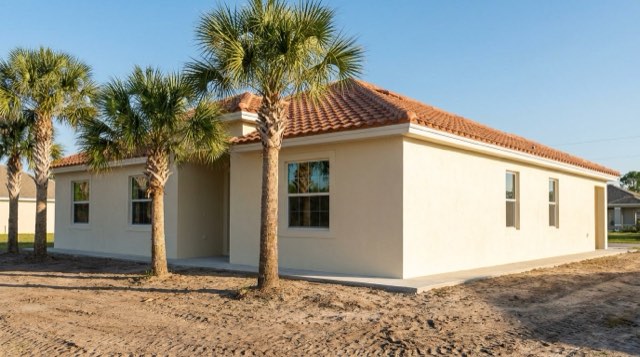
Stucco Installation
New three-coat stucco over frame or block
Learn more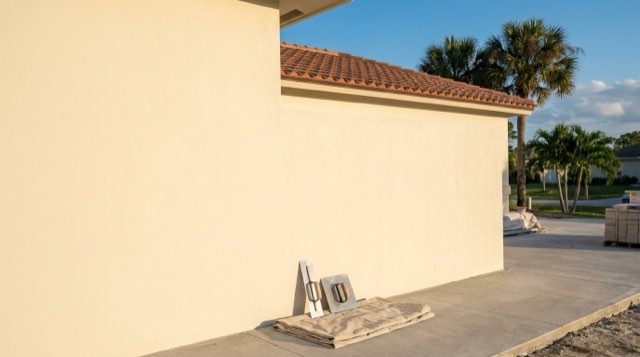
Stucco Repair
Cracks, spalling, bulges, and failed patches
Learn moreRestucco
Whole-house re-stucco, remove and replace
Learn more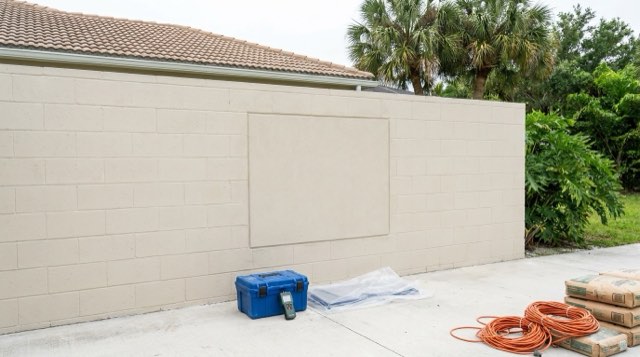
Stucco Remediation
Moisture intrusion and rotted substrate
Learn more
EIFS / Synthetic Stucco
Installation, inspection, and repair
Learn more
Stucco Resurfacing
Refinishing tired or mismatched walls
Learn more
Lath and Plaster
Wire lath, scratch and brown coat
Learn more
Stucco Painting and Coatings
Elastomeric and breathable coatings
Learn more
Stucco Waterproofing and Sealing
Sealants, flashing details, and weather barriers
Learn more
Block and Foundation Stucco
CMU parge coats and stem wall finishes
Learn more
Commercial Stucco
Multi-family, retail, and light commercial
Learn more
Commercial Stucco Repair
Scheduled maintenance and facade repair
Learn moreStraight answer on your wall.
Call, or send the form and we will get you a written price.