Stucco Repair and Recoating in Palm City, FL
Palm City is inland Martin County, and the housing is newer than the coastal towns around it. We serve the area from Port St. Lucie, and the problems we see here are about water and cracking rather than salt.

Request a quote
Four questions, about a minute. We'll call you back.
Newer Block Homes and Hairline Cracking
Most Palm City subdivisions went up from the 1990s onward on concrete block with a thinner stucco system than older construction used. That system performs well, but it cracks in predictable places. Corners of windows and doors, along control joints, at the line where a lintel meets block, and above and below openings where the wall is at its thinnest.
Almost all of it is cosmetic and normal. Concrete shrinks as it cures and the building moves seasonally, so hairline cracking is not evidence that something is wrong. What matters is whether the crack is wide enough to take water in. A hairline you can barely see is a maintenance item. A crack you can catch a fingernail in, or one that has a stain running out of it, is a repair.
- Diagonal cracks off window and door corners, the most common pattern
- Straight vertical cracks that follow a control joint
- Horizontal cracking at lintel and tie beam lines
- Map or spiderweb cracking across a full elevation, usually a coating problem
Summer Rain and Water Getting Behind the Wall
Inland Palm City does not get the salt load the coast does, but it gets the full summer rainy season. Heavy afternoon storms, wind driven rain and long stretches of high humidity. On block construction water that gets past a crack does not run out again quickly. It sits in the block and works through.
That is why we chase the source before we patch. A crack that keeps reopening in the same spot usually has help. A downspout discharging against the foundation, a roof valley concentrating runoff on one wall, a window head with no flashing, or grade sloping back toward the house. We fix the stucco, but if the water has a path we will point it out, because sealing the crack alone just moves the failure a few feet over.
Efflorescence, Staining and Sprinkler Damage
The white powdery deposit that shows up on block and stucco walls is efflorescence. Water moves through the wall, dissolves salts in the masonry, then evaporates at the surface and leaves them behind. It is not mold and it is not a coating defect. It is a signal that moisture is passing through the wall.
Irrigation is the other big one in Palm City, where lots are larger and sprinkler systems run long. Overspray hitting a wall every morning keeps that section permanently damp and leaves mineral staining that no amount of washing removes for long. Adjusting head throw and spray pattern away from the house does more for the exterior than any product we could apply.
- Redirect sprinkler heads so spray does not hit the wall
- Extend downspouts away from the foundation
- Keep mulch and soil below the stucco termination line
- Trim vegetation back so walls can dry after rain
Recoating and Color Matching
On subdivision homes the finish is usually a sprayed texture such as knockdown or a light lace, and the same texture repeats through the neighborhood. That is good news for repairs, because those finishes are straightforward to reproduce.
Color is the harder half. Ten or fifteen years of sun will have moved the existing color away from whatever was originally specified, so matching to the original paint code rarely lands. We match to the wall as it looks now. Even then, a spot repair in a large flat elevation tends to show, so on a visible wall we usually recommend coating from corner to corner. A stop at a natural break disappears. A stop in the middle of a wall does not.
Larger Lots, Additions and Lanai Work
Palm City lots run bigger than the coastal towns, which changes the practical side of the job. There is room to stage material and set scaffold without blocking a street, and access around the house is usually easy. That tends to make the work go faster.
Larger lots also mean more added structures. Enclosed lanais, screen room conversions, garage extensions and additions built years after the original house. Where new construction meets old, the two sections move independently and crack along the joint almost every time. That junction needs a proper joint detail rather than a rigid patch, otherwise it opens again in the first season.
Services in Palm City
All services →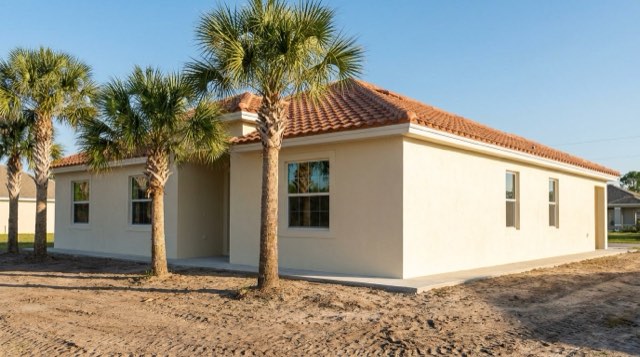
Stucco Installation
New three-coat stucco over frame or block
Learn more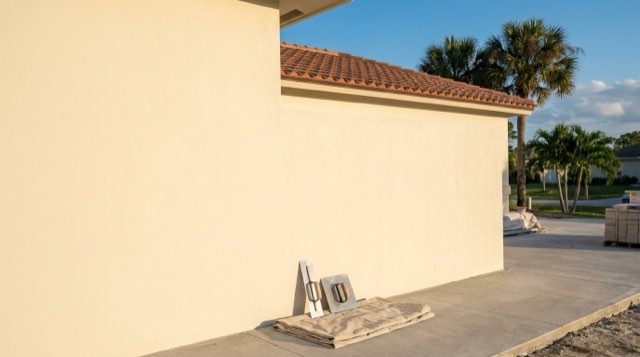
Stucco Repair
Cracks, spalling, bulges, and failed patches
Learn moreRestucco
Whole-house re-stucco, remove and replace
Learn more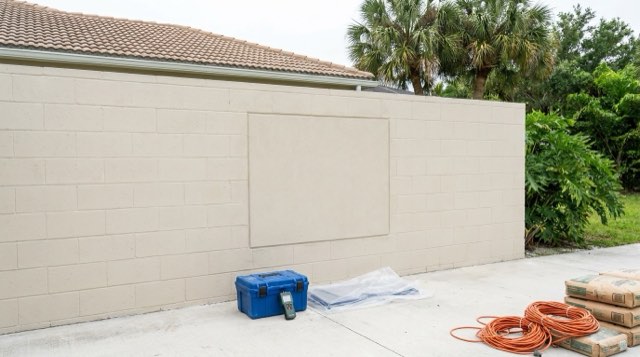
Stucco Remediation
Moisture intrusion and rotted substrate
Learn more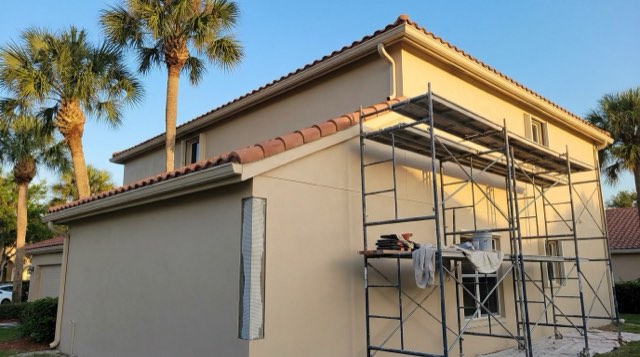
EIFS / Synthetic Stucco
Installation, inspection, and repair
Learn more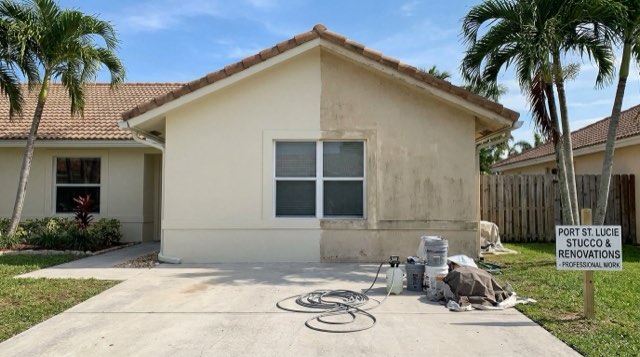
Stucco Resurfacing
Refinishing tired or mismatched walls
Learn more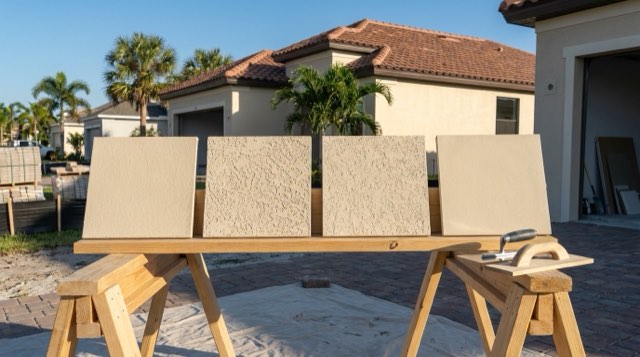
Decorative Stucco Finishes
Sand, lace, knockdown, smooth, and Santa Barbara
Learn more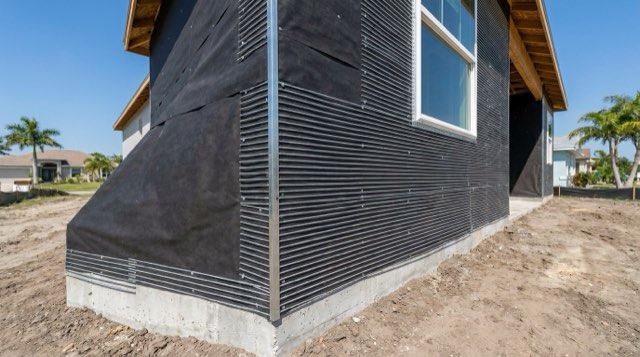
Lath and Plaster
Wire lath, scratch and brown coat
Learn more
Stucco Painting and Coatings
Elastomeric and breathable coatings
Learn morePalm City stucco questions
My Palm City house has cracks all over the stucco. Is the structure failing?
Almost never. Hairline cracking on block construction is normal shrinkage and seasonal movement, and it is very common on homes built from the 1990s onward. The cracks worth acting on are the ones wide enough to take water, the ones with staining bleeding out of them, and stair step cracking that follows the block joints. We will walk the house and tell you which category yours falls into.
What is the white chalky residue on the bottom of my wall?
That is efflorescence. Moisture travels through the block, picks up mineral salts, then evaporates at the surface and leaves the salts behind. It is harmless in itself but it tells you water is moving through the wall. Washing it off treats the symptom. The lasting fix is to find the water, which near the base of a wall is usually irrigation, grade or a downspout.
Can you match my existing stucco color for a repair?
We match to the wall as it looks today rather than to the original color code, because sun exposure will have shifted it. On a small or hidden area that is usually good enough. On a large visible elevation a spot repair still tends to read differently in raking light, so we normally recommend coating that elevation corner to corner and quote it as an option.
Why does the crack where my addition meets the house keep coming back?
Because the addition and the original house have separate foundations and they move independently. A rigid patch across that line is being asked to hold two structures together, and it loses. The correct detail is a joint that allows movement, which means cutting in a proper control joint with a flexible sealant rather than filling it with stucco.
Stucco quotes for Palm City, FL
Call, or send the form and we will get you a written price.