Stucco Painting and Coatings in Port St. Lucie, FL
A coating on stucco has to stretch, shed rain, and still let the wall dry outward. Pick the wrong product for a Florida block house and you get blisters instead of protection.
Request a quote
Four questions, about a minute. We'll call you back.
Coating Stucco Is a Different Job
Stucco is alkaline, porous, and it moves. It absorbs water during a storm and gives it back over the following days. A coating has to live with all three of those facts.
That rules out treating an exterior wall like interior trim. Standard flat house paint goes on at a thin film, has almost no elongation, and splits over the first hairline it crosses. Within a couple of Treasure Coast summers you are looking at a chalky wall with fine cracks showing straight through the paint.
Elastomeric Coatings and Film Build
Elastomeric is a high build acrylic. The value is in thickness and stretch. Manufacturers generally call for something in the range of 10 mils dry film across two coats, roughly four to five times the film of ordinary exterior paint, and the cured film can typically elongate a couple hundred percent before it tears.
That combination is what lets it bridge hairline cracks and keep bridging them when the wall expands in afternoon heat and contracts overnight. Applied thin, it does none of that. A single skimpy coat of elastomeric is just expensive paint, and it will crack over the same hairlines a cheap coating would.
We work to a spread rate, not to a look. That means measuring coverage per gallon on the job rather than stretching material until the wall stops looking patchy, and it is the difference between a coating that performs and one that only looks like it did on day one.
Breathable Acrylic and Mineral Coatings
Not every wall wants a heavy elastomeric. Vapor permeability is measured in perms, and the higher the number the more freely the wall can dry outward through the coating. Thick elastomeric films sit at the low end. Standard exterior acrylics sit higher. Mineral coatings, meaning silicate and lime based products, sit higher still and stay chemically compatible with cement stucco.
Mineral coatings bond into the surface rather than forming a skin on top of it, so there is no film to blister off. They shed liquid water while staying open to vapor. The tradeoff is a narrower color range, a more matte mineral look, and less crack bridging than an elastomeric can offer.
The choice comes down to what the wall needs most. A wall with fine crazing that stays dry wants crack bridging. A wall on a block house that gets wet and needs to dry wants permeability. Very often the right answer on the Treasure Coast is a high quality permeable acrylic, with elastomeric reserved for walls that genuinely have a cracking problem.
Why Trapped Moisture Matters on Block
Concrete block holds water. It wicks it up from the slab and stem wall, it takes it in through the face during wind driven rain, and it stores it. On a house that has stucco on the outside and a vapor retarding paint or vinyl wallcovering on the inside, the outside face is the main drying path the wall has.
Put a low perm elastomeric on that face and the moisture keeps arriving but stops leaving. It collects at the coating line. Sun heats the wall, the vapor pressure pushes out, and the film lifts. That is what most blistering and peeling on Florida block homes actually is. It is rarely a bad batch of paint.
So before we quote a coating we look for where the water is coming from. Sprinkler heads hitting the wall, grade built up over the weep screed, failed sealant at windows, roof water dumping on a wall. Fixing the source first is cheaper than coating the same wall twice.
Prep Decides the Outcome
Adhesion is won or lost before the first gallon opens. Coastal walls carry salt deposits, mildew and chalk from the previous coating, and none of that is a bonding surface.
We wash the wall, let it dry, then deal with what the wash exposes. Chalk gets sealed with a penetrating primer. Cracks get opened and filled with a flexible patching compound rather than skimmed over. Hollow and delaminated areas get cut out and replastered, because no coating holds up loose stucco.
New cement stucco needs to cure and lose its free alkalinity before it takes a coating. The traditional wait is around 28 days, and rushing it risks saponification and color burn on the fresh wall. Some acrylic finish systems and high pH tolerant primers shorten that window, but it is a decision to make on purpose, not by accident.
- Pressure wash at a pressure that cleans without cutting the stucco face
- Treat mildew and rinse it, do not just paint over the stain
- Prime chalky and porous surfaces with a penetrating masonry primer
- Repair cracks with an elastomeric patch and repair hollow areas with plaster
- Mask, protect and cut back landscaping and irrigation heads
- Check moisture and let a recently washed or recently rained on wall dry
Spray and Back Roll
High build coatings are sprayed for output and back rolled for contact. The spray puts the material on. The roller pushes it into the texture, fills the pinholes and voids the spray skips over, and levels the film so you get consistent thickness instead of thick ridges and thin valleys.
On lace and knockdown especially, spray alone leaves the shadowed side of every raised pattern under coated. Those are exactly the spots where water sits. We back roll every coat.
Two coats, with the manufacturer recoat window respected between them. Working in Florida means watching dew point and afternoon storms as closely as temperature, because a coating that gets rained on before it forms a film will streak or wash and has to be redone.
Recoat Intervals and What Shortens Them
A properly applied high build acrylic or elastomeric system on a sound wall is a long interval product, not an annual chore. Expect to be looking at the wall again somewhere in the range of a decade, sooner on the elevations that take the worst of the sun and the salt.
What shortens it is almost always environmental rather than the coating itself. South and west walls fade and chalk first. Walls within sight of the water take salt loading. Anything an irrigation head hits every morning will fail years ahead of the rest of the house.
Sealant joints run on a much shorter clock than the coating. Plan on inspecting the caulking at windows, doors and penetrations well before the wall itself is due, because a failed joint puts water behind a perfectly good coating.
What a stucco coating costs in Port St. Lucie
Coatings are priced by the square foot of wall. The spread rate is fixed by the manufacturer, so the number moves on prep rather than on paint. Repairs found during prep are priced separately, by the area that has to be rebuilt.
| Clean, sound walls on a single story block home | $2.00 to $3.50 per square foot of wall |
|---|---|
| Crack routing and surface repair before coating | $3.50 to $6.00 per square foot of wall |
| Isolated hollow areas cut out and replastered first | $10 to $25 per square foot of patched area |
| A larger continuous damaged area rebuilt first | $8 to $15 per square foot of patched area |
What moves the number
- How much crack repair, patching and hollow area rebuild the wall needs first
- Wall square footage and how many elevations are being coated
- Height and access, including scaffold or a lift on two story walls
- The system chosen, from a permeable acrylic to a full high build elastomeric
- Whether old failing paint has to come off and whether chalk needs a primer
- Detail count, meaning bands, shutters, columns, railings and trim edges
These are ranges rather than a quote, and the wall has to be washed, sounded and checked for moisture before the number is real. Call (772) 251-6654 or send the form and we will put it in writing.
Stucco Painting and Coatings across our area
All areas →Questions about stucco painting and coatings in Port St. Lucie
How soon can new stucco be painted?
For traditional cement stucco, plan on about 28 days of cure before coating. The wall needs to finish hydrating and its surface alkalinity needs to come down, or the coating can be chemically attacked and colors can burn out unevenly. If the schedule cannot wait, there are alkali resistant primers and systems rated for early application, but that has to be specified up front.
Will an elastomeric coating stop my wall from leaking?
No. Coatings handle the wall face, not the openings. Water on Treasure Coast homes almost always enters at windows, doors, penetrations, roof to wall junctions and the base of the wall. A coating over an unaddressed leak hides the evidence for a season and then blisters. Fix the flashing and sealant details first, then coat.
Is one coat of elastomeric enough?
Not if you want the properties you are paying for. Elastomeric performance comes from dry film thickness, and reaching the specified build takes two coats at the rated spread rate. A single coat stretched thin cracks over the same hairlines that a standard paint would, so you spend elastomeric money for standard paint performance.
What sheen should I use on stucco?
Flat and low sheen finishes are standard on stucco because texture and sheen fight each other. Any gloss picks out every trowel mark, patch and slight variation in the wall. Low sheen also touches up more cleanly. Where a bit of sheen helps is on trim bands and smooth surfaces that get handled or need washing down.
What drives the price of a stucco coating job?
Repair scope first. A wall with cracking, hollow areas and old failing coating needs hours of prep before a gallon goes on, and that prep often outweighs the coating itself. After that it is square footage, height and access, the product system chosen, and detail count. Elevations broken up by bands, shutters, columns and railings are slow work.
Other services
All services →
Stucco Installation
New three-coat stucco over frame or block
Learn more
Stucco Repair
Cracks, spalling, bulges, and failed patches
Learn moreRestucco
Whole-house re-stucco, remove and replace
Learn more
Stucco Remediation
Moisture intrusion and rotted substrate
Learn more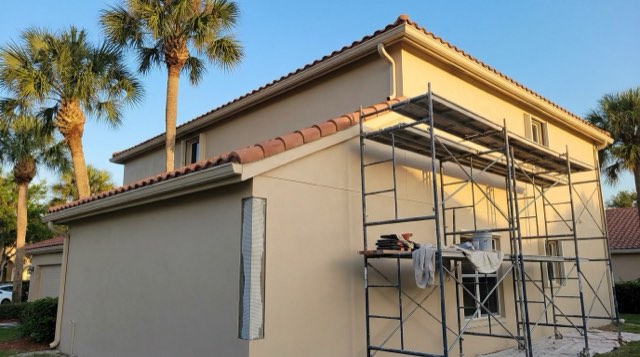
EIFS / Synthetic Stucco
Installation, inspection, and repair
Learn more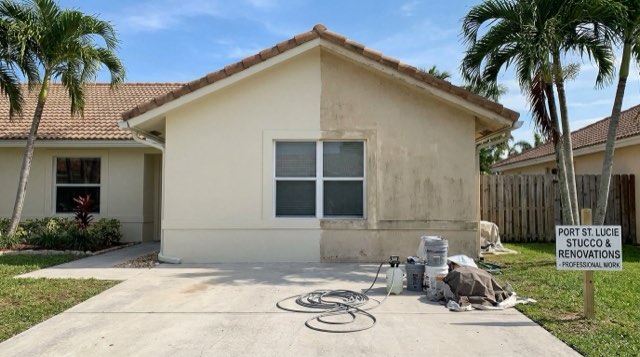
Stucco Resurfacing
Refinishing tired or mismatched walls
Learn more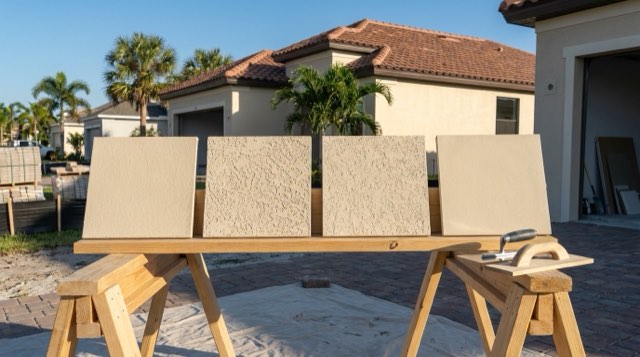
Decorative Stucco Finishes
Sand, lace, knockdown, smooth, and Santa Barbara
Learn more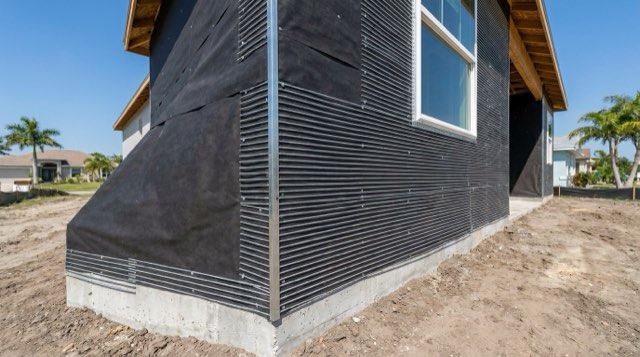
Lath and Plaster
Wire lath, scratch and brown coat
Learn more
Stucco Waterproofing and Sealing
Sealants, flashing details, and weather barriers
Learn more
Block and Foundation Stucco
CMU parge coats and stem wall finishes
Learn more
Commercial Stucco
Multi-family, retail, and light commercial
Learn more
Commercial Stucco Repair
Scheduled maintenance and facade repair
Learn moreStraight answer on your wall.
Call, or send the form and we will get you a written price.