Whole-House Restucco in Port St. Lucie, FL
A restucco is the job where the old material leaves the property. We take failed plaster down to the block or the lath and rebuild the wall in coats. It is the largest exterior project most Port St. Lucie homes ever get, so we will also tell you when a smaller one will do.

Request a quote
Four questions, about a minute. We'll call you back.
What a restucco is, and what leaves the property
Restucco and re-stucco get used for anything that makes a tired wall look new. Here the word means one thing. The old plaster comes off the house, goes in a dumpster, and a new wall gets built in its place.
What goes back depends on what is behind it. On block, the masonry gets cleaned and wet down, then plastered from the base coats up. On frame, the barrier and the lath come off with the plaster and get rebuilt too. The finish runs the full elevation, so no seam shows where new work meets old.
- Finish, brown, and scratch coats come off to the substrate
- Rusted corner bead, casing bead, and accessories go with them
- Barrier and wire lath get replaced on every framed wall
- Color and texture run wall to wall instead of patch to patch
How we tell a wall that can stay from one that has to come off
The answer comes off your wall, not off a photograph. We walk every elevation and tap it. Bonded plaster rings. Debonded plaster gives a flat knock, and the sound changes at the line where good material stops. We chalk those areas while we are standing there, so you see the same map we do.
Then we read the cracks rather than count them. Map cracking across a wall field is usually shrinkage. Cracks that link hollow areas together are a wall coming apart in sections. A crack that reopens on the same line after two repairs says the repair was never the problem.
Two checks settle most houses. We sight along the wall from an outside corner, because no finish coat corrects a bulge. Then we cut a test opening in the worst spot. Base coat that crumbles between two fingers, or orange lath, means nothing is left to grip. Where failures are scattered, targeted repair and a refinish is the better job.
- How much of each elevation has failed, not how many spots
- Cracks that connect hollow areas rather than sitting alone
- How many old patch perimeters the wall already carries
- A test opening showing sandy base coat or rusted lath
Restucco or paint
These two are not competitors. Paint is a film a few thousandths of an inch thick. It adds no material and corrects no plane, so patch outlines and hollow spots come back into view in a season or two. If the walls are sound and you are tired of the color, paint is the right spend.
A coating is the middle option. Elastomeric builds a thicker film than paint and bridges hairline cracking, and on clean single story block it costs a fraction of a removal. What it cannot do is hold loose plaster on a building. Over hollow or damp stucco it traps water and buys a season. The coatings page covers where it works.
Can you restucco over existing stucco?
Yes, and going over what is there has its own name. It is a resurface, and on a bonded wall it is usually the better purchase, because the old stucco stays and keeps working. A leveling coat and a new finish go over the top, cracks get prepped first, and the elevation comes out uniform for roughly half the cost of removal. Our resurfacing page has the detail.
It goes wrong in four situations. Widespread hollow areas, because a new coat is only as attached as what sits under it. Water still moving through the wall, because damp masonry will not hold a cement finish. Rust bleeding out of lath or bead, because that metal keeps swelling. And heavy glossy paint, because a cement finish has to bond to the wall, not to a film.
- Sound, bonded stucco with cosmetic problems: go over it
- A few hollow spots in a solid wall: cut those out, then refinish
- Hollow, wet, or rusting across whole elevations: it comes off
- A wall already resurfaced once: check total thickness first
Block or frame changes both the price and the process
Concrete block is most of what stands in St. Lucie and Martin County, and block keeps a restucco predictable. It does not rot and it needs no lath across the field. Once the old plaster is down the crew is usually looking at sound masonry, and new base coats go straight onto it. That is why block sits at the low end of the ranges below.
Frame carries different risk. Plaster on frame lives on lath over a barrier over sheathing, so the tear-off takes all three off and the rebuild puts them back. More material, an extra phase, and this is where the surprises are. Soft sheathing, rusted lath, fasteners that stopped in plywood, a window head never flashed. The older frame stock around Fort Pierce and Stuart is where we meet it.
Plenty of houses here are both. Block on the first floor, framed gable ends above, foam bands glued onto masonry. Ask every quote which square footage is priced as block and which as frame, because that split is where two bids separate.
Windows, doors, trim, flashing, and the weep screed
This is the half of a restucco nobody pictures. Plaster does not stop in the open field of a wall. It runs into every window and door edge, wraps corner bead, dies into the soffit under those deep eaves, and terminates at the bottom. All of it comes apart.
At the openings, plaster gets cut free of the frames and the old casing bead comes away with it. That exposes the window flange and the flashing behind it, which is the one moment a bad head detail is cheap to correct. New stucco over an old leak is still a leak. If your windows are near the end anyway, replace them first, so flashing and plaster go in as one assembly.
Foam bands, sills, and surrounds either survive removal or get replaced, and that is the cheapest chance you get to change the front of the house. At the base of a framed wall sits a weep screed that lets water back out, and mulch, sod, or pavers laid tight to the house can bury it. Clearance is a building department question, so ask St. Lucie County, Martin, or Indian River.
- Flashing at heads and sills inspected while the wall is open
- Window replacement scheduled ahead of the stucco, not after
- Foam bands, sills, and surrounds repaired, replaced, or redesigned
- New corner bead, casing bead, and control joint accessories
- Light boxes, hose bibs, vents, and meter mounts pulled and re-sealed
How long it takes, and what living through it is like
Plan on two to three weeks for a whole house. Wall area, access, how much frame is in the walls, and the weather move that either way, and a promise of a long weekend is a warning. In Tradition, St. Lucie West, or any community with architectural review, add approval time in front of all of it.
The waiting is what makes the calendar. Protection and tear-off come first, the loudest and dirtiest days, with a dumpster in the driveway. Base coats follow, elevation by elevation, and then the wall has to sit. Cement plaster cures instead of drying, and forcing a finish onto a green base coat is how a new wall maps out with cracks in its first year.
Most people stay in the house. Expect covered windows on the elevation being worked, a mixer running in the morning, dust on that side, and cars out of the garage. Dogs need a plan, because gates get opened. Pool cages slow the work, since those walls get done by hand.
Florida has no freeze shutdown, so this work runs all year. What we schedule around is water. Summer humidity and afternoon storms stretch cure times and close coating windows, so an honest calendar has weather days in it. In hurricane season, June to November, we stage the tear-off so no elevation stays open longer than it has to be.
What a whole-house restucco costs in Port St. Lucie
Restucco is priced per square foot of wall, not off the floor area on your tax record. Scope decides which band you land in, and the ladder starts well below a full removal.
| Full remove and replace, block wall | $7 to $12 per sq ft of wall |
|---|---|
| Full remove and replace, frame with new lath and three coats | $9 to $15 per sq ft of wall |
| Failed sections replaced, then the whole house refinished | $5 to $9 per sq ft of wall |
| Resurface instead, sound stucco kept and refinished | $3 to $6 per sq ft of wall |
| Elastomeric coating on clean single story block | $2.00 to $3.50 per sq ft |
What moves the number
- Measured wall area, taken per elevation rather than off the deed
- How much of the house is frame, since barrier and lath add a phase
- What the substrate turns out to be once the old plaster is down
- Height, gable ends, pool cages, and side yards too narrow for a lift
- Openings, bands, sills, and surrounds, which are all hand work
- Texture, and whether color is integral or coated afterward
These are market ranges for reading quotes, not a quote, and your number comes from someone measuring and sounding your walls. Call (772) 251-6654 or send the form and we will put it in writing.
Questions about restucco in Port St. Lucie
How much does it cost to restucco a 2,000 square foot house?
Stucco is priced on wall area, not floor area. Measure the perimeter, multiply by wall height, then take off about a fifth for openings. Most single story block homes here land between 1,600 and 2,400 square feet of wall. At $7 to $12 per square foot, 2,000 square feet of wall is $14,000 to $24,000. Frame and second story work move it up.
Is it cheaper to restucco or to paint?
Paint is far cheaper, and on a sound wall it is the right call. They are not doing the same job though. Paint is a thin film that follows whatever is under it, so old patch outlines and hollow spots return. A restucco replaces the material. If the wall works, paint it. If it has stopped working, paint only delays the conversation.
Can you restucco over existing stucco without removing it?
On stucco that is still bonded, yes, and that is a resurface rather than a restucco. It runs closer to half the cost, because the existing wall stays and carries the finish. It is the wrong move over hollow, wet, or rust stained walls, and over heavy glossy paint, since cement finish has to bond to the wall and not to a coating.
Do the windows have to come out for a restucco?
Usually not. The plaster gets cut free of the frames and the old casing bead is removed, which exposes the flange and the flashing behind it for inspection. If your windows are close to needing replacement, replace them first and restucco second. That order lets flashing and plaster go in as one assembly instead of being sealed together afterward.
Is my house exposed to rain while the old stucco is off?
The wall behind the plaster keeps water out during the work, so it depends on the wall. Block is masonry and handles a storm. Framed walls rely on the barrier, so we open, dry in, and lath within the same stretch of work rather than leaving sheathing bare over a weekend. In hurricane season we go one elevation at a time.
Other services
All services →
Stucco Installation
New three-coat stucco over frame or block
Learn more
Stucco Repair
Cracks, spalling, bulges, and failed patches
Learn more
Stucco Remediation
Moisture intrusion and rotted substrate
Learn more
EIFS / Synthetic Stucco
Installation, inspection, and repair
Learn more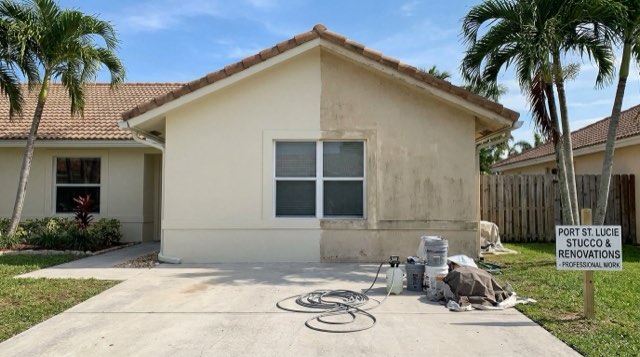
Stucco Resurfacing
Refinishing tired or mismatched walls
Learn more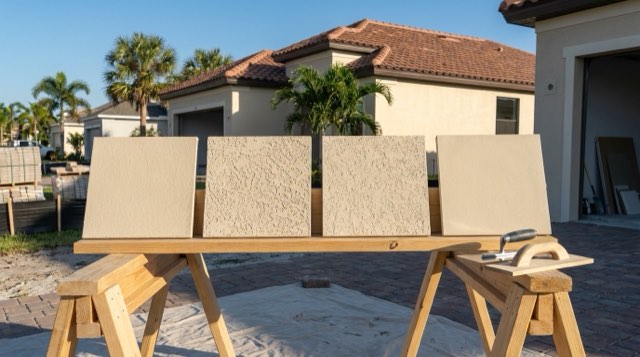
Decorative Stucco Finishes
Sand, lace, knockdown, smooth, and Santa Barbara
Learn more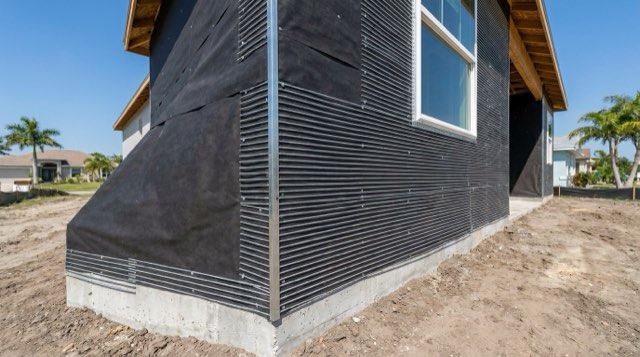
Lath and Plaster
Wire lath, scratch and brown coat
Learn more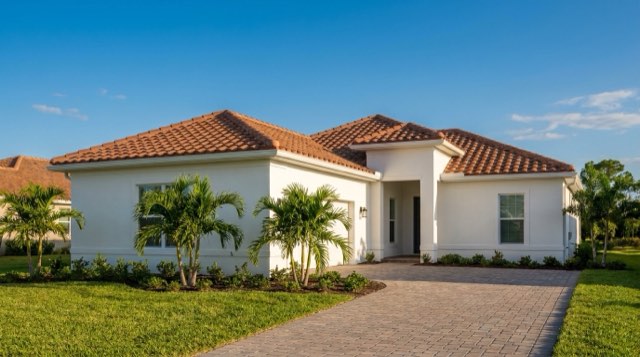
Stucco Painting and Coatings
Elastomeric and breathable coatings
Learn more
Stucco Waterproofing and Sealing
Sealants, flashing details, and weather barriers
Learn more
Block and Foundation Stucco
CMU parge coats and stem wall finishes
Learn more
Commercial Stucco
Multi-family, retail, and light commercial
Learn more
Commercial Stucco Repair
Scheduled maintenance and facade repair
Learn moreStraight answer on your wall.
Call, or send the form and we will get you a written price.