Stucco Repair in Port St. Lucie, FL
Cracked, hollow, or badly patched stucco almost always has a reason behind it. We repair stucco on block and frame homes throughout Port St. Lucie and the Treasure Coast, and we work out the cause before anything gets filled in.
Request a quote
Four questions, about a minute. We'll call you back.
Every repair starts with a diagnosis
Anybody can push material into a crack. The real question is why the crack is there. A fine shrinkage crack drifting across a big flat wall field is a completely different animal from a diagonal crack running out of a window corner, and the two do not get the same repair.
So we sound the wall first. Tap it with a knuckle or the handle of a hammer and listen. Solid, bonded stucco rings. Delaminated stucco thuds. That one simple test tells us how far the failure runs past the part you can see, and it is almost always farther than the visible damage suggests.
- Fine map cracking, generally shrinkage in the finish or brown coat
- Diagonal cracks off window and door corners, stress concentrating at the opening
- Horizontal cracks at floor lines, differential movement between framing and masonry
- Hollow or drummy areas, loss of bond to the substrate
- Bulges and blisters, water sitting behind the plaster or a failed prior patch
- Spalling with rust staining, corroding lath, ties, or embedded steel
How a repair runs, start to finish
We cut back to sound material. That means the edge of the patch lands on stucco that is still bonded, not on the ragged line where the damage happened to stop being visible. The cut gets undercut slightly so the new material has something to lock into rather than a feathered edge that will lift.
Then we rebuild the wall the way it was built. Lath goes back if there was lath. Scratch and brown go back in sequence if there is enough depth. The finish coat goes on last and gets worked out into the surrounding wall. Collapsing three coats into one to save a day is exactly how you end up with a patch you can spot from the driveway.
- Sound the wall and mark the full extent of the failure, not just the damage you can see
- Cut back past the failure into solid, bonded stucco
- Remove and replace rusted lath, fasteners, corner bead, or accessories
- Rebuild in layers, with cure time between them
- Feather and blend the texture well past the patch line
- Prime and coat once the patch has cured out
Patching methods and making the texture disappear
Getting a patch to vanish is a hand skill, not a product. Knockdown gets sprayed or troweled on and then flattened at the right moment, and that moment shifts with the heat and the humidity. Sand and float finishes are the easiest to blend. Dash and lace need the same tool and the same wrist that put the original on. Smooth trowel work is the hardest to hide because there is no texture to break up the sightline.
Where a crack is narrow and static, we route it out into a shallow V, fill it, and mesh it before the finish goes over. Where a section is drummy, filling is pointless. That material has already let go of the wall and it comes off. We would rather cut out two extra feet now than come back and do the same repair again next year.
- Route, fill, and mesh for narrow, stable cracks
- Full cut-out and rebuild for delaminated or drummy sections
- Lath replacement wherever the existing wire is rusted through
- Texture worked out past the patch so the transition is not a rectangle
- Elastomeric or breathable coating over the finished repair, depending on what the wall needs
Why two repairs on the same street price differently
Repair pricing is driven by access and unknowns, not by the square footage of the damage. A crack at eye level on a one-story wall is a ladder and an hour of blending. The same crack forty feet up a gable end over a pool cage is a scaffold day before anyone touches plaster.
The bigger variable is how far the failure travels. Sounding the wall gets us a good picture, but some of it does not reveal itself until the first section comes off. We would rather show you the range up front and explain what would push the job to the high end than write a low number and hand you a change order.
- Height, access, and whether scaffold or a lift is required
- How far the delamination extends past the visible damage
- Whether lath and embedded metal have to be replaced
- Texture type and how difficult it is to blend
- Whether the full elevation needs coating afterward for a uniform look
- Number of separate repair areas versus one continuous section
What the coast does to a stucco wall
Salt air is corrosive, and stucco is full of metal. Lath, tie wire, corner bead, casing bead, lintel steel. When salt-laden moisture reaches that metal, it rusts, and rust expands. The expansion pushes the stucco off the wall from the inside. That is what causes most of the spalling and the rust-streaked cracks you see on older homes near the water.
Then there is the wet season. Wind-driven rain hits a wall sideways, not straight down, so it gets into places a vertical drip never would. Add constant humidity and a wall that gets wet behind the surface does not dry out. It stays wet, and it stays wet long enough to do real damage.
Which cracks are worth worrying about
Here is the short version. Width, direction, and company. Fine cracks scattered around a wall field are usually cosmetic. A crack you can catch a fingernail in is not. A crack that runs at an angle out of a window or door corner is telling you about stress at that opening. A crack that steps down along the mortar joints is telling you about the block behind it.
The company a crack keeps matters as much as the crack itself. A hairline crack on its own is one thing. A hairline crack with a hollow sound next to it, or a chalky white bloom, or a stain that keeps bleeding back through fresh paint, is something else. That combination means water is in the wall and the crack is only where you happened to notice it.
- Cracks wide enough to catch a fingernail
- Diagonal cracking from opening corners
- Stair-step cracking following the block joints
- Any crack paired with a hollow sound nearby
- Efflorescence, the white powdery bloom, at or near the crack
- Stains that reappear through new paint within a season
How to read a repair estimate
Look for a cause, not just a task. If the estimate says caulk and paint the cracks with no explanation of why the wall cracked, you are buying a season. Cosmetic filling over an active problem is the single most common thing we get called back to undo.
Ask directly whether the contractor sounded the wall and what they found. Ask what happens if the delamination runs past what was quoted, and get that answer in writing before work starts. And be careful with anyone selling elastomeric coating as the fix for everything. Over a sound wall with hairline cracking it is a reasonable product. Over a wall that is wet or delaminated it seals the moisture in.
- A stated cause for the damage, not just a list of tasks
- Confirmation the wall was sounded and how far the failure extends
- A written procedure for what happens if the damage runs wider than quoted
- Whether lath replacement is included or excluded
- How the texture will be matched, and whether you get to approve it
- What gets painted afterward, the patch or the whole elevation
What stucco repair costs in Port St. Lucie
Repairs carry a service minimum, then price by the square foot of the area we actually patch rather than by the size of the wall. Plenty of calls are one visit on an otherwise sound wall, and crack work that runs across a whole face is usually quoted as a single number for that elevation.
| Service minimum for a small repair visit | $350 to $750 |
|---|---|
| Small isolated patches | $10 to $25 per sq ft patched |
| One larger continuous damaged area | $8 to $15 per sq ft patched |
| One elevation of routine crack work | $400 to $1,500 |
| Coating the full elevation afterward, one-story block | $2.00 to $3.50 per sq ft |
What moves the number
- Height and access, and whether scaffold or a lift is needed
- How far the delamination runs past the damage you can see
- Whether rusted lath, corner bead, or embedded metal has to come out
- Texture type, and how hard that texture is to blend
- Several separate patch areas versus one continuous section
- Whether the whole elevation gets coated afterward for a uniform look
None of this is a quote, because how far the failure runs past the visible damage only shows up once someone sounds the wall in person. Call (772) 251-6654 or send the form and we will put it in writing.
Questions about stucco repair in Port St. Lucie
Can I just caulk a stucco crack myself?
For a narrow, stable hairline crack in the field of a wall, a good elastomeric sealant will hold for a while and it is not a crazy thing to do. The problem is that caulk sits proud of the surface and reads as a shiny line once it is painted. It also does nothing at all if the crack is a symptom of movement or of water behind the wall. Use it as a stopgap, not as a repair.
Why can I still see the last contractor's patch?
Almost always one of three reasons. The patch was troweled on in a single coat instead of built up, so it shrank and telegraphed. The texture was applied with a different tool or at a different consistency than the original, or the patch was painted by itself instead of coating the full elevation, so it sits at a different sheen than the sun-faded paint around it. All three are fixable, though the first one usually means cutting the patch back out.
Do you have to repaint the entire wall after a repair?
For a result you will actually be happy with, usually yes, corner to corner on that elevation. Existing exterior paint fades and chalks under Florida sun, and no touch-up will match it in both color and sheen. Painting the full plane gives you one uniform surface with no halo around the repair. We will quote both ways so the choice is yours.
How urgent is a hollow-sounding spot if nothing has fallen off yet?
More urgent than it looks. A drummy area means the stucco has already released from the substrate, so there is a gap behind it where water collects and stays. Once it is holding water it will keep spreading outward, and in a wind event a large delaminated panel can come down. It does not need to be an emergency, but it should not wait a year either.
Is elastomeric coating a fix for cracking?
It bridges fine hairline cracking well, which is why it is popular on block walls in this climate, and it builds a much thicker film than standard exterior paint. It is not a repair for anything structural and it is the wrong choice over a wall that is delaminated or actively taking on water, because it traps moisture that then has nowhere to go. The wall has to be repaired and dry first. Then a coating makes sense.
Other services
All services →
Stucco Installation
New three-coat stucco over frame or block
Learn moreRestucco
Whole-house re-stucco, remove and replace
Learn more
Stucco Remediation
Moisture intrusion and rotted substrate
Learn more
EIFS / Synthetic Stucco
Installation, inspection, and repair
Learn more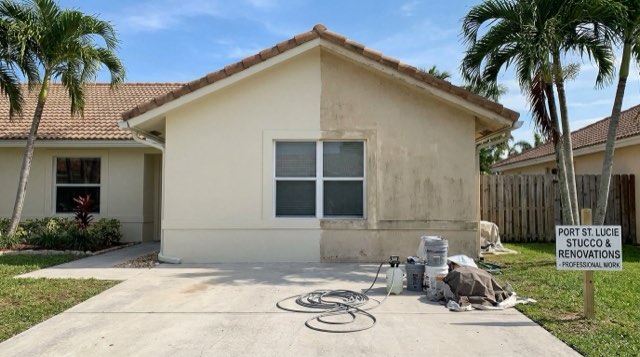
Stucco Resurfacing
Refinishing tired or mismatched walls
Learn more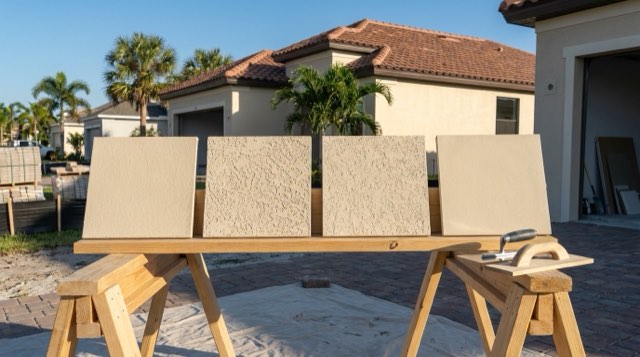
Decorative Stucco Finishes
Sand, lace, knockdown, smooth, and Santa Barbara
Learn more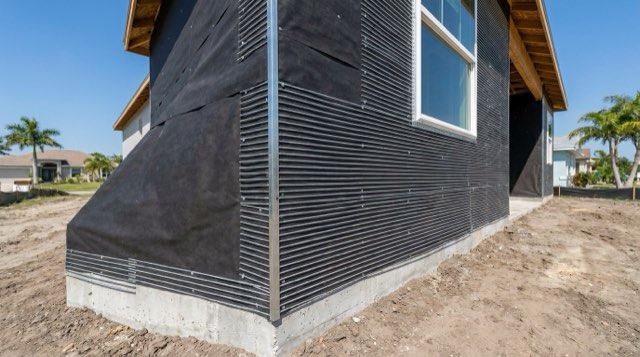
Lath and Plaster
Wire lath, scratch and brown coat
Learn more
Stucco Painting and Coatings
Elastomeric and breathable coatings
Learn more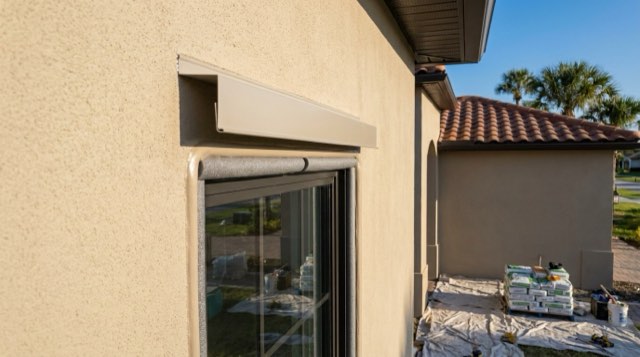
Stucco Waterproofing and Sealing
Sealants, flashing details, and weather barriers
Learn more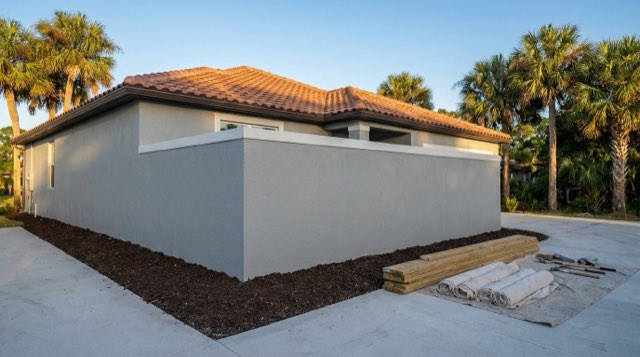
Block and Foundation Stucco
CMU parge coats and stem wall finishes
Learn more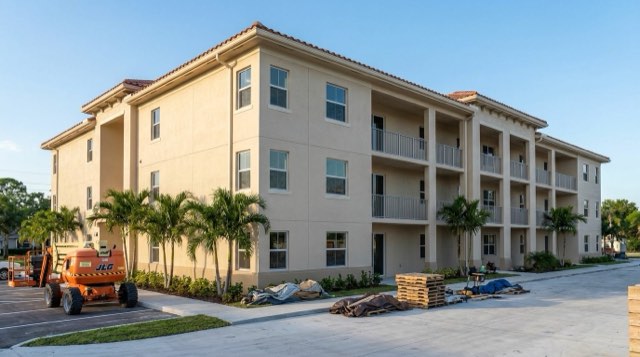
Commercial Stucco
Multi-family, retail, and light commercial
Learn more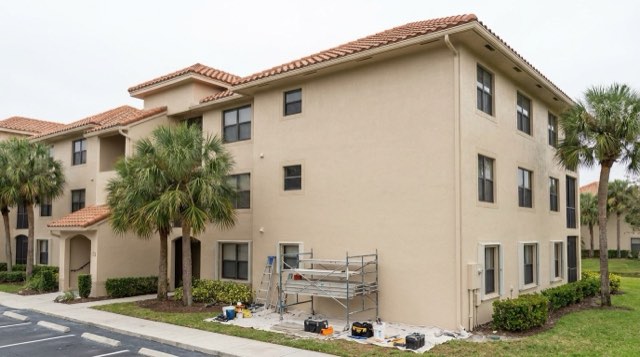
Commercial Stucco Repair
Scheduled maintenance and facade repair
Learn moreStraight answer on your wall.
Call, or send the form and we will get you a written price.