Getting HOA Approval for Stucco Work in Tradition and St. Lucie West
Most master planned communities on the Treasure Coast run exterior work through an architectural review process. Here is how that generally works, what a submittal usually contains, and why you check with your own association before anyone mixes material.
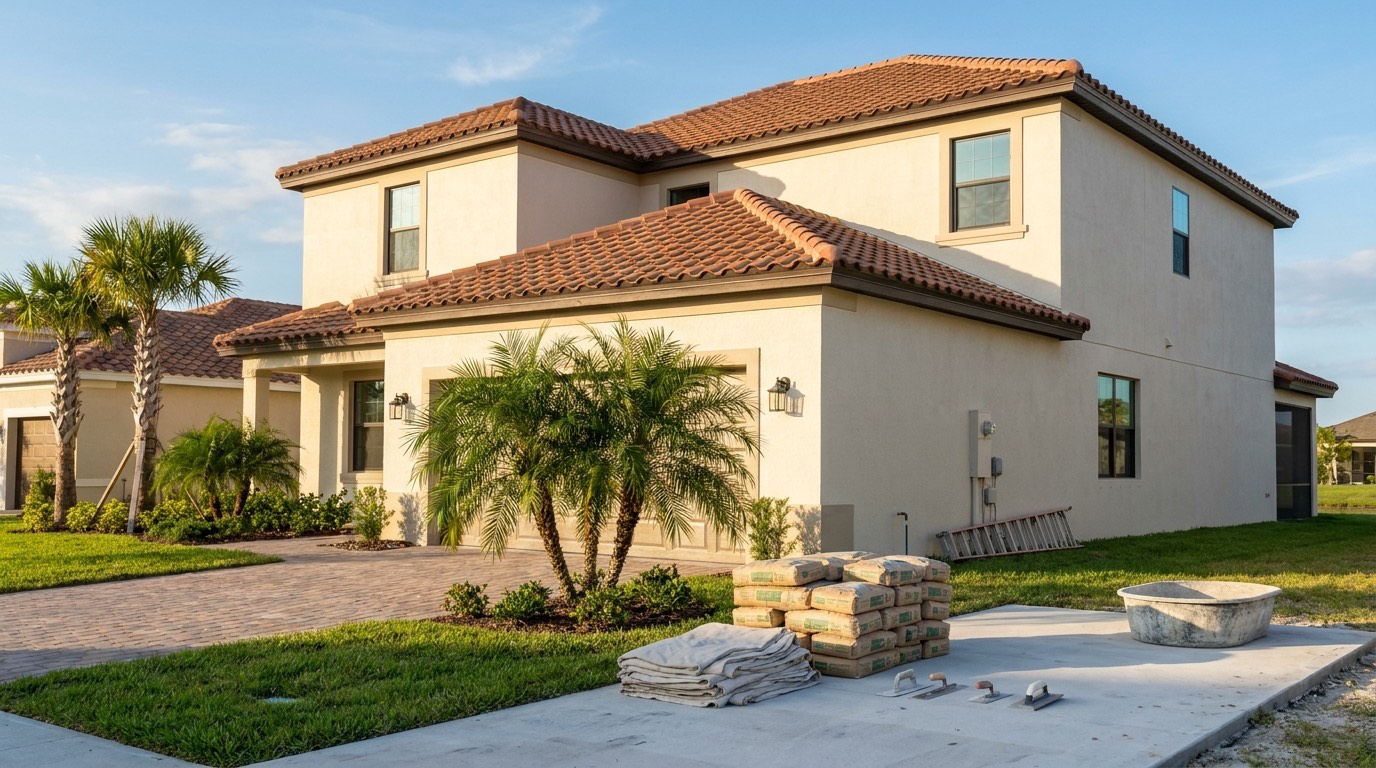
Check before you pick a color, not after
A large share of the housing around Port St. Lucie sits inside master planned communities. Tradition and St. Lucie West are the two most people name, and there are many others across St. Lucie, Martin, and Indian River counties. Most of them have governing documents that cover the exterior appearance of the building, and most of them run exterior changes through some form of architectural review.
Every association is different. The rules, the forms, the meeting schedule, the fees if any, and what does or does not need approval are set by that association's own governing documents. We do not know your community's requirements and we will not guess at them. What we can do is describe how this process generally works so you know what to ask.
The one piece of advice that applies everywhere is timing. Find out what your association requires before you fall in love with a color, before you sign anything, and certainly before a crew is on site. Undoing finished stucco because it was not approved is the most expensive kind of rework there is.
What an architectural review committee generally looks at
Committees go by different names. Architectural Review Board, Architectural Review Committee, Modification Committee. The function is the same. They evaluate proposed exterior changes against the community's standards so the neighborhood stays visually consistent.
For stucco work, the things most commonly under review are color, texture, and anything that changes the shape or profile of the building. Repainting a wall a different color is almost always a reviewable change. Adding decorative bands, changing a texture from smooth to knockdown, or altering trim details often is too.
Many communities maintain an approved color palette, sometimes tied to a specific manufacturer's color deck, and some limit which colors can appear on adjacent homes. Whether yours does is a question for your association, not for us and not for a neighbor's recollection of what was allowed five years ago.
- Body and trim color, often against an approved palette
- Finish texture and any change from the original texture
- Decorative bands, quoins, trim, and other profile changes
- Whether the change affects one elevation or the whole building
- Consistency with attached or adjacent units
- Contractor licensing and insurance documentation in many communities
Want a price for your own wall?
Four quick questions and we come back with a written quote. Or call (772) 251-6654 if that is faster.
Request a quote
Four questions, about a minute. We'll call you back.
What a submittal package usually contains
The specific form and its requirements come from your association. In general, though, an architectural application asks you to describe what is being changed, show what it will look like when it is done, and identify who is doing the work.
That usually translates into a written scope of work, color information in a form the committee can verify rather than a name you wrote down, and some way of showing the texture. Photographs of the existing condition are commonly requested for repair work, since they establish what the wall looked like before.
Some communities ask for more. A site plan or survey, a rendering or elevation drawing, a physical sample, or documentation from the contractor. Ask what your association wants before assembling anything, because submitting an incomplete package usually means waiting for the next review cycle.
- A written description of the work and which elevations it covers
- Color identification, typically a manufacturer name and code rather than a description
- Texture identification, and sometimes a physical sample or sample board
- Photographs of the existing condition, especially for repairs
- Contractor license and certificate of insurance in many communities
- Whatever else the association's own application form asks for
Attached units and shared elevations
Townhomes, villas, and paired or duplex-style homes are common throughout the newer sections of Port St. Lucie, and they add a layer to this. When your unit shares a wall or a continuous elevation with a neighbor, a change to your portion changes the appearance of the whole building.
Communities generally handle that by requiring the building to read as one unit. That can mean matching your neighbor exactly, coordinating with them, or in some arrangements the association itself is responsible for the exterior rather than the individual owner. Which of those applies to your address is written in your governing documents.
This is worth confirming early even for a repair. If the association owns or maintains the exterior of your building type, the repair may not be yours to schedule at all, and homeowners have paid for work that the association would have handled. One phone call answers it.
Timelines, and why you ask early
Review committees in master planned communities typically meet on a set schedule rather than reviewing applications the day they arrive. That means there is a real gap between submitting and hearing back, and the length of it depends entirely on your association's process.
Practically, plan for the approval to be its own phase of the project rather than a formality that happens in the background. Ask the association two things up front. How long does review normally take, and what happens if my application is incomplete. Those two answers let you build a realistic schedule.
There is a seasonal wrinkle here too. The dry season from roughly November through April is when most exterior work in this area gets done, so that is also when review committees see the most applications. If you want a February start on your stucco, the approval conversation belongs in the fall.
Repairs, emergencies, and like-for-like work
There is often a practical difference between changing the appearance of a building and restoring it to what it already was. Many communities treat a like-for-like repair, meaning the same texture and the same color with no change to the design, differently from a color change or a redesign.
That said, do not assume. Whether your association requires an application for a repair is a question for your association. The same goes for anything urgent, such as damage after a storm. Some communities have a process for emergency work with documentation submitted afterward, and some do not. Ask before you commit, and get the answer in writing if you can.
Keep in mind that a repair often turns into a color question anyway. Once you are coating a full elevation to hide the patch, you are back to the palette conversation whether you meant to be or not.
Permits are separate from HOA approval
This catches people regularly. Association approval and building department permitting are two independent things. Getting one does not get you the other, and neither one substitutes for the other.
Whether a given stucco job requires a permit depends on the scope and on the jurisdiction your address falls in, which around here might be the City of Port St. Lucie, St. Lucie County, Martin County, Indian River County, or one of the municipalities like Fort Pierce, Stuart, or Vero Beach. Check with the building department that covers your property. We will tell you honestly what we believe applies to your scope and we will pull what needs pulling, but the authority on that question is the department itself.
On our side, what we can hand you for a submittal is straightforward. A written scope that says exactly what we are doing and where, the manufacturer and color information for the products we plan to use, a texture sample or sample board you can present, photographs of the existing wall, and our license and insurance documentation. Then you take that to your association and find out what else they want.
- HOA approval and building permits are separate processes with separate authorities
- Confirm the permitting question with the department that covers your address
- We provide scope, product and color data, texture samples, photos, and insurance documentation
- We do not start a job that is waiting on an approval, and we will say so
Related questions
Do I need HOA approval to repair stucco cracks?
It depends entirely on your association's governing documents, so ask them directly. As a general pattern, many communities treat a like-for-like repair that does not change color or texture differently from a change to the building's appearance. Once the repair grows into repainting a full elevation, you are usually back into color review territory.
How long does architectural review take in Tradition or St. Lucie West?
We cannot tell you, and you should be skeptical of any contractor who quotes you a number. Committees generally meet on a set schedule and each association runs its own process, so the honest answer is to call your association and ask what their normal turnaround is. Then build your project timeline around the answer they give you.
What happens if I do the work without approval?
That is governed by your community's documents, and the consequences described in those documents can include being required to restore the exterior to an approved condition at your own expense. Ripping out finished stucco or recoating a house a second time is a bad outcome for something a phone call would have prevented. Check first.
Can you submit the HOA application for me?
We can give you everything on our side of it. Written scope, product and color information, a texture sample, photographs of the existing wall, and our license and insurance documentation. The application itself is between you and your association, since they will correspond with the owner of record and their process is theirs to run.
My neighbor got a color approved. Can I use the same one?
Maybe, and maybe not. Some communities restrict repeating a color on adjacent homes specifically so the street does not read as uniform. Others limit you to a fixed palette where repetition is fine. Standards also get updated over time, so what was approved a few years ago is not proof of what is approved now. Confirm it with the association before you order material.
Does the association handle the exterior on my villa or townhome?
That depends on your community's documents and on your building type. In some arrangements the association maintains the exterior of attached units and the owner does not schedule that work at all. In others it is fully the owner's responsibility with a requirement that the building stay visually consistent. Find out which one applies to your address before you pay for anything.
More guides
All guides → How it works
How Long Stucco Takes to Cure in Florida Humidity
Cement stucco does not dry, it cures. Here is what happens coat by coat, why Florida humidity helps the chemistry and hurts the schedule, and why coating a wall early is the most expensive week you can save.
Read Hiring
How to Hire a Stucco Contractor in Florida
Most of what protects you on a stucco job happens before anyone touches your wall. Here is how to verify a license and insurance yourself, read a scope, and check references that actually apply to your house.
Read Storm season
A Pre-Season Stucco Checklist for Treasure Coast Homeowners
Forty minutes in April is worth more than a week of worry in September. Here is what to look at on a Treasure Coast stucco wall before hurricane season starts, and what you can honestly leave alone.
Read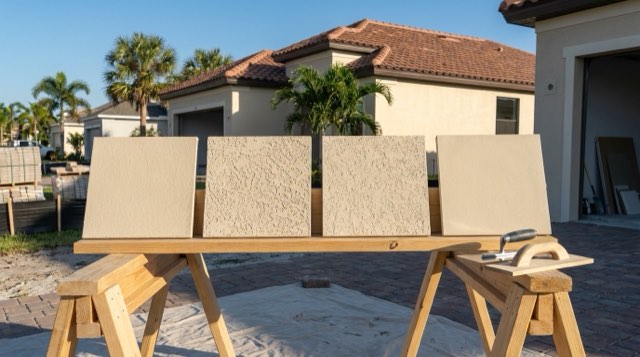 How it works
How to Match Existing Stucco Texture on a Repair
Matching stucco texture is a hand skill, not a product you buy. Here is how the common Treasure Coast finishes get matched, why a patch can still show after a perfect color match, and when re-coating the whole elevation is the cheaper answer.
Read Diagnosis
Signs of Moisture Behind Your Stucco, and What to Do
Trapped water leaves evidence long before the wall fails. Here is what to look for outside and inside a Port St. Lucie home, how water actually gets in, and what to do first.
ReadStraight answer on your wall.
Call, or send the form and we will get you a written price.