How to Match Existing Stucco Texture on a Repair
Matching stucco texture is a hand skill, not a product you buy. Here is how the common Treasure Coast finishes get matched, why a patch can still show after a perfect color match, and when re-coating the whole elevation is the cheaper answer.
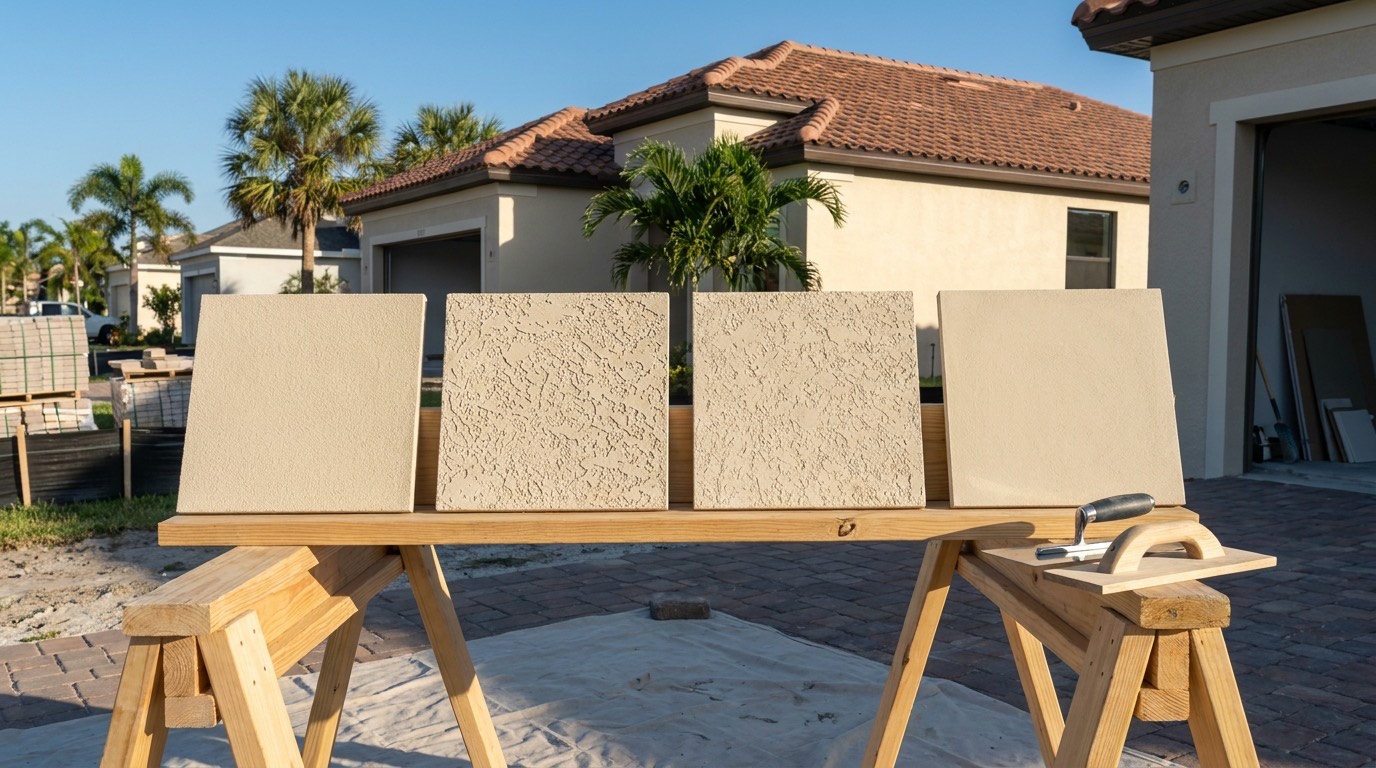
The finishes you actually see around here
Most homes across Port St. Lucie, Fort Pierce, and Stuart wear one of a handful of textures, and each behaves differently under a patch. Knowing which one you have is the first step, because the tool and the timing change completely between them.
Sand or float finish is the most forgiving. The texture comes from aggregate worked with a sponge or rubber float, and the pattern is random enough that a blended edge disappears easily. Coarse, medium, and fine sand read differently, so the aggregate size has to match before anything else does.
Lace and skip trowel is the classic Florida look. Material gets dashed on and then partially flattened, leaving raised islands with smooth valleys between them. Knockdown is its cousin, sprayed or troweled and then flattened harder at exactly the right moment. Smooth trowel, sometimes called Santa Barbara, is the hardest to match because there is no texture to hide the transition.
- Sand and float finish: most forgiving, matched by aggregate size and float pressure
- Lace and skip trowel: matched by material consistency, dash pattern, and how hard it gets flattened
- Knockdown: matched by spray density and the timing of the knockdown pass
- Dash: heavy hopper texture, matched by tip size, air pressure, and mix wetness
- Smooth or Santa Barbara: no texture to hide behind, the plane and the trowel work have to be right
- Worm and swirl patterns: less common here, and they need the same tool that made the original
Why a patch shows even when the color is right
Homeowners usually assume a visible patch means the color was wrong. Most of the time the color is fine and something else gave it away. There are four usual culprits, and they stack.
The first is plane. If the patch sits even a small amount proud of or below the surrounding wall, raking sunlight will draw a shadow line around it. On the Treasure Coast this is worse than in most places because low morning and late afternoon sun hits west and east elevations at a hard angle, and barrel tile roofs throw shadow lines that make every surface irregularity read.
The second is scale. Aggregate one grade coarser or finer reads as a different texture from twenty feet even if it feels similar in your hand. The third is timing. On knockdown and lace, the same material flattened thirty seconds earlier gives a different pattern. The fourth is paint. Existing paint on a Florida wall has faded and chalked under years of sun, and no fresh touch up matches it in both color and sheen.
Want a price for your own wall?
Four quick questions and we come back with a written quote. Or call (772) 251-6654 if that is faster.
Request a quote
Four questions, about a minute. We'll call you back.
Sample boards before anyone touches the wall
The right way to do this is to practice off the wall. We work the texture on a scrap board or a piece of cement board, hold it up against the existing surface, and look at it from where people actually stand. That means the driveway or the sidewalk, not six inches away.
Then look again at a different time of day. A match that looks perfect at noon can look obviously wrong at four in the afternoon when light rakes across the elevation. It is worth walking the board around the house, because sun exposure has aged the north wall very differently from the south wall.
For lace and knockdown we will often do two or three boards at different timings and let you pick. That extra half hour is the difference between a repair you forget about and one you notice every time you pull in.
Feathering, and where you stop the patch
The worst thing you can do is stop a patch at a rectangle in the middle of a wall field. Straight edges catch the eye. Even a good texture match reads as a panel if it has a hard boundary.
So the texture gets worked out well past the repair, and wherever possible the patch is carried to a natural break. A corner, a control joint, a band or trim detail, a change of plane. Those are places the eye already expects a transition, so a slight difference in texture or sheen stops registering as damage.
On a small crack in the field of a wall, feathering out in an irregular boundary is usually enough. On anything larger we look at where the nearest break is and price the patch to that line rather than to the edge of the damage.
- Carry the patch to a corner, control joint, band, or plane change where there is a natural break
- Use an irregular, feathered boundary instead of a rectangle when there is no break to reach
- Match plane first, texture second, color third, because a shadow line beats a color match every time
- Wash and de-chalk the surrounding wall before judging any match against it
- Check the blend from the street, in the light the wall gets, not from arm's length
When re-coating the whole elevation is the cheaper answer
There is a point where chasing a match costs more than not chasing it. If a wall has several repairs scattered across one plane, or the texture is worn and inconsistent from years of sun and salt air, or a previous contractor already patched it badly, you can spend real money getting close and still see every location.
The alternative is a skim or level coat over the entire elevation followed by fresh texture across the whole plane. Now there is nothing to match. The wall is one surface, applied the same day by the same hands.
That sounds like the expensive option and often it is not. Multiple careful blend attempts, plus painting the full elevation anyway to hide the sheen difference, can land close to the cost of re-coating it properly. We price both ways so you see the numbers. This comes up constantly on the newer stucco in St. Lucie West and Tradition, where large flat elevations give a patch nowhere to hide.
Integral color versus painted stucco
This changes the whole conversation, so find out which one you have before planning a repair. A painted wall is cement stucco with an exterior coating over it. An integral color finish is a finish coat, usually acrylic, with the color mixed into the material itself and no paint over it.
Painted walls are far more forgiving. Get the texture right and you can paint the elevation corner to corner afterward, and the repair vanishes. That is why the answer to a patch on a painted wall is usually to coat the full plane and not just the patch.
Integral color is harder. Even with the same manufacturer and the same color code, batches vary, and the existing wall has been fading in Florida sun for years while the new material has not. A patch in integral color almost always shows. The realistic options are to re-coat the full elevation, accept a visible repair, or convert the wall to a painted finish. You should be told which one you are buying before work starts.
- Painted cement stucco: match the texture, then coat the full elevation for a clean result
- Integral acrylic finish: expect batch and fade variation, and plan at the elevation level
- Never assume a color code alone will match a wall that has been in the sun for years
- Salt film and mildew on coastal walls in Jensen Beach and Hobe Sound change the apparent color until the wall is washed
What to ask before you approve a texture match
The questions below sort out most of the problems before they become permanent. A contractor who can answer them without hedging has done this on your kind of wall before.
The one that matters most is the last one. If nobody has told you what gets painted afterward, you do not yet know what the repair is going to look like.
- What is my existing texture called, and how will you reproduce it
- Will you do a sample board first, and do I get to approve it from the street
- Where will the patch stop, and is that a natural break in the wall
- Is my finish integral color or painted, and how does that change the plan
- What is the plan if the match is not close enough once it is on the wall
- What gets coated when the repair is done, the patch or the full elevation
Related questions
Can you match my stucco exactly?
On texture, usually yes, and on the common Florida finishes like lace, knockdown, and sand float we can get close enough that you will not find the repair from the driveway. On color, an exact match to an aged painted wall is not realistic, which is why we normally recommend coating the full elevation once the patch has cured. Anyone promising an invisible patch with a touch up of paint is telling you what you want to hear.
Why does the previous owner's patch stand out so badly?
Usually because it was applied in one heavy coat instead of built up, so it shrank and now sits at a slightly different plane. Add a texture put on with the wrong tool and a spot of touch up paint against a sun-faded wall and you get a patch that is visible from the street. It is fixable, though sometimes the fix is cutting the old patch back out and starting over.
How long does the patch need to cure before it can be painted?
Same as any cement stucco. The common guidance is around 28 days before painting, both for strength and because fresh stucco is highly alkaline and will attack an ordinary exterior paint. An alkali resistant masonry primer can shorten that if the schedule demands it. On acrylic finish patches the window is different, so we tell you the specific number for the material we are using.
Is a lace or knockdown finish harder to match than a sand finish?
Harder than sand float, but not the hardest. They depend on material consistency and on flattening the texture at exactly the right moment, which shifts with heat and humidity, so the same technique gives a different result in August than in January. Smooth trowel finishes are the real challenge, because there is no pattern at all to break up the transition.
Do I have to repaint the whole house after a stucco repair?
Not the whole house, but usually the whole elevation the repair is on. Paint fades and chalks unevenly under Florida sun, so a spot of new paint sits at a different color and sheen than the wall around it. Coating corner to corner on that one plane gives you a uniform surface with no halo. We quote it both ways so you can decide.
Can I just buy a matching texture spray from the store and do it myself?
For a small patch in a spot nobody looks at, it will get you something. The problem is that aerosol textures spray a different pattern than a hopper gun and the material shrinks differently than the wall around it. The bigger issue is that a cosmetic patch over a crack caused by movement or water hides the symptom and lets the real problem keep going.
More guides
All guides → Diagnosis
Signs of Moisture Behind Your Stucco, and What to Do
Trapped water leaves evidence long before the wall fails. Here is what to look for outside and inside a Port St. Lucie home, how water actually gets in, and what to do first.
Read How it works
Phasing Stucco Work on Occupied Multi-Family Buildings
The building does not empty out for the work, and on the Treasure Coast how full it is depends on the month. Phasing, season, access and containment are what separate a project residents tolerate from one that generates complaints for a year.
Read Local guide
Stucco Away From the Coast: Okeechobee and Inland Properties
Take salt out of the equation and the whole failure list changes. Inland stucco around Okeechobee and the western county lines is a rain, heat and mineral problem, on properties where the water and the power are not always waiting for you.
Read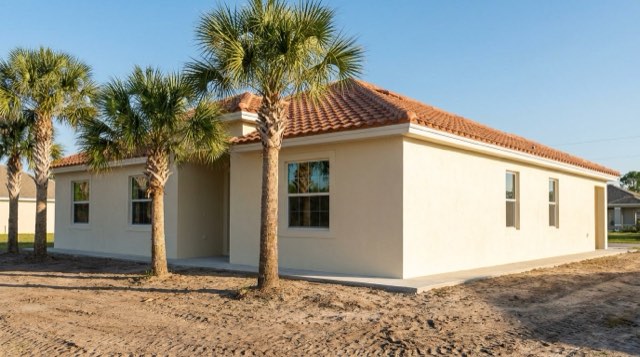 How it works
One-Coat and Three-Coat Stucco Systems Compared
Three-coat, two-coat direct to block, and proprietary one-coat over foam are three different walls. Here is what separates them, where each turns up on the Treasure Coast, and how each repairs.
Read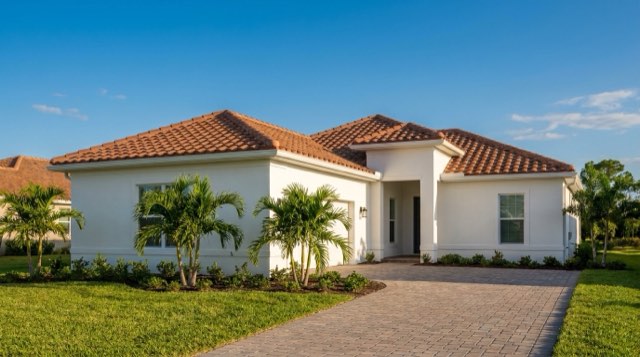 How it works
Paint or Elastomeric? Coating a Treasure Coast Stucco Wall
The same block house gets a different answer in Sebastian than it does in Okeechobee. Salt, drying time and the sun load on a given face matter more than the brand on the bucket.
ReadStraight answer on your wall.
Call, or send the form and we will get you a written price.