A Pre-Season Stucco Checklist for Treasure Coast Homeowners
Forty minutes in April is worth more than a week of worry in September. Here is what to look at on a Treasure Coast stucco wall before hurricane season starts, and what you can honestly leave alone.
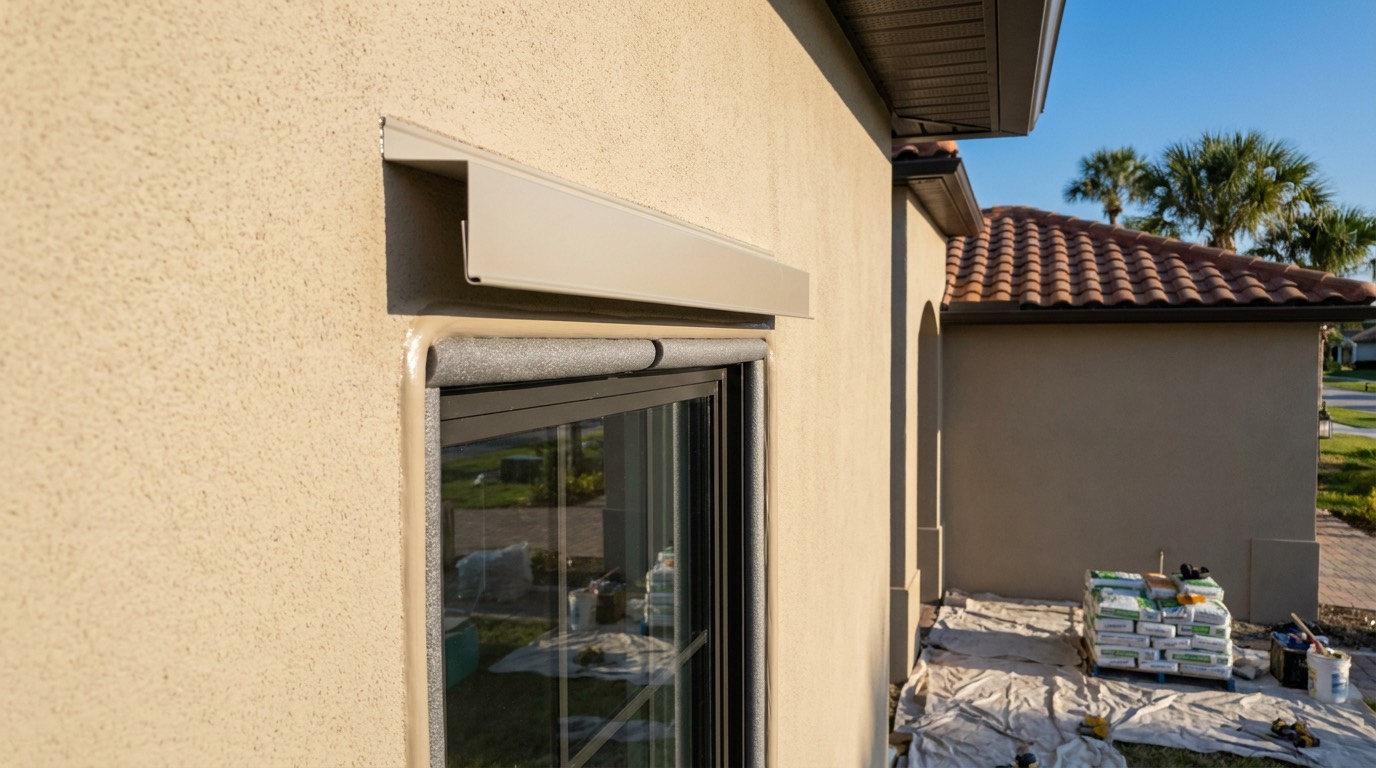
Do this in spring, not in the first week of June
The Atlantic hurricane season runs June through November, and the NOAA National Hurricane Center is where the Treasure Coast watches it from. That is a useful date to work backward from. By the time a name shows up inside a forecast cone, the window for calm wall work has already closed.
So the walk happens in March, April or early May, which is dry season here. Sealant cures under good conditions, a patch has time to sit and be painted, and crews across Port St. Lucie, Fort Pierce and Stuart are not yet buried in emergency calls.
None of this needs to be dramatic. Most houses turn up two or three small items, and plenty turn up none. A checklist exists to find those, not to talk anybody into a project.
Walk the house slowly, with a notebook
Give it forty minutes. Start at a corner and go one direction so you do not skip an elevation. Early or late beats noon, because low sun rakes across a wall and shows every ridge, bulge and open joint that midday light hides.
You are not diagnosing anything on this walk. You are listing places where water has an easy path in, which is a far simpler job than working out what any given crack means.
- A phone, so you have a dated baseline to compare against in October
- A small screwdriver or putty knife for testing sealant
- Binoculars for gable ends and second story walls you cannot reach
- A note on your phone, one line per elevation, so nothing gets lost
Want a price for your own wall?
Four quick questions and we come back with a written quote. Or call (772) 251-6654 if that is faster.
Request a quote
Four questions, about a minute. We'll call you back.
Sealant joints fail first and cost the least to fix
Every place where stucco meets something that is not stucco is a joint, and that joint is only as good as the sealant in it. Window and door perimeters. Hose bibs. Dryer vents. The line set running through to the air handler. Light fixtures, house numbers, shutter hardware, anything screwed through a wall.
Failed sealant announces itself once you know the signs. It pulls away from one side and leaves a visible gap. It cracks across its face. It goes hard and chalky and lifts out with a fingernail. Under Florida sun a cheap bead on a west elevation can be finished in three or four years.
Test it with the screwdriver. Good sealant is rubbery and springs back. Failed sealant is brittle or already gone. Mark those spots, because a morning spent replacing bad joints is the highest value work anyone does on a wall before storm season.
- Window and door perimeters, all four sides, on every elevation
- Hose bibs, dryer vents, exhaust caps and electrical penetrations
- The line set and condensate penetration at the air handler wall
- Anything fastened through the stucco, including shutter tracks and bolts
- Control joints, and where the garage door frame meets the wall
The bottom of the wall, and what is buried against it
On a framed wall or a gable end, stucco goes over wire lath and terminates at a weep screed. That screed does what the name says. Water that gets behind the stucco runs down the drainage plane and exits through the holes along the bottom flange.
It only works if it is open to air. Soil pushed against it, mulch renewed every spring until the bed is four inches deep, a paver patio added years later, a planter run right up to the wall. All of them bury the escape route and turn it into a trap. Walk the base of every framed wall and pull that material back.
The rule of thumb is a few inches of clearance above soil and a smaller gap above paving. The number that governs your house is whatever your building department enforces, so ask St. Lucie, Martin or Indian River County before you rebuild a bed or pour a slab against a wall. On direct to block walls there is often no screed at all, and what matters is simply that the stucco is not buried in wet dirt.
Which cracks are worth closing before June
Not all of them, and anybody telling you otherwise is selling something. A stable hairline in a flat wall field admits very little water, and storm season does not change that. It can wait for your next paint cycle.
What wind driven rain changes is the value of location. A crack next to a window corner, beside a penetration, at the top of a wall under the eave, or on the elevation your weather arrives from, is a crack with water aimed at it under pressure. Those move to the front of the list.
Priority also goes to anything a fingernail catches in, anything with brown staining bleeding out of it, and anything running unnaturally straight along an outside corner where the bead sits. Corroding metal does not wait for the dry season.
- Close first: cracks within a foot of a window, door or penetration
- Close first: anything wide enough to catch a fingernail on
- Close first: cracks with rust or brown staining running out of them
- Can wait: stable hairline and map cracking out in an open wall field
Where the water goes once it lands
A good share of what damages a stucco wall never arrives as rain on the wall. It arrives as splash. A downspout discharging at the base, a low spot that ponds against the foundation, a walkway settled back toward the house. All of them hold water at the bottom of the wall long after the sky clears.
So walk the ground line as carefully as you walked the wall. Grade should fall away from the house. Downspouts should let go well clear of the base. Irrigation heads should water plants rather than stucco, a common find in St. Lucie West and Tradition where the landscape went in before the plants filled out.
Look up too. On the barrel tile roofs common here, a blocked valley sends a lot of water onto one spot, and so does a roof edge that dies into a wall with no kick-out flashing at the end of it. Both are worth a roofer's eye while it is still dry.
- Grade falling away from the wall, with no ponding left after rain
- Downspouts discharging clear of the base, not into a bed at the wall
- Irrigation heads aimed at planting, never at the stucco
- Valleys, gutters and kick-out flashing checked before the season
What to do with the list you just made
Sort it into three piles. Things you can handle yourself, things worth a contractor, and things to watch. Most lists come out heavy on the first pile, which is why the walk is worth doing.
Cutting out a failed sealant joint and laying a new bead is homeowner work if you are steady on a ladder and buy a decent polyurethane or hybrid rather than the cheapest tube on the shelf. Pulling mulch off a weep screed is a Saturday morning. Resetting a settled walkway is a landscaper.
Call somebody when the list includes a hollow sound, a bulge, rust staining, or a crack that came back in the same line after a repair. Call in April rather than August. The week after a storm crosses the Treasure Coast, every crew from Vero Beach to Hobe Sound is booked, and a morning's work turns into a wait.
Related questions
When is the right time to do this walk?
Spring, ahead of the June start of hurricane season. March through early May is dry season here, so sealant and patch work cures well and there is room on a contractor calendar. If you have never done it, July is still far better than not at all.
Do I need to fill every crack before hurricane season?
No. Stable hairline cracking in an open wall field takes on very little water and is handled with a quality coating on your regular paint cycle. Put the money into cracks near windows, doors and penetrations, cracks a fingernail catches in, and anything with staining. Those are the ones wind driven rain can use.
How much clearance should there be at the bottom of the wall?
The rule of thumb people quote is a few inches above soil and a smaller gap above paving, so a weep screed stays open to air. The figure that governs your house is whatever your local building department enforces, so ask the county directly before you build up a bed or pour a slab against a wall.
Can I replace the sealant myself?
Yes, if you can work safely at the height involved. Cut the old bead out completely rather than laying new sealant over it, clean the joint, and use a quality exterior polyurethane or hybrid rated for movement. Fresh caulk smeared over a failed bead lasts about a season.
Does an elastomeric coating count as storm prep?
It helps, and it is not a substitute for the rest of the list. A good coating bridges hairline cracking and sheds water off the field of a wall. It does nothing for an open sealant joint, a buried weep screed or a missing kick-out, and those interfaces are where the water gets in.
Should I pressure wash the house before I inspect it?
Wash after, not before. Dirt patterns show where water has been running, and a pressure washer takes that away with the algae. When you wash, keep the pressure moderate and the tip moving. A tight tip held on one spot cuts a stucco finish and opens hairlines that were closed.
References
Standards bodies and agencies referenced above. We are not affiliated with them.
More guides
All guides →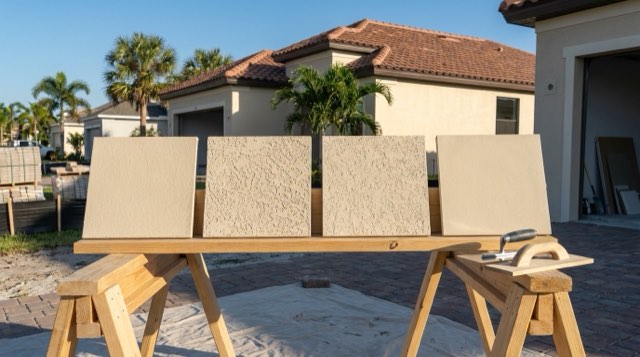 How it works
How to Match Existing Stucco Texture on a Repair
Matching stucco texture is a hand skill, not a product you buy. Here is how the common Treasure Coast finishes get matched, why a patch can still show after a perfect color match, and when re-coating the whole elevation is the cheaper answer.
Read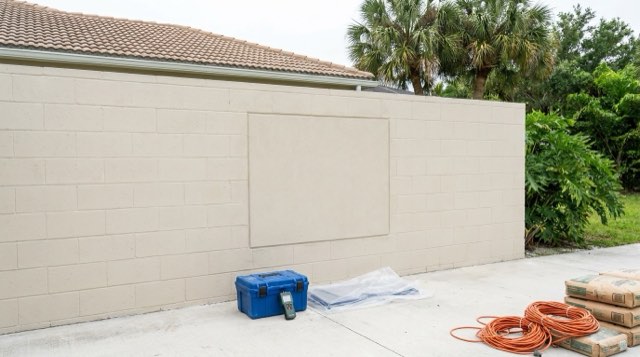 Diagnosis
Signs of Moisture Behind Your Stucco, and What to Do
Trapped water leaves evidence long before the wall fails. Here is what to look for outside and inside a Port St. Lucie home, how water actually gets in, and what to do first.
Read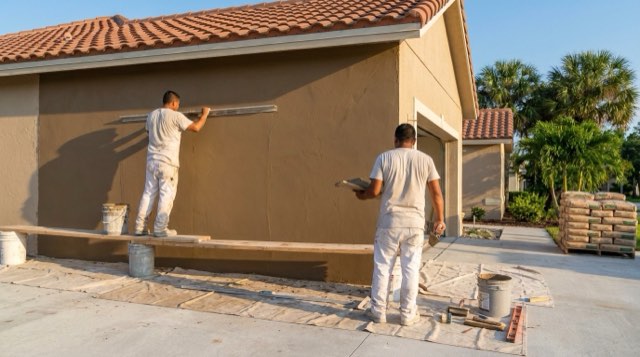 How it works
Phasing Stucco Work on Occupied Multi-Family Buildings
The building does not empty out for the work, and on the Treasure Coast how full it is depends on the month. Phasing, season, access and containment are what separate a project residents tolerate from one that generates complaints for a year.
Read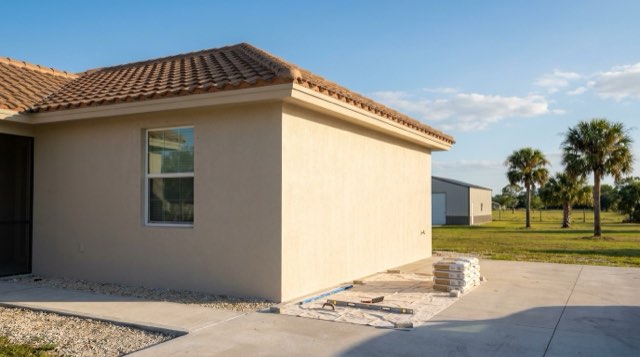 Local guide
Stucco Away From the Coast: Okeechobee and Inland Properties
Take salt out of the equation and the whole failure list changes. Inland stucco around Okeechobee and the western county lines is a rain, heat and mineral problem, on properties where the water and the power are not always waiting for you.
Read How it works
One-Coat and Three-Coat Stucco Systems Compared
Three-coat, two-coat direct to block, and proprietary one-coat over foam are three different walls. Here is what separates them, where each turns up on the Treasure Coast, and how each repairs.
ReadStraight answer on your wall.
Call, or send the form and we will get you a written price.