Stucco Away From the Coast: Okeechobee and Inland Properties
Take salt out of the equation and the whole failure list changes. Inland stucco around Okeechobee and the western county lines is a rain, heat and mineral problem, on properties where the water and the power are not always waiting for you.
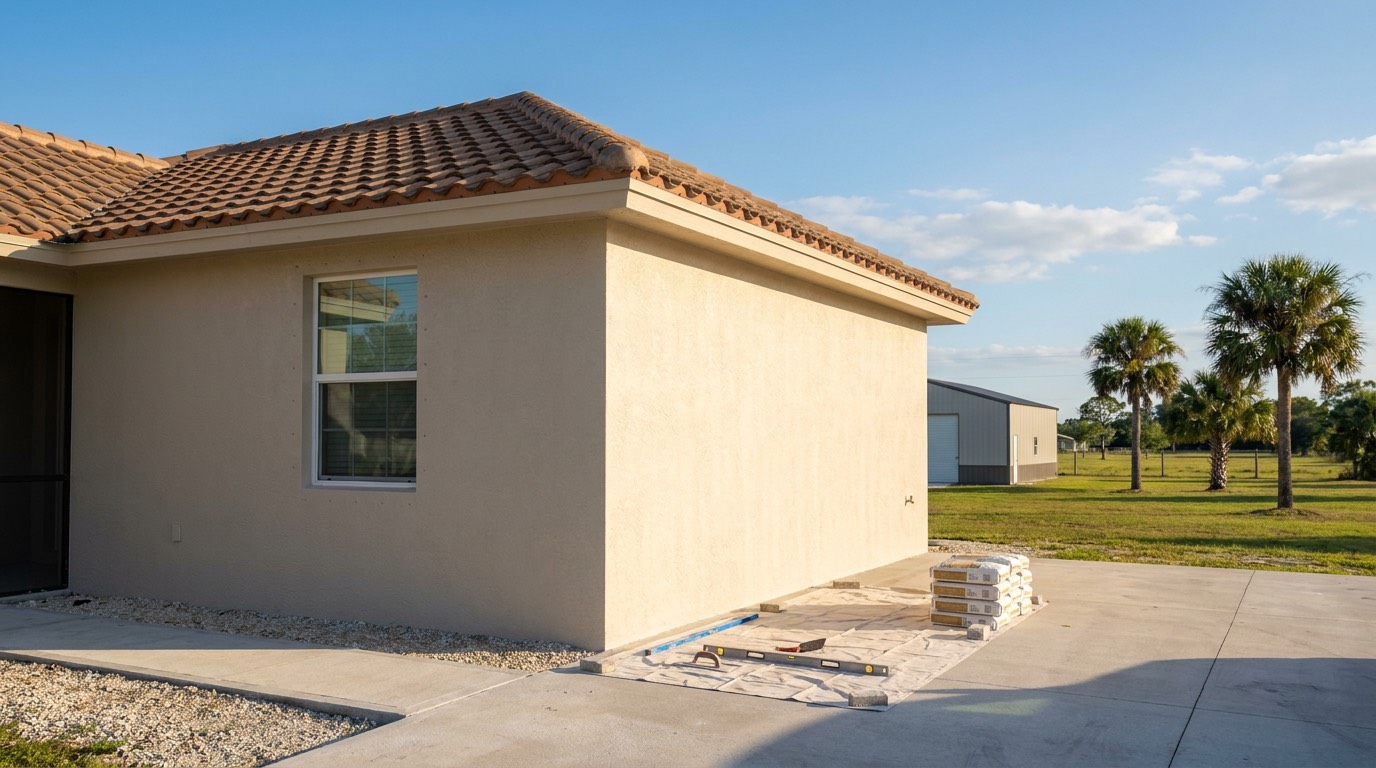
No salt changes the whole failure list
Half of what we write about stucco on the Treasure Coast is really about chloride. Salt air off the Atlantic and the Indian River Lagoon reaches a long way inland and finds every piece of unprotected metal in a wall. Bead, lath and fasteners corrode, and the rust expands and pushes the stucco apart from inside.
Head west toward Okeechobee and that driver largely disappears. Rust jacking still turns up where something was left unprotected or a leak has kept metal wet for years, but it stops being the first thing we look for.
What remains is everything else, and it is enough to keep a crew busy. Water, sun and minerals do the work out here, and the walls tell you so.
Rain and heat carry the load inland
Summer storms build over the interior and do not always move off quickly the way a sea breeze storm does on the coast. A property west of the county line can sit under one cell for an hour, and the water comes down hard and straight.
Sun is the other half. Inland lots are often open, with pasture or cleared ground around the house instead of the tree canopy and neighboring roofs that shade an older street in Fort Pierce. A west elevation with nothing in front of it takes full afternoon sun, then gets hit by a cool storm an hour later. That daily swing drives most thermal cracking.
The result is that inland walls show more open field cracking and finish coat fatigue than coastal walls of the same age, and less of the corner and bead damage that dominates near the water.
Want a price for your own wall?
Four quick questions and we come back with a written quote. Or call (772) 251-6654 if that is faster.
Request a quote
Four questions, about a minute. We'll call you back.
Efflorescence is the inland signature
The white, powdery bloom on a stucco or block wall is efflorescence. It is salt, but not sea salt. Soluble minerals inside the masonry get dissolved by water moving through the wall, travel with that water to the surface, and stay behind as a crust when the water evaporates.
It is a moisture report, not a defect in itself. Wherever efflorescence shows up repeatedly, water is moving through that spot on a schedule. A band along the bottom of a wall usually means splash or wicking at grade. A patch under a window means the perimeter is letting water in. A bloom on a block outbuilding often means it has no coating and never has.
Which is why brushing it off solves nothing. Dry brushing and a masonry cleaner take the deposit away, and if the water path is still open it returns within a season looking the same. Find the water first, then clean, then coat.
- A band at the base of a wall points at splash, grade or a buried wall bottom
- A patch under an opening points at the window or door perimeter
- A vertical streak points at a roof edge, valley or downspout above it
- Bloom on new work is often just curing moisture and will settle down
More frame and lath, and a lot more outbuildings
The housing mix changes as you go inland. Alongside the block homes there is a good deal of older wood frame stock, stucco over wire lath, sometimes on properties that have been added to over three or four decades. It is common to find a frame original with a block addition on the back and two different wall assemblies meeting at one line.
Then there is everything that is not the house. Barns, workshops, equipment sheds, pump houses, guest quarters and the odd block structure that predates anyone's memory of it. These get stuccoed, then neglected, and they usually have no coating and no gutters.
Both matter for how a job is priced. Frame and lath is a different repair from direct to block, because there is a drainage plane behind it that has to stay continuous. Outbuildings are simple walls with easy access, which makes them some of the most cost effective stucco work anybody buys.
Sprinklers, well water and the bottom of the wall
Irrigation causes more inland stucco staining than weather does. A head that clips the wall every morning wets the same band of stucco three hundred and sixty five days a year, which is a far more relentless load than a storm that passes through in July.
Well water makes it visible. Iron leaves the orange staining seen on so many walls and drives out here, and hard water leaves deposits that build into a chalky film. Neither harms the stucco quickly, but both keep returning until the head is moved or the arc adjusted. UF/IFAS Extension, the university's county extension service, publishes guidance on irrigation and water quality and the county offices field these questions regularly.
While you are down at that level, check what is sitting against the wall. Pasture grass grown up to the block, a feed bin, fence posts, a pile of soil from a project two years ago. Anything holding moisture against stucco all day is a slow problem you solve with an afternoon and a shovel.
Site access is a real variable out here
On a suburban lot in St. Lucie West, access is a driveway and a gate. On acreage west of Okeechobee it is a quarter mile of dirt drive, a cattle gate, a turnaround that may or may not fit a loaded truck, and ground that goes soft for two days after a storm.
It is worth saying before the estimate rather than after. How wide the drive is. Where a truck can turn. Whether the ground near the building carries weight in August. Whether gates need to stay closed, or there are dogs with opinions about visitors.
None of this is a problem, it is just information. A crew that knows what it is driving into brings the right vehicle and staging plan. A crew that finds out at seven in the morning loses half a day, and half days end up in somebody's price.
- Drive width, surface, and how it behaves after heavy rain
- A turnaround that fits a loaded truck and trailer
- Gate access and who opens it, particularly on working property
- Somewhere flat and firm within reach of the wall for mixing and staging
Water and power are not guaranteed on site
Stucco needs water. Mixing takes it, cleaning tools takes it, wetting a hot substrate before material goes on takes it, and misting a fresh wall during the cure takes more of it. On municipal service nobody thinks about this. On a rural property it is worth a sentence in the conversation.
If the property runs on a well, the pump runs on power, so if the power is out or the outbuilding was never wired there is no water either. Older barns often have no working outlet, or one circuit that will not carry a mixer.
The answers are simple as long as they are known in advance. A water tank on the trailer, a generator, or an agreement to run from the house rather than the building being worked on. What creates problems is finding out on the morning of day one, which is the difference between a planned cost and a surprise.
Related questions
Is inland stucco work cheaper or more expensive than coastal?
The wall work is priced the same way anywhere, on square footage, condition, height and access. What moves an inland number is travel distance, site access, and whether water and power are available. Single story outbuildings with room to work around them often come in lower per square foot than a tight two story coastal elevation.
What is the white powder on my block wall?
Efflorescence. Minerals inside the masonry dissolve in water moving through the wall and are left on the surface when that water evaporates. The deposit itself is harmless and cleans off, but it tells you water is traveling through that spot. If it returns after cleaning, the water path is still open and that is the thing to chase.
Why does the bottom of my wall have orange staining?
Almost always iron in well water from irrigation. A sprinkler head hitting the wall every morning deposits it in the same band day after day until the stain is set into the surface. Adjusting the arc or moving the head stops it getting worse. Removing what is already there takes a cleaner made for mineral staining, and sometimes a recoat.
Do you work on barns, workshops and other outbuildings?
Yes, and they are often straightforward. Single story walls, open access all the way around, and no HOA architectural review. The usual finds are no coating on the block, damage at the base from equipment and vegetation, and open joints around doors fitted long ago.
Does my well water affect the stucco mix?
For ordinary well water, generally not in any way you would notice. Where it does show up is on the finished surface, since water carrying a lot of iron or minerals can contribute to staining and surface deposits over time. If a property is known to have unusually hard or heavy iron water, we would rather bring clean water for finish work and cleanup.
Do I need to have power and water available at the building?
It helps a great deal, and it is workable either way as long as we know in advance. Crews can bring a tank and a generator, and that gets planned into the schedule and the price. The situation to avoid is finding out on the first morning, because that costs a day that nobody budgeted for.
References
Standards bodies and agencies referenced above. We are not affiliated with them.
More guides
All guides → How it works
One-Coat and Three-Coat Stucco Systems Compared
Three-coat, two-coat direct to block, and proprietary one-coat over foam are three different walls. Here is what separates them, where each turns up on the Treasure Coast, and how each repairs.
Read How it works
Paint or Elastomeric? Coating a Treasure Coast Stucco Wall
The same block house gets a different answer in Sebastian than it does in Okeechobee. Salt, drying time and the sun load on a given face matter more than the brand on the bucket.
Read Maintenance
Pressure Washing Stucco Without Damaging It
A pressure washer will clean your stucco or resurface it, and the line between the two is thinner than most homeowners expect. Here is how to stay on the right side of it.
ReadHiringTwelve Questions Worth Asking Before You Sign
Twelve questions that separate a contractor who has thought about your particular wall from one who has not. Several of them only make sense in this climate and this housing stock.
Read How it works
Patch Repair or Full Restucco? How to Decide
The choice between a patch and a full restucco is arithmetic, not a feeling. Measure what has actually failed, count the old patches, and see where the two costs cross.
ReadStraight answer on your wall.
Call, or send the form and we will get you a written price.