Paint or Elastomeric? Coating a Treasure Coast Stucco Wall
The same block house gets a different answer in Sebastian than it does in Okeechobee. Salt, drying time and the sun load on a given face matter more than the brand on the bucket.
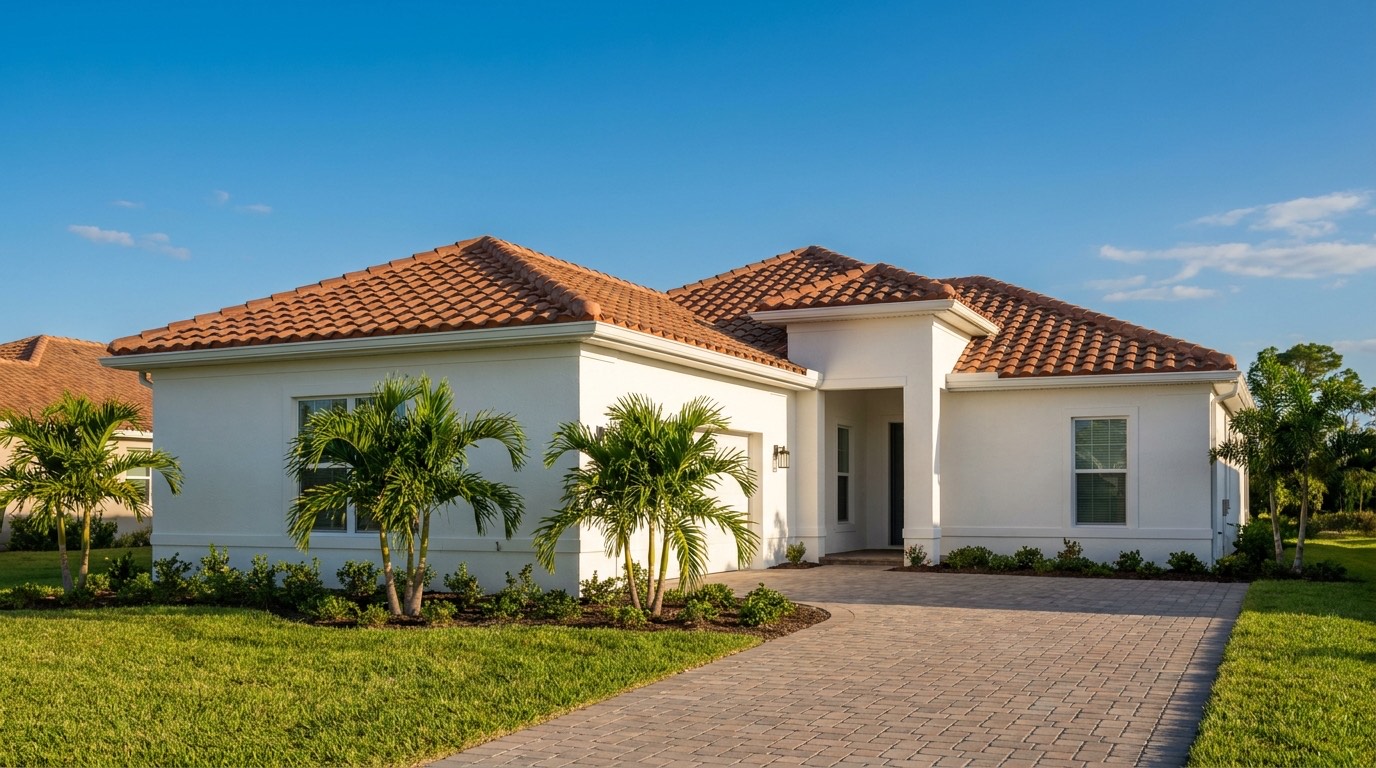
Where the wall stands decides more than what is in the bucket
A coating on a block house has four jobs and only one of them is color. Shed wind driven rain. Survive ultraviolet at a latitude where the sun never takes a season off. Tolerate a wall that moves every day. And let moisture already inside the wall get back out.
How those four rank changes with the address, by more than people expect across a fairly small region. On a house a few hundred yards off the water in Jensen Beach, Sebastian or Vero Beach, the fourth job decides everything. Out west toward Okeechobee, or well inland in Palm City, the first three dominate and the fourth is comparatively easy. Same product, same block wall, different correct answer.
The Portland Cement Association publishes general guidance on cement plaster and on coatings for masonry, and the thread running through it is compatibility. The coating has to suit the wall it is going on. Around here, the wall's exposure is half of what that word means.
Film build and elongation, the two properties that separate them
Standard exterior acrylic goes on thin. Two coats build a film measured in a couple of mils, and that film is fairly rigid. It colors and protects a surface that is not moving much.
Elastomeric is built to move. It goes on far heavier and it stretches. Elongation is the property being sold: the film can be pulled well beyond its own length and recover without splitting. On a wall carrying fine shrinkage cracking, that is what bridges the hairlines and keeps them bridged through the daily heat cycle.
The trade is real. Heavy films fill texture, so an elastomeric softens a fine finish and can bury a light sand pattern. Sprayed thin to stretch the material, it is simply expensive paint with none of the elongation you paid for.
- Ordinary acrylic: thin film, little stretch, easy to recoat later
- Elastomeric: heavy film, high elongation, bridges hairline cracking
- Below its specified build, an elastomeric does not deliver its elongation
- Heavy films soften fine sand and light lace textures
- Neither replaces repairing a crack you can catch a fingernail in
Want a price for your own wall?
Four quick questions and we come back with a written quote. Or call (772) 251-6654 if that is faster.
Request a quote
Four questions, about a minute. We'll call you back.
Permeability, and why a block wall here is a reservoir
Permeability describes how readily water vapor passes through a dried film. It is printed on the data sheet as a perm rating, and it decides whether your wall can dry.
Cement stucco over concrete block is a reservoir. It gets wet, it holds moisture in the mass, and it gives that moisture back in both directions. In Florida humidity it does this continuously. A cell crosses in the afternoon, the sun returns, the surface heats, and the wall pushes moisture outward.
Narrow that path with a low permeability film and the wall must cope with whatever is still inside it. Where the moisture load is light it manages. Where the wall stays damp, from daily irrigation, mulch at the base or grade against the slab, vapor gathers behind the film and pressure builds at the bond line.
That is why the coastal and inland answers diverge. The question is never only how much water gets in. It is how many hours a day the wall gets to dry.
Coastal walls: a salt film keeps the surface wet
Near the ocean and along the Indian River Lagoon, salt arrives as fine drift and settles on everything. It does not evaporate off with the rest of the moisture, and because it pulls water out of humid air it keeps the surface damp long after a wall in Palm City has dried. A house in Jensen Beach, Sebastian or Vero Beach therefore has a wall that spends far more hours wet than the same house built inland.
Two consequences follow. The first is bonding. Salt sitting on stucco is a contaminant, and a heavy film laid over it peels at that layer no matter what it cost. Washing salt off before coating is not padding the invoice on a coastal job. It is the difference between a coating that holds and one that comes away in sheets.
The second is drying. On a coastal wall with any standing moisture source, the tightest film is the wrong instinct. Blistering has a signature: round soft bubbles, often low on the wall or on the shaded side, peeling in sheets rather than chips, with damp or chalky stucco underneath. That is not a cheap product failing. It is a film given a job the wall could not accommodate.
This is where mineral coatings deserve more shelf space than they get. Potassium silicate paints and cement based fog coats are chemically related to the wall itself. Rather than forming a plastic film they bond into the stucco and leave a highly permeable finish. They will not bridge a moving crack, and the colors are flatter. What they return is a wall that keeps breathing.
- Rinse salt off exposed walls before any coating goes on
- Fix the wetting source first: irrigation, gutters, mulch, grade
- Soft round bubbles peeling in sheets rather than flaking off
- Damp or chalky stucco under the lifted film
- The same area failing again a year after a repaint
Inland walls: heat and driving rain instead of chloride
Head west and the failure list changes. Out toward Okeechobee there is effectively no salt on the wall, so the metal inside the assembly is not under attack and the coating is not sitting on a damp chloride film year round.
What replaces it is sun and volume. Inland lots are often open, with pasture or cleared ground rather than the canopy and close neighboring roofs that shade an older street in Fort Pierce or Stuart. A west wall with nothing in front of it takes full afternoon sun, then a storm arrives an hour later and drops water straight down onto a hot wall. That daily swing drives thermal cracking, which is why inland walls show more open field cracking than coastal walls of the same age.
For coating choice, that inverts the answer. The inland wall dries far more completely between wettings, so the penalty for a tight film is smaller while the crack bridging is worth more. On a sound, dry inland block wall an elastomeric at its specified build is usually a strong buy. On a lagoon-side wall that never fully dries, the same product is the risky one.
One inland caveat. Well water carries iron and hard minerals, and a sprinkler head clipping the wall every morning puts that into the same band of stucco all year. That is a wetting source, and no coating fixes it. Turn the head first.
Coat by elevation, because south and west carry the load
Whatever product you land on, stop thinking about the house as one surface. The south and west faces take the ultraviolet load on every building in St. Lucie County, so they fade and chalk first, and it is normal for one or two faces to want recoating while the rest look fine.
Exposure stacks. A west elevation on a Hutchinson Island or Jensen Beach house takes sun and salt at once and is on the shortest clock of anything we look at. The shaded north wall of that same house may hold its coating for years longer, and its problem is mildew in the humidity rather than fade, which is a washing job before it is a coating job.
Manufacturers publish an expected service life and those figures read as optimistic down here. As a working expectation, an ordinary acrylic on a Treasure Coast block home tends to look tired well inside a decade while a well applied elastomeric at the correct build runs longer. Plan by face, budget by face, and hold the same product, color formula and sheen across every phase.
- South and west walls fade and chalk first, anywhere in the region
- Sun plus salt on a west coastal elevation is the shortest clock there is
- The shaded north wall usually needs washing, not recoating
- Sprinkler overspray fails the base of a wall long before the field goes
- Coats piled up over decades eventually peel on their own
Approval, preparation, and the wall you actually have
In Tradition, St. Lucie West and most newer communities across Port St. Lucie, exterior color goes through architectural review before anything is bought or scheduled. What people forget is that a coating decision is not only a color decision. An elastomeric changes how a wall reads, because the heavy film softens fine texture, and sheen changes it again. Put the product and the sheen in front of your association alongside the chip, and get the response in writing. Timelines are theirs to set, so ask early.
Then match the coating to the wall. Sound, dry, fine shrinkage cracking, no moisture history: an elastomeric at the specified build holds those hairlines closed for years, and inland that is usually the easy call. A wetting source, a low base, salt film, or a wall that has blistered once already: a permeable finish, plus a fix to whatever is feeding the water. Cracks you can catch a fingernail in, hollow areas or rust staining: coating is not the next step at all, repair is.
Preparation decides the outcome more than product selection does. Wash it, let it dry, prime what the manufacturer says to prime, replace the sealant at window and door perimeters, and hit the stated spread rate. A mid grade coating applied properly outlasts a premium coating applied thin, on any street on this coast.
- Sound dry wall, hairline cracking, no moisture history: elastomeric
- Salt film, wet base or past blistering: mineral or permeable acrylic
- Fresh stucco: respect the stated cure time and use a compatible primer
- Fine texture you want to keep: avoid the heaviest film builds
- Hollow areas, open cracks or rust staining: repair before you coat
- Association communities: product, sheen and color approved before purchase
Related questions
Is elastomeric a mistake in Florida?
No, but it is misused often enough to have earned a mixed reputation. On a sound dry block wall with hairline cracking it performs very well, and inland that describes most houses. On a coastal wall with a salt film and a steady moisture source at the base it seals vapor in and blisters. The product is not the variable, the wall is.
Does living near the lagoon really change which coating I should buy?
It changes two things. Salt on the surface is a bonding problem, so the wash before coating matters far more than it does inland. And salt keeps the wall damp for more hours a day, which narrows how much drying capacity you can afford to give up. Both push a coastal wall toward a more breathable finish than the same house would want in Okeechobee.
How long should I wait before coating new stucco?
Long enough for the plaster to cure and the alkalinity to settle. Around a month is the figure most plasterers work to, but the product data sheet governs and some coatings are formulated to go on sooner. Ask which product is being used and check its stated cure requirement before anyone schedules the painters.
Will an elastomeric stop my wall leaking?
Not if water is entering somewhere other than the field of the wall. Coatings resist wind driven rain across a sound surface, but they do nothing for a failed sealant joint, a flashing problem or a hollow area. Treating a coating as waterproofing is how leaks get buried rather than fixed.
Can elastomeric go over existing paint?
Only if the existing paint is well bonded, and that has to be tested rather than assumed. A heavy elastomeric film weighs much more than what is under it, so marginal adhesion below gets pulled loose as the new film cures. Scrape test several areas on each elevation and remove whatever lifts.
My HOA approved the color. Is that the whole approval?
Not necessarily, and it is worth asking rather than assuming. Communities like Tradition and St. Lucie West review exterior appearance, and a heavy coating changes texture and sheen as well as color. Submit the product and sheen with the chip, get the response in writing, and let your association tell you what their process actually covers.
References
Standards bodies and agencies referenced above. We are not affiliated with them.
More guides
All guides →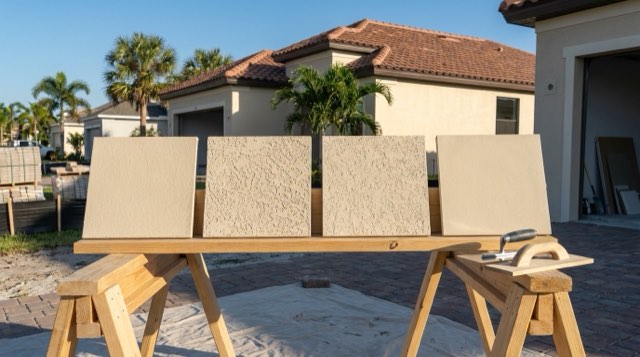 Maintenance
Pressure Washing Stucco Without Damaging It
A pressure washer will clean your stucco or resurface it, and the line between the two is thinner than most homeowners expect. Here is how to stay on the right side of it.
ReadHiringTwelve Questions Worth Asking Before You Sign
Twelve questions that separate a contractor who has thought about your particular wall from one who has not. Several of them only make sense in this climate and this housing stock.
Read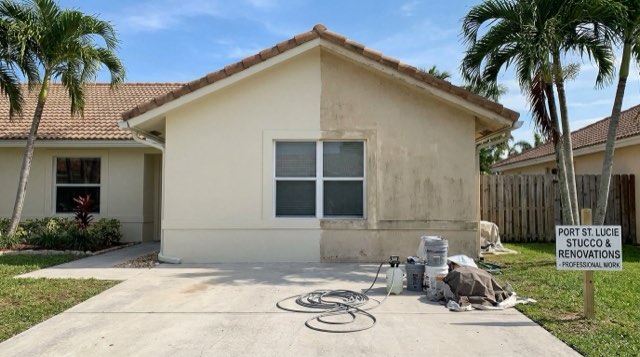 How it works
Patch Repair or Full Restucco? How to Decide
The choice between a patch and a full restucco is arithmetic, not a feeling. Measure what has actually failed, count the old patches, and see where the two costs cross.
ReadCost guideWhat Does It Cost to Restucco a Whole House in St. Lucie County?
Restucco means three different jobs at three different prices. Measure your own wall area first, then use the per square foot ranges below to work out which conversation you are actually having.
Read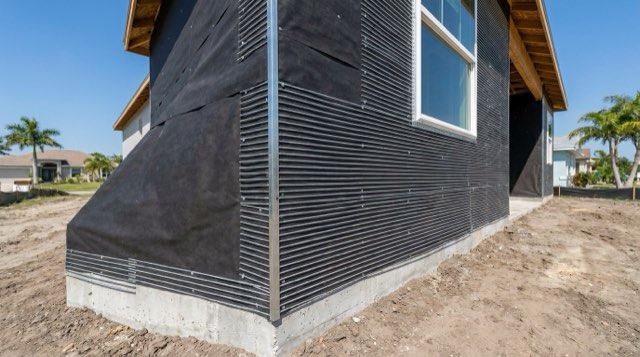 Diagnosis
Rust Stains Bleeding Through Stucco
An orange stain on stucco is downstream evidence. Something metal inside the wall is corroding and water is carrying it out. Here is how to find it and how the repair has to be done.
ReadStraight answer on your wall.
Call, or send the form and we will get you a written price.