Patch Repair or Full Restucco? How to Decide
The choice between a patch and a full restucco is arithmetic, not a feeling. Measure what has actually failed, count the old patches, and see where the two costs cross.
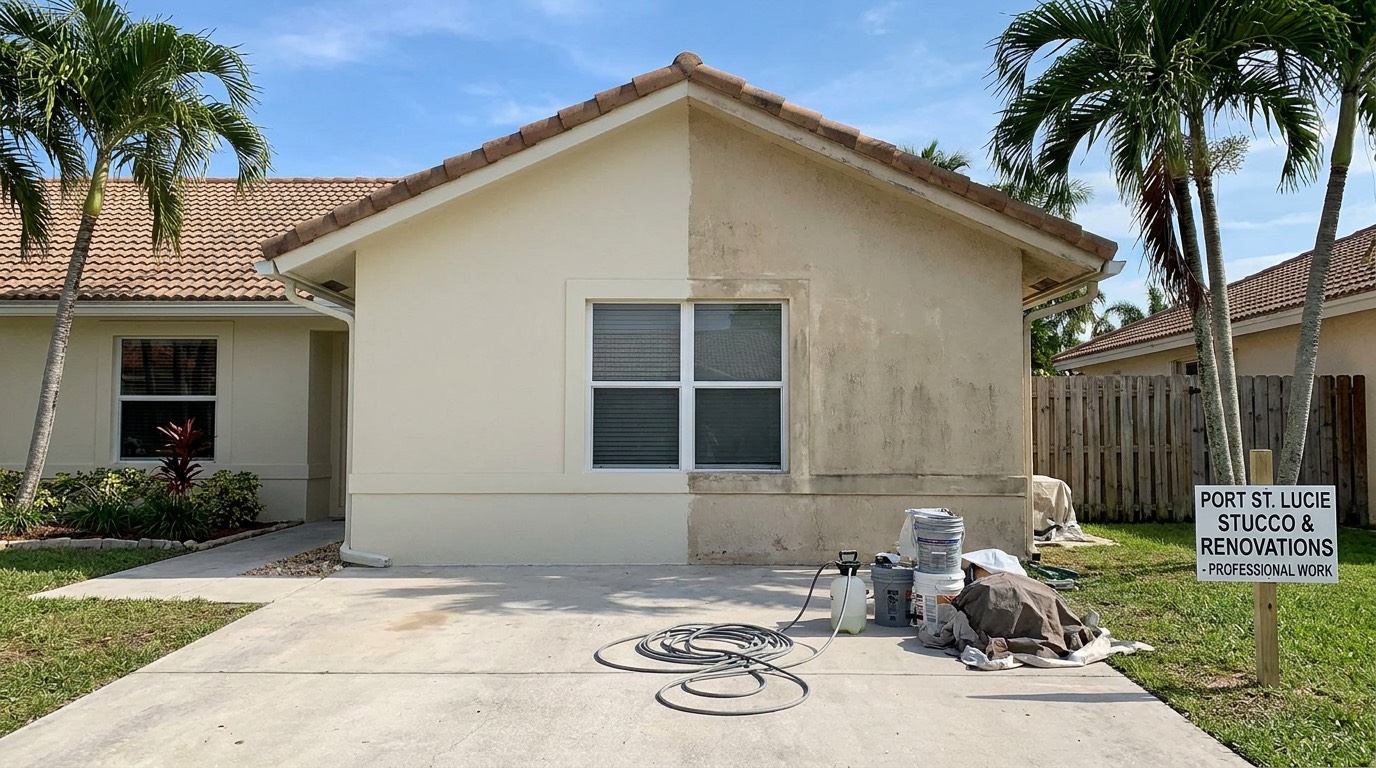
Start with a percentage, not a feeling
The decision between patching and restuccoing is not a judgment call about how bad a wall looks from the driveway. It is arithmetic. Work out how much of each elevation has genuinely failed, then let that number choose the scope.
Most homeowners come at it the other way. They see three cracks and a soft spot near the hose bib, then either want the smallest possible fix or assume the house is finished. Both instincts cost money.
So before anybody quotes anything, the wall gets measured. Not the crack. The failure.
How to measure what has really failed
Sounding is the whole test. Tap across the wall with a knuckle, a plastic mallet or the butt of a screwdriver and listen. Bonded stucco rings. Debonded stucco gives a dull, flat thud, and the sound changes the moment you cross the edge of the failure.
Chalk the boundary as you go. What you end up with is not cracks, it is shapes, and the shapes are almost always larger than the visible damage. A crack six inches long can sit in the middle of a hollow area four feet across.
Then do the arithmetic wall by wall, because stucco does not fail evenly. On a Treasure Coast ranch the west and south faces take the sun, while the wall behind a sprinkler head or under an overflowing gutter takes the water.
- Tap the whole wall, not only around the cracks
- Chalk every hollow area while you are standing there
- Measure the marked areas and add the square footage up
- Measure the elevation, length times height, less the openings
- Do each wall separately, then compare the numbers
Want a price for your own wall?
Four quick questions and we come back with a written quote. Or call (772) 251-6654 if that is faster.
Request a quote
Four questions, about a minute. We'll call you back.
The percentage that flips the decision
There is no code number for this, and a contractor who states one as a rule is making it up. What exists is a working range most crews land on, worth knowing so you can hear where a bid is coming from.
Under roughly a tenth of an elevation, patching is nearly always right. Between a tenth and a third, pattern matters more than area. Ten percent in one continuous block below a window is a patch. The same ten percent scattered across twenty hollow spots is a wall letting go, and patching it buys twenty seams for the next failure to start in.
Past about a third, the case for patching thins fast. You are already paying setup, access, material, texture work and coating across most of that face anyway.
- Under about 10 percent of an elevation: patch, then coat the wall
- 10 to 30 percent in one continuous area: still usually a patch
- 10 to 30 percent scattered across the face: lean to resurfacing
- Over about a third: resurface or rebuild that elevation
- Any percentage with moisture behind it: find the source first
How many rounds this wall has already had
Ask how many times this wall has been repaired. A first repair on a twenty year old finish is ordinary maintenance. A third repair in the same band of wall is information, and what it says is that patching is not solving the thing that is happening.
Every patch leaves a perimeter. That seam is where old material meets new, where two mixes of different ages sit against each other, and it is the natural place for the next crack. A wall carrying six old patch perimeters has been cut into pieces, and it moves like pieces.
There is a visual limit too. Patches made at different times, with different sand and different coating batches, never quite line up. Long repair histories in Fort Pierce and Stuart often produce sound walls that read as a quilt from the street. That alone is a fair reason to resurface.
Whether the texture can ever be matched
Texture decides how the repair looks, and how it looks is what you live with. A flat or light sand finish blends most easily. Knockdown and lace can be matched by a good hand, but the match has to be made on your wall, in your light, by somebody willing to throw away two sample boards.
Age works against all of it. A finish that has sat under Florida sun since the house was built has chalked and bleached, so new material beside it reads brighter even when the pattern is right. The usual answer is to coat the elevation corner to corner once the repair is done.
Where the texture is unusual, worn past matching, or the patch count is high, resurfacing gives a uniform wall for a cost close to patching plus full coating anyway. In Tradition and St. Lucie West, put the color to your architectural review committee before material is ordered. Requirements vary by community, so ask your association first.
What is underneath decides more than what is on top
All of that assumes the wall behind the stucco is sound, so confirm it before trusting any percentage. On a block home it normally is. Block does not rot, and once failed plaster is off, the crew is usually looking at clean masonry.
Framed walls are the other story. Gable ends, second stories, bump-outs and the older frame stock around Fort Pierce and Stuart carry stucco on wire lath over sheathing, where water can leave rusted lath, corroded fasteners and soft sheathing. None of it is visible until the wall is open.
So the order of operations matters. Find the water, fix the water, then decide the scope.
Where the two costs cross
Patch work is priced as a minimum plus area. The minimum covers the truck, the mixing, the protection and the return trips, and it does not shrink because your damage is small. Restucco is priced closer to straight square footage, so the unit cost falls as area grows.
On one elevation of a single story block home here, isolated patch work commonly sits in the region of $10 to $25 per square foot of patched area with a service minimum on top, while resurfacing an elevation tends to land around $4 to $9 per square foot of wall. Put your measured square footage into both and the crossing point shows itself.
Two things move that crossing point earlier. Access, paid for once whether you patch a spot or redo the face, and coating, which most homeowners buy for the whole elevation anyway. None of these figures is a quote. They are a frame for reading estimates, and the only number that means anything comes from somebody standing at your wall with a mallet.
- Patch: service minimum, plus per square foot, plus texture work
- Restucco: per square foot of wall, unit price falling with area
- Access is a fixed cost either way above one story
- Full elevation coating usually gets bought in both cases
- Several small patches carry the minimum once in a single visit
Related questions
What does a full restucco actually include?
It covers two different jobs. Resurfacing leaves sound stucco in place and puts a new coat and finish over it, which suits walls that are bonded but tired or heavily patched. Removal and replacement takes the plaster back to block or lath and rebuilds the coats. Make sure the proposal says which one you are buying.
Can I do one elevation now and the rest later?
Yes, and it is a sensible way to spread the cost, since corners make natural break lines. The catch is color. Coatings applied years apart weather differently, so either plan to coat the whole house at the end or accept some variation between faces.
The same patch keeps failing. What does that mean?
It means the repair treated the symptom. Repeat failure in one line usually traces to water still entering there, movement the patch cannot absorb, or corroding metal behind the plaster. Before paying for a third round, have somebody open a small area and find out which.
How many patches are too many on one wall?
There is no fixed count. The practical limit arrives when patch perimeters outnumber clean field, or when the wall reads as mismatched from the street even though every repair is sound. At that point you are buying appearance, and resurfacing usually delivers it more cheaply.
Is a full restucco worth doing before selling?
It depends on what a buyer inspection will flag. Delamination, rust staining and open cracks tend to become negotiation items, so repairing them usually pays. A cosmetic restucco on a sound wall rarely returns what it costs. Ask your agent what buyers in your neighborhood react to.
Should I ask for both options on the same estimate?
Yes, and good contractors expect it. Ask for the patch scope and the resurface scope priced separately on the same visit, with the measured failed area stated in both. Seeing the two against your square footage is the clearest way to decide, and it shows whether the contractor measured or guessed.
More guides
All guides → Cost guide
What Does It Cost to Restucco a Whole House in St. Lucie County?
Restucco means three different jobs at three different prices. Measure your own wall area first, then use the per square foot ranges below to work out which conversation you are actually having.
Read Diagnosis
Rust Stains Bleeding Through Stucco
An orange stain on stucco is downstream evidence. Something metal inside the wall is corroding and water is carrying it out. Here is how to find it and how the repair has to be done.
Read Maintenance
Sealing Hairline Stucco Cracks Yourself: When It Works
Some stucco cracks are a genuine Saturday job with a five dollar tube. Others will cost you money if you fill them. Here is how to tell which one you have, and how the season decides your prep.
Read Maintenance
What Sprinkler Overspray Does to Your Stucco
A head that clips the wall three mornings a week does more damage over five years than any storm does in a season. Start by reading the color of the band it leaves.
Read Diagnosis
Why Stucco Color Fades on the Treasure Coast
Three different things get called faded stucco, and only one of them needs new color on the wall. Where your house sits, and which way the wall faces, usually tells you which one you have.
ReadStraight answer on your wall.
Call, or send the form and we will get you a written price.