What Sprinkler Overspray Does to Your Stucco
A head that clips the wall three mornings a week does more damage over five years than any storm does in a season. Start by reading the color of the band it leaves.

The color of the band tells you which water you are on
The pattern is unmistakable once you know it. The top of the wall looks close to the day it was coated. The bottom two or three feet is a different color, sometimes with a wavy upper edge tracing the arc of a spray head, sometimes as a hard line stopping dead at a fixed height.
What color it went tells you where the water came from. Orange through rust brown is iron, and iron means a shallow irrigation well. That is the everyday situation on larger lots and rural parcels out toward Okeechobee, on plenty of properties around Sebastian, and west of Vero Beach where homes water from their own wells rather than off a meter.
A chalky white film is hardness, the mineral load in treated water left behind as it evaporates. Heavy staining that also goes green and gray usually means reclaimed water, which many of the newer master planned communities are plumbed for on the irrigation side. Reclaimed carries minerals and nutrients together, and the nutrients feed whatever is already living on a damp wall.
If you do not know what your zones run on, your water provider does. It is a one call question and it changes what the stain is and how it should be cleaned.
Iron staining is not rust coming out of the wall
These two get mixed up constantly and they are not the same problem or the same bill. Well water iron sits on the surface. Rust from corroding metal comes from inside the assembly and pushes the finish off as it grows.
Iron staining has a fan or an arc to it, because it maps the shape of a spray pattern. It covers a broad area rather than a line, strongest where the head throws hardest and fading toward the edges. The best confirmation is free. Look at the driveway, the sidewalk, the fence posts and the screen enclosure frame. If they are all wearing the same orange, the water is doing it, and your wall is stained rather than damaged.
Rust jacking reads completely differently. It follows a construction line, usually straight and usually at an outside corner or across the top of an opening. There is a ridge you can feel by dragging a flat hand over it. The stain bleeds out of the crack itself rather than covering the field, and the plaster either side often sounds hollow. That is metal work, not cleaning.
Want a price for your own wall?
Four quick questions and we come back with a written quote. Or call (772) 251-6654 if that is faster.
Request a quote
Four questions, about a minute. We'll call you back.
The wetting cycle, and the metal at the base of the wall
Stucco is built to get wet. It gets soaked in every storm from June into September and it is fine, because after the storm it dries. Plaster, block, coating and everything embedded in the wall is designed around wetting and drying as a cycle.
Irrigation breaks the cycle rather than adding to it. A head that catches the wall three mornings a week wets it more often than the wet season does, on a schedule that never lets the base reach genuinely dry. Add humidity, mulch holding damp against the foundation and a shrub line killing the airflow, and the bottom of that wall is damp permanently.
That is what turns a cosmetic complaint into a repair. There is metal down there, and metal that stays wet corrodes. On a block home that means corner bead at every outside corner, casing bead around the openings, and the fasteners holding accessories in place. On framed areas, gable ends, second stories and porch infills, it also means wire lath and a line of fasteners running through the wettest band of the wall.
Corroding steel expands and the plaster over it has nowhere to go, so it lifts in a raised line or a row of small pops. Once that starts, the metal has to come out and be replaced. It began with a sprinkler head.
- Corner bead at outside corners, the most common casualty by far
- Casing bead and accessories around lower windows and doors
- Lath and fasteners on framed walls, gable ends and porch infills
- The weep screed and its fasteners at the base of framed walls
- Anything anchored low on the wall, including hose bib brackets and rail posts
Why a whole street shares the same stain line
Walk a block in Tradition or St. Lucie West and look at the bottom three feet of each house. The band often sits at the same height on four houses in a row, because the elevations repeat, the beds went in from the same plan, and the irrigation was installed by the same crew with the same head layout on every lot.
That is useful information. If your neighbors have your stain at your height, the cause is the design of the system rather than one knocked nozzle at your address, and the fix is the same conversation for all of you. Communities that hold turf to a standard also run more water through the dry months than an unwatered lot ever sees, which is how a manicured lawn ends up being hard on the wall behind it. Older streets in Port St. Lucie and Fort Pierce show the opposite pattern, one stained house between two clean ones, because every system on the block was put in separately.
Before you adjust anything, find out who owns the zone. On many properties the heads near the building sit on a community system maintained by the association rather than on the owner's controller. If that is your situation, a misaimed head is a photograph and a work order rather than a job for your screwdriver, and putting it in writing gets it recorded. Ask your property manager who maintains the zone and how they want it reported.
- Compare the stain height on neighboring houses before blaming your own heads
- Check whether the beds against the building are on a community zone
- Report a misaimed head in writing, with a photograph and the zone number
- Repeated elevations mean repeated failures, so one fix often covers several homes
- Ask whether landscaping crews have moved or replaced heads recently
Near the water, the wall has no spare capacity
A wall in Jensen Beach, Port Salerno or on Hutchinson Island is already carrying a load that an inland wall is not. Airborne chloride off the ocean and the Indian River Lagoon lands on it continuously and sits on the surface between rains.
Rain is the thing that removes it. A hard storm washes the deposit down and off the wall. Irrigation does close to the opposite. It wets the salt without volume enough to carry it away, keeps it in solution against the plaster, and gives it time to move into the wall. Salt in solution reaching bead, lath or lintel steel is precisely the mechanism that corrodes it.
So the same misaimed head costs a coastal owner more than it costs somebody in Palm City or out at Okeechobee, and the bead near the water gives up years earlier. Where a wall on the water side has already lost bead once, pricing non corroding accessory for the replacement is a fair question to put to your contractor.
Flat lots, splash back and a buried base
Overspray is only half of it. The other half is what happens to the water after it lands.
Lots on the Treasure Coast are flat. Drainage runs to swales and shallow grades rather than downhill, so water arriving beside the house stays near the house. A head that sprays a driveway, walkway or pool deck alongside the wall throws a fine mist back onto the plaster on every pass, and roof runoff off an eave does the same. That explains a low, even stripe on a wall no sprinkler can physically reach. Look at the height of the line and it usually points straight down at the hardscape under it.
Then there is everything piled against the base. Mulch topped up each year and rising. New sod laid over the old grade. A patio poured hard to the house. All of it buries the bottom of the wall, which is the one part of the assembly built to shed water and dry out. Keep a visible gap between the ground and the bottom edge of the stucco, and settle the clearance question with a hardscape contractor before the concrete truck is booked.
- Keep spray off driveways, walkways and pool decks that sit tight to the house
- Pull mulch and soil back and down off the base of the wall
- Do not let new sod raise the grade against the stucco
- A low, even splash line points at hardscape rather than at a head
- Check base clearance before any patio, deck or driveway extension is poured
One morning with a screwdriver, then a dry month
Run each zone manually in daylight and watch it through a full rotation. A rotor only clips the wall for part of its sweep, so a quick glance misses it. Most spray bodies adjust with a screw on top for radius and a collar or tab for arc, and rotors have their own arc stops.
If a head cannot be set to keep water off the house, change the nozzle for a tighter pattern, swap a full circle for a half or a quarter, or move the riser out into the bed. In a narrow bed against the wall the better answer is usually to pull the spray heads and run drip line, which waters roots and never touches plaster. Leave margin between the pattern and the wall rather than setting the edge at the foundation, because a breeze off the water moves everything. Watering days and hours come from your water provider and they do change, so check what applies at your address.
Then leave it alone for a month, ideally in the dry season, before deciding anything about the wall. Stains that fade or wash off easily were surface deposits. A band still dark after two dry weeks means water is reaching it from somewhere else. Clean gently at that point, low pressure and the right solution, because the base of a wall that has been wet for years is the last place to bring a narrow pressure tip.
After that, sound it. Knuckle along the bottom three feet listening for a hollow answer, and check outside corners for straight cracks with a ridge or a rust weep. Staining on solid plaster cleans up and gets coated at your next repaint. Hollow areas, bulges or rust mean the wall gets opened, and that repair is usually local rather than the whole elevation, provided the water has genuinely stopped arriving.
Related questions
Our irrigation is on a shallow well and the wall is orange. Can that be removed?
Often, at least mostly. Iron deposits sit on the surface and respond to the right cleaner rather than to pressure, though a heavy stain that has been building for years can leave a shadow in an old coating. Treat it at the source first. Keeping well water off the plaster, or filtering the iron out of the irrigation line, decides whether you clean it once or every year.
Every house on our street has the same stain line. Whose problem is that?
A shared stain height usually means a shared cause, which is the irrigation layout rather than your particular heads. Find out whether those zones are maintained by the association or by each owner, then report it accordingly and in writing. Neighbors with the same band are useful evidence rather than competition.
Is overspray worse near the water than it is inland?
Yes, because the coastal wall starts with salt already on it. Rain rinses that deposit away, and irrigation instead keeps it wet against the plaster without washing it off, which is what drives chloride toward the metal inside the wall. The same head aimed at a house in Okeechobee is a staining problem. Near the lagoon it is a corrosion problem.
We are on reclaimed water. Does that change the damage?
The mechanical damage is identical, since constant wetting is what does the harm. What changes is the appearance. Reclaimed typically carries more minerals and more nutrient than potable water, so those walls stain heavier and grow more algae in our humidity. Keeping it off the stucco matters more, not less.
How far back should a sprinkler head be from the wall?
There is no fixed number, because it depends on the nozzle, the pressure and the wind that morning. The working rule is to watch the zone run and confirm that no part of any pattern reaches the house, with room left over for a breezy day. In narrow beds along the building, drip line settles it permanently.
The bottom of my wall sounds hollow. Is the irrigation to blame?
It is a strong suspect, particularly with staining in the same band, but it is not the only candidate. Roof drainage, a failed joint above, or grade piled against the wall all put water in the same place. Stop the water first, then have the area sounded and the cause confirmed before anybody quotes a repair.
More guides
All guides → Diagnosis
Why Stucco Color Fades on the Treasure Coast
Three different things get called faded stucco, and only one of them needs new color on the wall. Where your house sits, and which way the wall faces, usually tells you which one you have.
Read Hiring
Warning Signs When Hiring for Stucco Work
None of these prove anybody is dishonest. They are patterns that turn up often enough on the Treasure Coast to be worth a pause, and each one has a check you can finish in a few minutes.
Read Local guide
Stucco Work in Hobe Sound: Estate Homes and Older Cottages
Hobe Sound is two housing markets under one name. A custom home with a hand applied finish and a 1960s cottage need very different stucco work, and very different pricing.
Read Storm season
Stucco Damage and Insurance Claims: What to Document
We are stucco contractors, not insurance advisers. What we can explain is how a wall gets recorded properly here, because a soaked block wall photographed on the wrong day tells the wrong story to everyone.
Read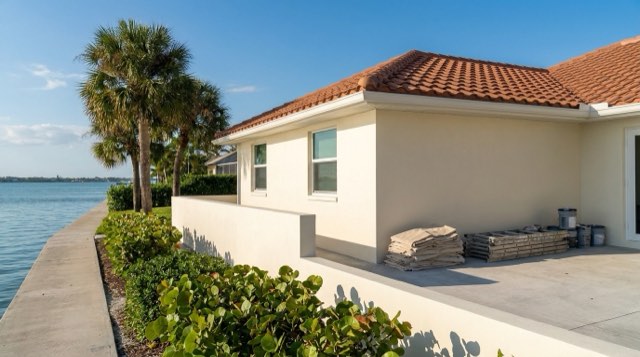 Local guide
Salt Damage to Stucco in Jensen Beach
Jensen Beach has the Atlantic on one side and the Indian River on the other. That geography, not the age of the house, is what decides how long your stucco and sealant last.
ReadStraight answer on your wall.
Call, or send the form and we will get you a written price.