Rust Stains Bleeding Through Stucco
An orange stain on stucco is downstream evidence. Something metal inside the wall is corroding and water is carrying it out. Here is how to find it and how the repair has to be done.
The stain is iron on the move
Rust does not travel through a wall as rust. Water reaches unprotected steel somewhere inside the wall, the steel corrodes, and dissolved iron migrates out with that water through a crack or the pores of the plaster. When it meets air and the water evaporates, the iron drops out as an orange brown oxide on your finish.
So the stain is downstream evidence rather than the problem. It sits below the source and spreads wider, in a plume, because gravity moved it there. The source is at the top of that plume, usually a line or a point.
It also tells you two things at once. There is steel in the wall without working protection, and there is water reaching it. Fix only one of those and you have bought a season or two.
What metal is actually inside a stucco wall
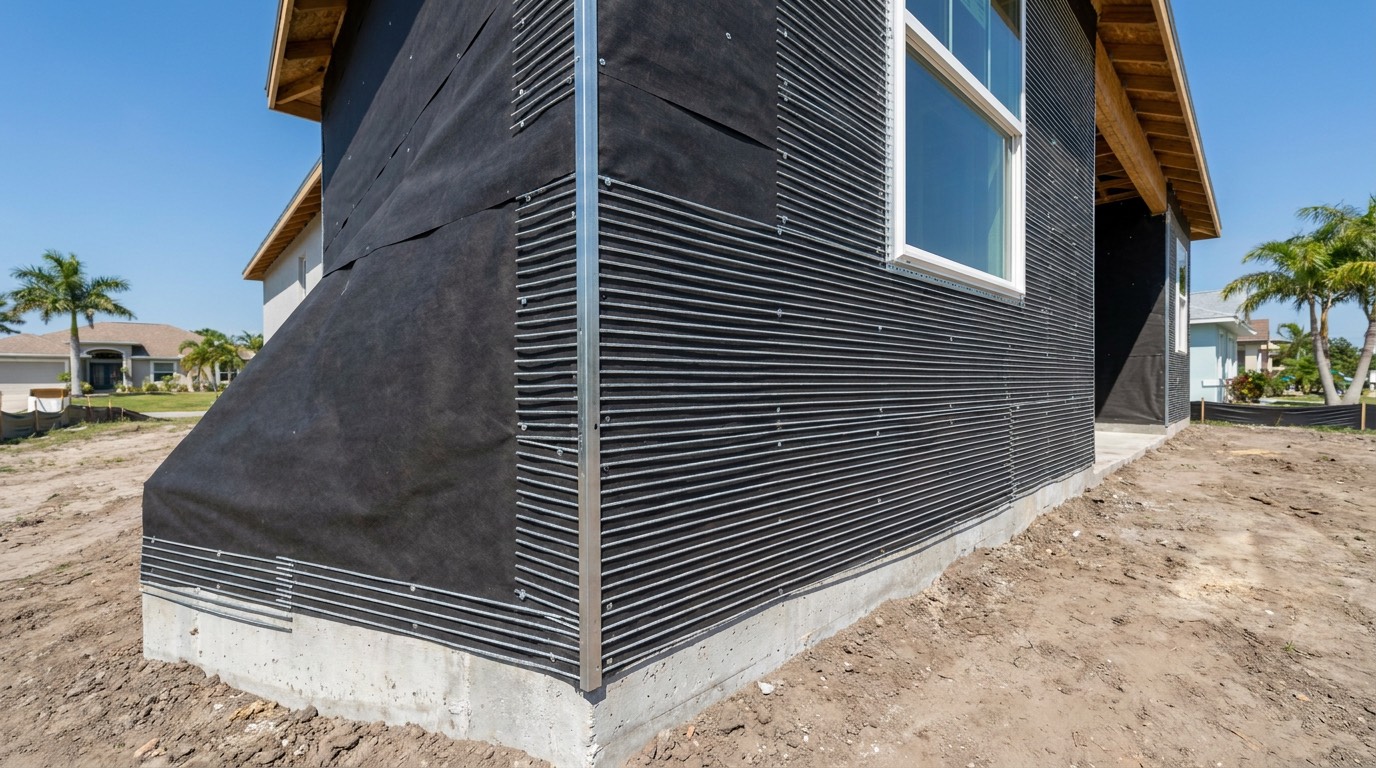
People are often surprised how much steel is in a plastered wall. On a block house the stucco is bonded straight to the block and the metal is concentrated in the accessories, the trim pieces forming edges, corners and terminations. On a frame wall or a gable end there is a full sheet of metal lath plus a fastener every few inches, so there is far more of it.
Most of those parts arrive galvanised. Galvanising is a sacrificial zinc coating and it buys years, not forever. It is also absent exactly where it matters most. Every cut end where a bead was trimmed to length, every fastener driven through it and every trowel scratch is bare steel from the day the wall went up.
ASTM C1063 covers installation of lath and accessories for portland cement plaster, and corrosion resistance of those parts sits in that territory. The Stucco Manufacturers Association publishes detail guidance on the same accessories. What applies to permits on your own house is a question for the St. Lucie County or Martin County building department.
- Corner bead, the nosing that forms every outside corner of the wall
- Casing bead and plaster stops where stucco terminates at a window, door or soffit
- Weep screed at the base of a frame wall
- Control joint and expansion joint accessories
- Expanded metal lath and its fasteners on frame walls, gable ends and soffits
- Tie wire and clipped offcuts left in the wall by accident during the original build
- Metal unrelated to the plaster: shutter anchors, conduit straps, fixture screws, a steel lintel angle
Want a price for your own wall?
Four quick questions and we come back with a written quote. Or call (772) 251-6654 if that is faster.
Request a quote
Four questions, about a minute. We'll call you back.
Rule out the stains that come from outside the wall
Before anybody opens a wall, rule out the sources sitting on the surface. A good share of the orange staining we get called to never came from inside the plaster at all, and the fix is a cleaning plus a small adjustment.
The test is geometry. A surface source produces a stain that starts at the visible thing producing it. Embedded corrosion produces a stain that starts at a crack line, a dead straight edge, or a repeating pattern with nothing visible at the top of it at all.
- Irrigation off a well. Iron in the water leaves an orange fan low on the wall, matching the sprinkler throw, often on several unrelated walls at once
- A corroding fixture, screw head, shutter anchor or hose bib with the stain running directly beneath it
- Steel above the wall: a railing, an awning bracket, a light arm, a rusting piece of flashing
- Mulch and organic splash at the base of the wall, browner than rust and stopping at splash height
- Rust transferred off equipment during a previous pressure washing
Reading the pattern to find the metal
Corroding accessories draw straight lines, because they are straight. A crack running dead straight down an outside corner, with a ridge you can feel under a flat hand and rust color seeping from the line, is corner bead. A straight line above a window head or under a soffit edge is casing bead. That geometry does not occur naturally in cement plaster, and it is the strongest clue you get from the ground.
Lath and fasteners draw patterns instead of lines. A row of small rust dots at even spacing, repeating at the spacing of the framing behind, is fasteners. A faint diamond print through the finish, or a field of small blisters, is the lath sheet itself. That shows up far more on older frame stock in Fort Pierce and Stuart than on block.
Two field checks cost nothing. Run a fridge magnet along the suspect line and it grabs wherever steel sits close under the finish, which maps the accessory without cutting anything. Then tap the area with a knuckle. Corrosion breaks the bond before it breaks the surface, so a dull zone running past the stain means the damage is bigger than the stain suggests.
Why the same crack keeps reopening after a patch
This is the most common callback in the trade. Someone fills the crack, blends the texture, paints it, and eleven months later the same line is back, a little wider, with the orange coming through the new paint.
Two mechanisms are doing that. The first is mechanical. Steel turning into oxide expands, and the corrosion products take up a multiple of the volume of the metal they replaced. Inside a rigid cement shell that acts as a slow wedge, generating far more tension than plaster can carry, and it does not stop. Filler laid over a wedge fails at the same plane every time.
The second is chemical. Patching places fresh wet material against the same steel, which delivers water to the one spot that needed none, and the salt already in a coastal wall stays there. Dissolved iron also bleeds through ordinary water based paint, so the stain returns through a fresh topcoat even where the crack held.
That is also why cleaning is cosmetic rather than a repair. Oxalic acid based removers do lift surface staining off masonry, and stronger acids lift it while burning the finish. Either way the source is untouched and the plume returns after the next few storms.
Coastal walls and inland walls fail differently
Chloride is the driver. Airborne salt off the ocean and the Indian River Lagoon lands on the wall and soaks in with rain and dew, and chloride is what breaks down the protection alkaline cement would otherwise give embedded steel. Homes in Jensen Beach, Port Salerno, Hobe Sound, Sebastian and along the water in Fort Pierce and Vero Beach sit in that year round.
That produces a recognisable pattern. Several corners going at once, windward elevations worse than sheltered ones, and beads failing on houses with no leaks anywhere, because ambient salt needs no leak to arrive. Distance from open water matters a great deal, and the exposure drops off quickly heading west.
Inland the pattern flips. Through central Port St. Lucie, Tradition, St. Lucie West and out toward Okeechobee, ambient salt is not the driver. Corrosion there is almost always local and fed by one water source. A corner under a failed window seal. A screed buried by raised sod. A bead below a roof edge with no kick out flashing. That is better news than it sounds, because a findable water source is a fixable one.
One slow process runs on every house regardless of address. Cement is strongly alkaline when new, and that alkalinity is what protects steel sitting in it. Over years the outer layers react with carbon dioxide from the air and the protection weakens from the surface inward.
The repair sequence that holds
None of this is exotic. It is ordinary work that has to happen in order, and skipping a step is what produces the callback above.
Scale it honestly. A single corroding fastener with a two inch stain is a small job. A corner bead that has pushed a four foot ridge is a real repair, and doing half of it is the same as doing none. If there is no crack, no ridge, no dull sound and no pattern, you may have nothing worse than a surface stain, and we will tell you so.
- Confirm the source. Rule out surface staining, find the metal with a magnet, and sound the wall to map the debonded area
- Fix the water first: failed sealant at an opening, missing kick out flashing, a sprinkler on the wall, a buried weep screed. New metal in a wet wall starts the same clock over
- Cut the stucco back past the hollow boundary to sound bonded material, with square cut edges rather than feathered ones
- Remove all of the corroded metal, not only the visible part, back to bright sound metal or the end of the run. A rusted stub left buried restarts it
- Wire brush the block or framing, take rust residue off the face, and let it dry
- Reinstall with corrosion resistant accessories. Vinyl bead is the straightforward coastal answer, stainless where the detail needs metal, and keep fasteners compatible so you do not build a galvanic cell
- Where lath is involved, lap new lath into sound existing lath, and on frame walls repair the water resistive barrier so it drains shingle fashion into the flashings
- Replaster in coats rather than one thick pass, let each coat set, keep it damp as it cures, and carry the texture past the patch line
- Prime the stained area with a stain blocking primer before the topcoat, because iron bleeds through ordinary latex and a sound repair with an orange ghost still reads as a failure
- Coat out to a natural break, a corner or a control joint, rather than stopping mid wall
Related questions
Can I just paint over a rust stain?
Not with ordinary exterior paint. Dissolved iron migrates through a latex film and the stain returns, often inside a year. A stain blocking primer holds it back, but only as the last step after the corroding metal is out of the wall.
Will a rust remover take the stain off my stucco?
Oxalic acid based products lift surface staining from masonry reasonably well, but they treat the symptom. If the metal is still corroding the stain returns with the next stretch of rain. Avoid strong masonry acids, because they etch the finish and permanently lighten an integrally colored wall.
How do I tell corner bead corrosion from something on the surface?
Look at where the stain begins. A visible metal item at the top of it is your source, and that is a cleaning job. If the stain starts at a dead straight line with nothing above it, feel for a ridge and run a magnet along it. A ridge, a magnet hit and a dull sound when you tap is corner bead near enough every time.
Does the whole corner have to come off?
The corroded run does. You cannot leave a rusted section buried and expect the repair to hold, so the cut runs back until the metal is sound or the piece ends. In practice that is often one corner from base to soffit rather than a wall or a house.
Is vinyl corner bead as good as galvanised metal?
For coastal exposure it solves the problem galvanised bead has, because it cannot corrode. Metal bead is stiffer and gives a crisper arris, and heavier galvanising or stainless is reasonable inland. Near the water we lean on vinyl.
Is this urgent, or can it wait?
It will not heal and it will not stop, but very little of it is an emergency. A small stain with no crack and no hollow can be photographed, dated and watched for a season. What moves it up the list is a ridge you can feel, a hollow area that is growing, or water that is also reaching framing.
References
Standards bodies and agencies referenced above. We are not affiliated with them.
More guides
All guides → Maintenance
Sealing Hairline Stucco Cracks Yourself: When It Works
Some stucco cracks are a genuine Saturday job with a five dollar tube. Others will cost you money if you fill them. Here is how to tell which one you have, and how the season decides your prep.
Read Maintenance
What Sprinkler Overspray Does to Your Stucco
A head that clips the wall three mornings a week does more damage over five years than any storm does in a season. Start by reading the color of the band it leaves.
Read Diagnosis
Why Stucco Color Fades on the Treasure Coast
Three different things get called faded stucco, and only one of them needs new color on the wall. Where your house sits, and which way the wall faces, usually tells you which one you have.
ReadHiringWarning Signs When Hiring for Stucco Work
None of these prove anybody is dishonest. They are patterns that turn up often enough on the Treasure Coast to be worth a pause, and each one has a check you can finish in a few minutes.
Read Local guide
Stucco Work in Hobe Sound: Estate Homes and Older Cottages
Hobe Sound is two housing markets under one name. A custom home with a hand applied finish and a 1960s cottage need very different stucco work, and very different pricing.
ReadStraight answer on your wall.
Call, or send the form and we will get you a written price.