Warning Signs When Hiring for Stucco Work
None of these prove anybody is dishonest. They are patterns that turn up often enough on the Treasure Coast to be worth a pause, and each one has a check you can finish in a few minutes.
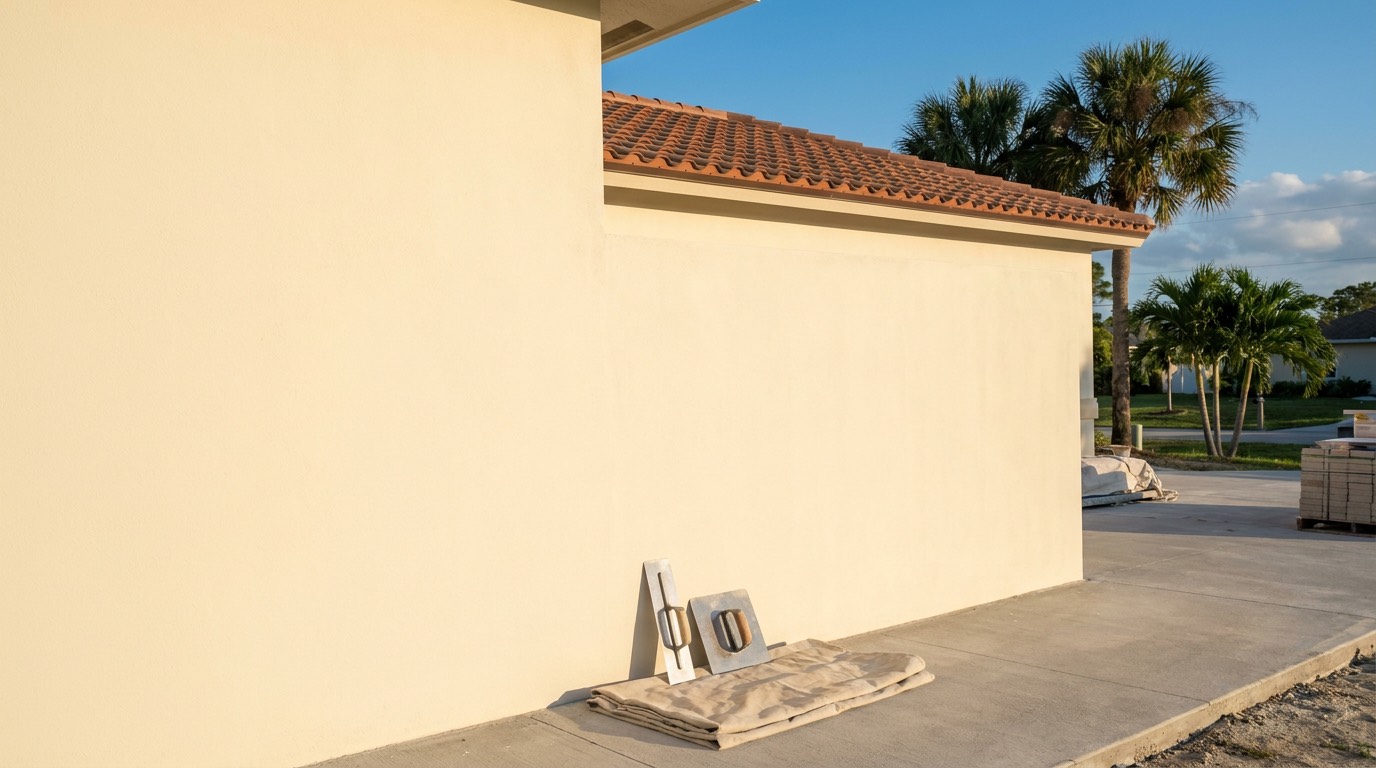
One sign is ordinary. Three is a shape.
Every item on this page has an innocent explanation sitting behind it somewhere. Small outfits run thin on paperwork. A crew genuinely can have one week open in October. And a quote that lands well under the others is often a narrower scope written by somebody who read the wall differently, not a plan to cut anything.
So treat these as places to slow down rather than verdicts. Each one comes with something checkable, usually free, usually finished before dinner. Plenty of skilled plasterers working St. Lucie County trip one of these and are still exactly who you want on your house.
What deserves a reaction is a cluster. One flag on an estimate is life. Three on the same estimate is a shape, and the shape is what costs people money.
The trucks that appear after a system passes
Within days of any system crossing or brushing the Treasure Coast, out of area plates show up on the road. Some belong to real companies who came down because the work is here, stayed a season and did careful work. Some belong to people who will not be reachable by the time your wall reports what actually happened to it.
The method is door to door. A crew works a Port St. Lucie street in the morning, a Fort Pierce block after lunch and a Stuart neighborhood the next day, offering to look at your elevation while the ladder is already up next door. The knock proves nothing by itself. What you do standing in the driveway is the whole decision.
So decide nothing in the driveway. Take a person's name, the business name and the license number, let them leave, and check. If the wall is genuinely open to weather, a tarp and a temporary cover hold it for the days you need to hire properly. No stucco repair on this coast has to be signed inside the hour, and anyone saying otherwise can be asked to name what happens in the next two days that does not happen in the next two weeks.
- Sign nothing at the door, and nothing you have not read all the way through
- Go slowly with any document assigning your insurance claim or benefits to a contractor
- Photograph the damage yourself before a tarp or temporary cover goes on
- Ask where the company was working six months ago and whether it was in Florida
- Write the license number down and verify it before you call anybody back
Want a price for your own wall?
Four quick questions and we come back with a written quote. Or call (772) 251-6654 if that is faster.
Request a quote
Four questions, about a minute. We'll call you back.
Ask which building department your address goes to
This question is quiet and it sorts people fast. Ask the contractor which department a job at your address would be filed with. Someone who works here answers without a pause, because they have stood at that counter and waited.
The service area is not one jurisdiction. Port St. Lucie and Fort Pierce are cities within St. Lucie County. Stuart and Port Salerno sit in Martin County, and so does Palm City. Vero Beach and Sebastian are Indian River County. Somebody who has been pulling paperwork on the Treasure Coast for years knows which office is which and usually has an opinion about each of them.
Do not use the answer to work out whether your own job needs a permit. That belongs to the department covering your address and nowhere else, because it turns on what is actually being done to the wall. The point of the question is narrower than that. A contractor who cannot name the department, or who waves the subject off, has told you how often they really work here.
The license check that takes four minutes
Florida licenses contractors through the Department of Business and Professional Regulation, and DBPR runs a public search that anybody can use from a phone. This is the highest value check on the page and it costs almost nothing.
Search the name that will appear on your contract, not the name on the shirt or the door of the truck. A license is held by a qualifying individual, and the business trading under it should line up with the business you are about to pay. When the truck, the contract and the license carry three different names, that is a fair thing to raise, and it often has a dull answer about a company that changed what it trades as.
Handle insurance the same way. Ask the agency to send the certificate straight to you with your address listed as certificate holder instead of taking a copy handed over at the estimate. Both requests are routine paperwork. Nobody who works here is insulted by either one.
- Look the license up yourself rather than accepting a photograph of one
- Match the license name against the contract, the invoice and the payee
- Confirm the license is active and current, not simply that it once existed
- Have the insurance certificate sent to you by the agency, not by the contractor
- Keep a screenshot of what the search showed on the day you looked
Money that arrives well ahead of the work
A deposit is normal in this trade. Material gets bought, a lift gets reserved, and a stretch of a crew's calendar gets held for you instead of somebody else. What earns a question is a deposit sized to the entire job rather than to the beginning of it, or one requested before any written scope exists.
The shape you want is easy to describe. Enough at the front to cover mobilisation and material, then payments tied to work you can walk outside and look at, then a final payment after you have been round every elevation with the sun on it. Once the money is front loaded, the pull to come back for the fiddly last half day quietly weakens.
Florida does have consumer protection rules covering deposits on residential work and what has to follow one. Rather than print a figure here, ask the contractor to set out their terms in writing, then confirm the current rules with DBPR or your county consumer office if the number feels heavy for the size of the job.
- A deposit asked for before anything at all is written down
- Most of the contract value due before a crew has been on site
- Payments keyed to calendar dates instead of to visible milestones
- A discount that appears only if you pay the whole job up front
A scope you cannot picture, and a decision you cannot postpone
Most stucco jobs that end badly were not sabotaged. Two people simply never wrote down what they each had in mind. Repair the stucco and paint the house is not a scope. It is a sentence that means one thing in the kitchen and another on the ladder, and the gap gets discovered on day three with the wall already open.
Ask for the detail in the document. Which elevations, roughly how much area, what is coming off, what goes back, how the texture gets matched, what is excluded. A contractor who resists writing that down is usually not concealing anything dramatic. More often they have not decided yet, which means a number arrived before the thinking did.
Pressure is the companion to this one. Real scheduling constraints exist and they are worth something to both sides, since a crew wrapping up in Jensen Beach on Thursday can honestly start you Friday. The tell is that a real constraint gets stated once and survives you saying not yet. A tactic escalates instead. The price expires tonight, the crew is already in your area so it has to be now, a discount materialises if you sign before the truck pulls out.
The low number, and whether anybody answers next August
Resist the reflex in both directions on price. A quote far below the rest usually means a different scope: filling and coating what shows instead of removing failed material and rebuilding it. Sometimes that narrower scope is precisely the right job for your wall and the cheap quote is the honest one in the pile. Reading both scopes line by line is the only way to tell, because a number is neither high nor low until you know what work it was for.
What deserves more weight than the price is whether the company can still be found afterwards. Stucco reports problems on its own schedule. A coating issue surfaces after one summer of heat and wind driven rain, a bond issue after two. The question is not only whether the crew is good this week. It is who picks up the phone in August of next year.
The things that settle that are unglamorous. A license you looked up. A business name that matches the license and the contract. An address that is a place. An email at a domain rather than a free account. Being based out of the area is not disqualifying on its own, and the Treasure Coast has always drawn good crews from Palm Beach and Orlando. The check does not change: can you verify who they are today, and reach the same company a year from now.
- Put the low quote's scope beside the others before you judge the number
- Confirm the name on the contract is the name on the license you searched
- Ask for two or three addresses of past work you can look at from the street
- Keep every document, change order and receipt whatever the payment method
Related questions
Somebody knocked on my door after the storm. Is that automatically a scam?
No, and treating it that way will occasionally cost you a good crew. Door knocking after weather is used both by legitimate companies expanding into a busy area and by people who will not be here next year, and nobody can tell them apart from the driveway. Take the name and the license number, look it up, and call back if it holds up. Anyone worth hiring is fine with that.
Does it matter that the contractor is based outside St. Lucie County?
Not by itself. Crews from Palm Beach, Orlando and further have worked the Treasure Coast for as long as there has been work here, and plenty of them are excellent. What matters is whether the same company will still be reachable when the wall reports back. Verify the license, confirm the business name on the contract, and ask for local addresses you can drive past.
How do I actually check a license?
Use the DBPR public search and look up the name that will be printed on your contract, since licenses are held by a qualifying individual and trade names change. Confirm the license is active and current rather than simply present. If the truck, the contract and the license carry different names, ask how they connect before you pay anything.
Is the lowest quote always the one to avoid?
No, and assuming so is its own expensive habit. A low number usually reflects a narrower scope, and sometimes the narrower scope is genuinely everything your wall needs. Lay the scopes side by side first. If the cheap one covers the same area, the same removal and the same finish work, you may just be looking at a leaner operation with lower overhead.
The contractor could not say which building department my job goes through. Is that serious?
It is a signal rather than a verdict, and it is worth a follow up question or two. Somebody who regularly files in St. Lucie, Martin or Indian River County answers that instantly. If they cannot, ask how many jobs they have run in your town this year. Whether your particular scope needs a permit is a separate question, and only the department for your address can answer it.
I have already paid a deposit and the contractor has gone quiet. What now?
Start a written record today. Send an email or letter stating what was paid, what was agreed and what you are asking for, and keep copies of everything including texts. Complaints about licensed contractors can be filed with DBPR, and your county consumer affairs office may help as well. If the sum is significant, an hour of legal advice early usually costs less than waiting does.
References
Standards bodies and agencies referenced above. We are not affiliated with them.
More guides
All guides → Local guide
Stucco Work in Hobe Sound: Estate Homes and Older Cottages
Hobe Sound is two housing markets under one name. A custom home with a hand applied finish and a 1960s cottage need very different stucco work, and very different pricing.
Read Storm season
Stucco Damage and Insurance Claims: What to Document
We are stucco contractors, not insurance advisers. What we can explain is how a wall gets recorded properly here, because a soaked block wall photographed on the wrong day tells the wrong story to everyone.
Read Local guide
Salt Damage to Stucco in Jensen Beach
Jensen Beach has the Atlantic on one side and the Indian River on the other. That geography, not the age of the house, is what decides how long your stucco and sealant last.
Read Maintenance
A Realistic Stucco Maintenance Schedule for Florida Homes
Stucco is a low maintenance wall, not a no maintenance wall. Here is the schedule a Port St. Lucie homeowner can actually keep, including the parts where the right answer is to do nothing.
Read How it works
Block or Frame: Which Stucco Wall Does Your House Have?
Two walls that look identical from the driveway behave nothing alike. How to tell block from frame using the age of your house, the street it sits on and ten minutes with a magnet.
ReadStraight answer on your wall.
Call, or send the form and we will get you a written price.