Salt Damage to Stucco in Jensen Beach
Jensen Beach has the Atlantic on one side and the Indian River on the other. That geography, not the age of the house, is what decides how long your stucco and sealant last.
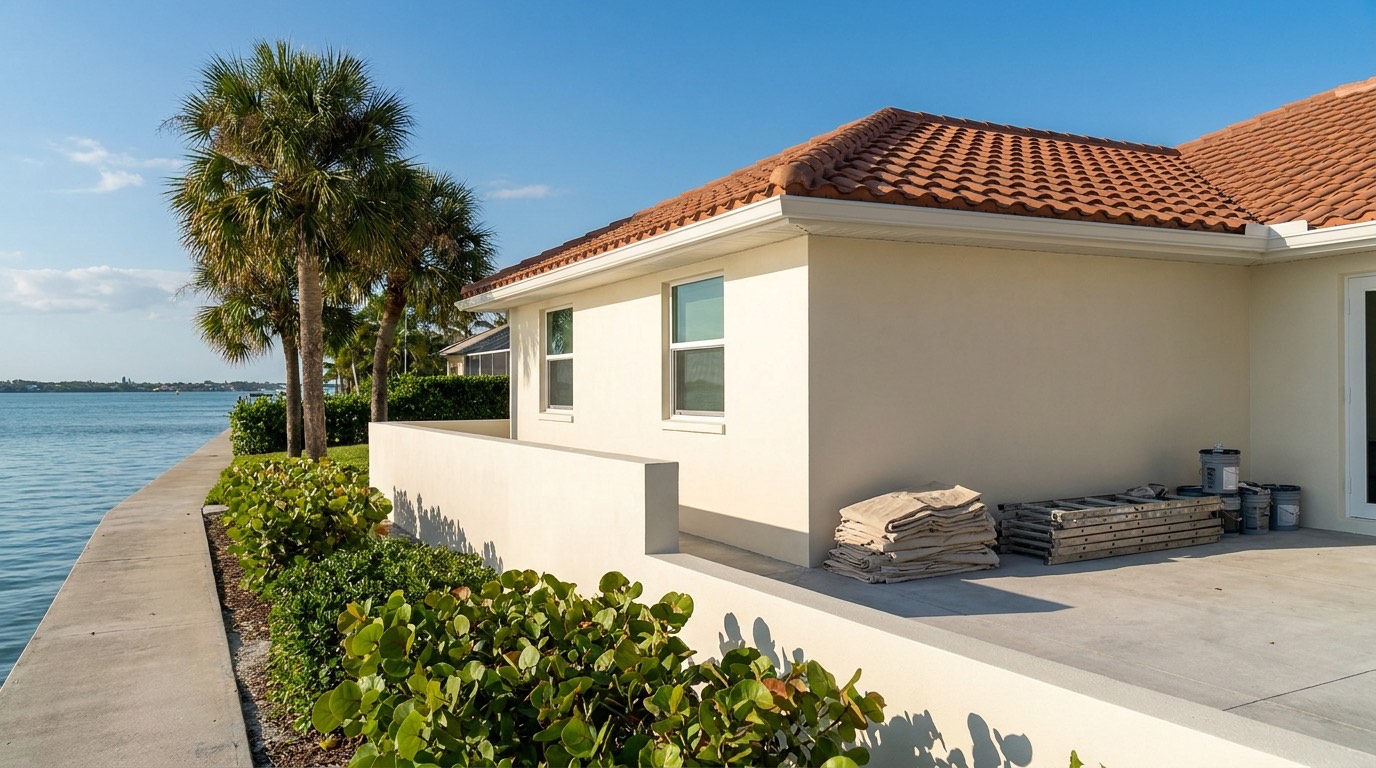
Water on both sides means there is no sheltered elevation
Most coastal towns have a good side. The wall facing away from the water gets a break, ages slower, and buys the owner a longer cycle on three quarters of the house. Jensen Beach does not offer that. The ocean is east and the Indian River Lagoon is west, and on a strip that narrow the wind delivers salt to whichever face is pointed at it that day.
The whole building therefore ages more evenly and more quickly than an inland house. Walking a property in Palm City we can usually point at one elevation and say that is where the money goes. Here the answer is more often all four, which makes exterior maintenance a scheduled item rather than something you react to.
What airborne salt actually does to a wall
Salt arrives as fine spray and drift and settles as a film on every exterior surface. It does not evaporate off with the rest of the moisture. Because salt pulls water out of humid air, that film keeps the surface damp long after a wall a few miles inland has dried.
Two things follow. Coatings and sealants spend far more hours wet than their makers assumed, which shortens their service life. And chloride works its way through the porous plaster toward any metal inside the assembly, where it attacks the protective layer that would otherwise keep steel stable inside cement.
None of this is a defect in your stucco. It is what happens to a cement product placed a few hundred yards from an ocean. The response is not better stucco. It is shorter intervals, better joint work, and coating chosen for this environment.
Want a price for your own wall?
Four quick questions and we come back with a written quote. Or call (772) 251-6654 if that is faster.
Request a quote
Four questions, about a minute. We'll call you back.
Sealant joints fail years before the stucco does
On coastal homes the water almost never comes through the middle of a wall. It comes through a joint. Window and door perimeters, control joints, the gaps around hose bibs and exterior fixtures, and every place two materials meet.
Sealant here takes UV, heat, movement and salt at once. It hardens, it shrinks, and eventually it lets go of one side of the joint. That failure is easy to miss because the bead is still visibly there. Run a fingernail down the edge instead of just looking. If it lifts away on one side, the joint is open regardless of how it looks from ten feet.
Caulking on top of a dead bead is the most common shortcut in this trade and it accomplishes nothing, because new sealant will not bond to hardened old sealant. The old material comes out, the joint gets cleaned to sound edges, backer rod goes in where the depth needs it, and the new bead is tooled so it can stretch instead of tear.
- Window and door perimeters, the single most common leak path
- Control joints and any expansion joint in a long wall
- Penetrations for hose bibs, vents, conduit and light fixtures
- Transitions from stucco to wood, metal, tile or a different wall material
- Handrail and awning anchors set into the wall
Rust jacking, and the metal you forgot was in the wall
Steel expands as it corrodes. It occupies several times the volume it started with, and that expansion has to push something out of the way. In a stucco wall the only thing available is the stucco, so the plaster cracks along the line of the metal and lifts.
Owners think of rebar and forget how much other metal is buried in an exterior. Corner bead down every outside corner. Casing bead at every stucco edge. Lintels over the openings. Lath on frame walls and gable ends. Anchors for shutters, railings and awnings. Here all of it is on a shorter clock than the same metal inland.
The signature is worth learning. An unnaturally straight crack where nature would not draw one. A ridge you can feel with a flat palm crossing it. Orange staining bleeding downward. That combination will not respond to filler, and a patch over it reopens within a season or two. The corroded metal has to come out before anything goes back on.
Elastomeric or breathable, and why the answer is not always the thick one
Elastomeric coatings are thick, flexible films that bridge hairline cracking and shed wind driven rain well, which is genuinely useful on a coastal wall. They also hold moisture in, and that is the part people skip past when they are sold on the crack bridging.
A block wall in this climate takes on water from rain, from humidity and sometimes from irrigation, and it has to give that moisture back to the air. Wrap it in a film too tight for the amount of water moving through it and the moisture collects behind the coating. Then it blisters, or it pushes the film off in sheets, and you have paid for a coating that made the wall worse.
So the choice is a judgment about the specific wall, not a brand preference. Where the wall is cracked but dry and drains well, elastomeric earns its price. Where there is efflorescence, a history of blistering, a known moisture source, or several tight coats already stacked on, a more breathable acrylic or mineral finish is safer. A contractor who recommends the same product on every house is not looking at yours.
What an owner can do between service visits
Rinsing helps more than people expect. Fresh water on the exposed elevations a few times a year, from a garden hose rather than a pressure washer, takes the salt film off before it sits and works. It is free and it measurably slows chalking.
Keep irrigation off the walls. A sprinkler head that clips the stucco every morning puts constant water into the same square foot, and near the lagoon that water is often mineral heavy. The staining and efflorescence that follow get blamed on the stucco when the cause is a head that needs turning ten degrees.
Then walk the house twice a year with your phone. Photograph every joint, every outside corner and every wall mounted fixture, always from the same spots. Comparing this spring to last catches an open joint or a rust line while it is still small.
- Rinse salt off exposed walls with fresh water a few times a year
- Redirect any sprinkler head that hits the house
- Check sealant with a fingernail, not just by eye
- Photograph corners, joints and fixtures on the same schedule each year
- Deal with rust staining early, while it is still surface work
How we walk a Jensen Beach house and what gets priority
We start with the joints, because open joints let water in today. Then embedded metal, because corrosion keeps working whether or not anyone is watching. Then coating condition, which can usually be scheduled rather than rushed. Cosmetic cracking comes last unless it is wide enough to take water.
That order matters when a budget is finite, and most are. Spending the whole number on a beautiful recoat while the window perimeters stay open is the wrong sequence. Water gets behind the new coating and you are back inside two years.
On price, expect a range rather than a figure until someone has been on site. Sealant renewal across a house is a modest job. Cutting out corroded bead and lintel metal across several elevations, then patching, texturing and recoating, is a much bigger one. Exposure, house height, the number of openings and the condition of the existing coating move the number, and none of that shows in photographs.
Related questions
How far inland does salt air actually reach?
Far enough that everything in Jensen Beach is affected, on both the ocean and the lagoon side. Intensity drops with distance and with anything that blocks wind, so a house screened by mature vegetation sees less than one on an open lot. Anywhere in town, plan on coastal maintenance intervals.
How often should sealant joints be replaced on a coastal home?
It is condition driven rather than calendar driven, but joints on a salt exposed house give up sooner than product literature suggests. Check them yearly with a fingernail along the edge. Once a bead has hardened, shrunk or released from one side, it is doing nothing and should be cut out.
Is elastomeric coating a good idea near the water?
Often, but not always. It bridges hairline cracks and sheds wind driven rain well, which is valuable here. It also slows drying, so it is the wrong choice on a wall with efflorescence, a moisture source, or a history of blistering. The wall should decide, not the product line.
What does rust staining coming out of a crack mean?
That metal inside the wall is corroding and expanding. It is usually corner bead, a lintel, lath or a fastener. Filling the crack traps the reaction and the same line reopens within a season or two, so the corroded metal needs to be removed and replaced before the stucco goes back.
Can I pressure wash salt off my stucco?
A gentle rinse is better. High pressure drives water into cracks and open joints, strips aging coating, and can damage the finish texture on older work. A garden hose handles salt film, and any real cleaning before a recoat should be done by the crew at controlled pressure.
My condo association handles the exterior. What should I be watching for?
The same things, and reporting them early helps. Open sealant at your windows and sliders, rust staining on corners or balcony edges, hollow sounding areas, and blistering coating. Building wide coastal work gets planned and budgeted well in advance, so a photo sent to management now is more useful than a complaint later.
More guides
All guides → Maintenance
A Realistic Stucco Maintenance Schedule for Florida Homes
Stucco is a low maintenance wall, not a no maintenance wall. Here is the schedule a Port St. Lucie homeowner can actually keep, including the parts where the right answer is to do nothing.
Read How it works
Block or Frame: Which Stucco Wall Does Your House Have?
Two walls that look identical from the driveway behave nothing alike. How to tell block from frame using the age of your house, the street it sits on and ten minutes with a magnet.
Read Local guide
Hairline Cracking on Palm City Block Homes
Inland Martin County has no salt problem, so almost everything that goes wrong on a Palm City stucco wall traces back to water and to where it is coming from.
Read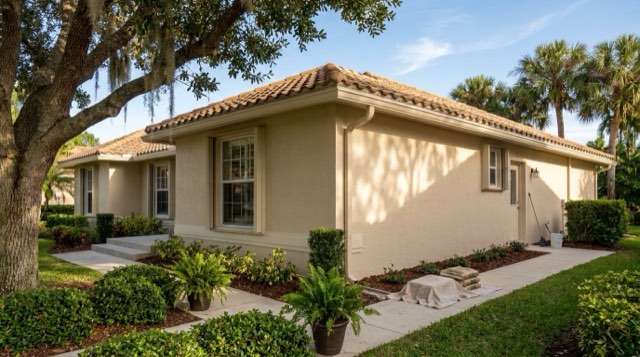 Local guide
Stucco in Port Salerno: A Village Built One Addition at a Time
Port Salerno is not Stuart and it is not Palm City. The houses grew by addition, they carry a full coastal salt load, and the lots are too tight to stage a whole house at once.
Read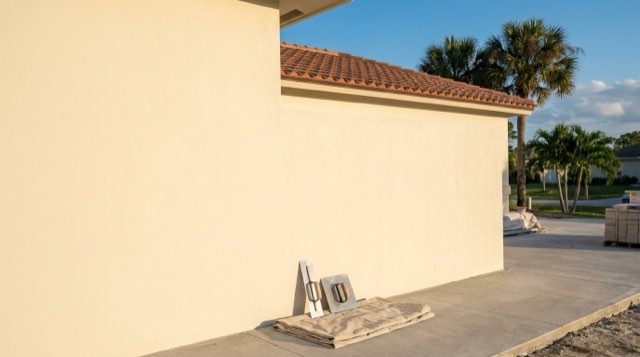 Cost guide
How Much Does Stucco Repair Cost in Port St. Lucie?
Stucco repair is priced off what the wall turns out to be, not off the crack you can see. Here are the ranges homeowners on the Treasure Coast run into and what pushes a job to the top of them.
ReadStraight answer on your wall.
Call, or send the form and we will get you a written price.