Stucco Damage and Insurance Claims: What to Document
We are stucco contractors, not insurance advisers. What we can explain is how a wall gets recorded properly here, because a soaked block wall photographed on the wrong day tells the wrong story to everyone.
What this is, and what it is not
This is a documentation guide. It covers how a damaged stucco wall gets recorded, measured and scoped, because that is our trade and because homeowners from Fort Pierce to Hobe Sound ask us about it constantly.
It is not advice about insurance. We do not know what your policy says, we have not read it, and we are not licensed to interpret it. Whether something is covered, what your deductible does, how a claim should be filed and what any of it means for you are questions for your carrier, your agent, or a licensed professional such as a public adjuster or an attorney.
Keep those two things apart and you will be fine. A contractor describes the wall. Your carrier and your policy decide everything else.
The record starts in the dry season, not after the storm
Hurricane season runs June through November, so households on the Treasure Coast go through this more than once and usually more than once a decade with real weather behind it. That predictability is worth using.
Some time in the dry months, stand in four fixed spots on your lot and shoot each elevation of the house in full. Pick spots you can find again, a corner of the drive, a gate post, the edge of a patio slab. Save the set with the year in the folder name. It takes fifteen minutes and it is the only document nobody can produce after the fact.
The reason it matters is that most disagreements about a stucco wall are about what was there before. Hairline cracking, an old patch, a stained band under a window, a coating that was already chalking. A dated set of frames from a quiet April settles all of that instantly, and repeating the frames each spring turns it into a record of how your walls have actually changed.
- Four or more fixed viewpoints you can stand on again, marked or described
- Every elevation in full, including the faces with nothing wrong with them
- The year in the folder name, and the files left as the camera wrote them
- A closer pass on anything already cracked, stained or previously repaired
- Sealant joints, outside corners and the base of each wall included
Want a price for your own wall?
Four quick questions and we come back with a written quote. Or call (772) 251-6654 if that is faster.
Request a quote
Four questions, about a minute. We'll call you back.
Note which elevation took the weather, and how you worked it out
Damage from a tropical system lands unevenly. Wind direction turns as a system passes, so one or two faces of a house take the sustained push and the rest come through comparatively untouched. Which faces those are is not fixed. Systems reach the Treasure Coast off the Atlantic and they also cross the peninsula from the other side, and how your lot was platted decides the rest.
The practical consequence for a record is simple. Label by compass direction rather than front and back. A house in Port St. Lucie whose long wall runs east and a house in Palm City turned ninety degrees to it come out of one event with damage in completely different places, and a folder called back of house means nothing to a stranger reading it later.
Write down how you decided, too, in one or two lines on the day. Which way debris fell. Which face had leaf litter plastered flat against it. Which windows were streaked with grit and which screens were pushed in. That reasoning is obvious while you are standing there and completely gone six weeks later, and it is the part nobody thinks to record.
A soaked block wall photographs badly and misleads both ways
This is the local trap, and it catches people every year. Cement plaster on concrete block is a reservoir. It takes on a great deal of water and gives it back slowly, so the morning after a saturating event the walls are dark, cool and blotchy from the ground up.
That surface photographs terribly and the image can be read in two opposite directions. Someone can look at a wet patch and see damage that is not there. Someone else can look at genuine debonded stucco and dismiss it as rain staining. Neither reading is anybody being difficult. It is a photograph of a wet wall doing what wet walls do.
So take two sets of the same frames. The first on the day, from those fixed viewpoints, because it is the record of the condition. The second after the wall has had a dry stretch, from exactly the same spots. In the wet season, when rain lands most afternoons through roughly June to September and the humidity never really breaks, a dry stretch can take several days, and a shaded north elevation under deep eaves is the last thing on the house to clear.
The second set is what shows the finding. An area still dark long after the rest of the house has come back to color is worth investigating. The whole wall being dark on day one is not.
Salt rinses, tarps, and everything else that changes the wall
After a system crosses, walls near the Indian River Lagoon, through Jensen Beach and Sebastian, up around Vero Beach and out on Hutchinson Island carry a salt film for weeks. Rinsing it off with fresh water at low pressure is good maintenance and we recommend it. It is also an act that changes the surface you photographed.
The rule that covers this and everything like it is one line long. Anything you do to the wall gets a frame before, a frame after, and a dated line in the log. Tarping an opening. Boarding a window. Clearing debris leaning on the stucco. Running a fan. A rinse.
None of that is about proving anything. It is about the record staying legible, so that six weeks later nobody has to reconstruct whether a clean wall was clean because it was rinsed or because it was never dirty. Keep receipts for any material you buy for temporary protection, and keep any stucco that comes off the wall in a bag somewhere dry until you are told it is no longer needed.
The written scope, and the moisture readings that belong with it
A number on the back of a card documents nothing. A written scope of work is what lets anyone else understand what is being repaired, and it is a fair thing to ask for before you sign.
It should say where the work is by elevation, how much of it there is in measured quantities, how deep material is coming off, what goes back in what coat sequence, how the texture gets matched, what coating is included and over what area, what access the job needs, and what is excluded. Ask for the photographs to be attached and referenced against line items.
Moisture readings come up because they are measurable. A picture of a dark patch is an opinion about a shadow. Readings taken at marked locations on a stated date are numbers somebody can check and repeat. They have limits on stucco: lath, foil facings and surface salts all skew a pinless scan, so readings work as a comparison across one wall rather than as a verdict.
Timing is the local part again. A reading taken while the whole house is still saturated says very little. Take readings after the wall has dried, and take one somewhere the wall is plainly sound on the same day so the suspect number has something to sit next to. If the repair needs a permit, that question goes to your county building department, St. Lucie, Martin or Indian River depending on the address, rather than to a contractor's opinion.
- Locations by elevation with quantities, not a lump description
- Removal depth and extent, including areas found hollow by sounding
- Coat sequence and named materials for the replacement work
- Texture match approach and how far the blend runs past the patch
- Access, staging and protection listed rather than assumed
- Readings recorded by location and date, with a sound-wall comparison
Keep a plain log, and know where our part ends
The most useful record is the dullest one. A running note with dates. Who came to the property and when. What was inspected. What was said, in plain words. Copies of anything handed to you in writing. Type three lines the same afternoon, because a memory of a conversation four weeks later is worth almost nothing next to a note written on the day.
Note where your local information came from as well. Each county here runs an emergency management office, St. Lucie County, Martin County and Indian River County, and those offices are the local channel for official notices during and after an event. If you relied on one, log which and when.
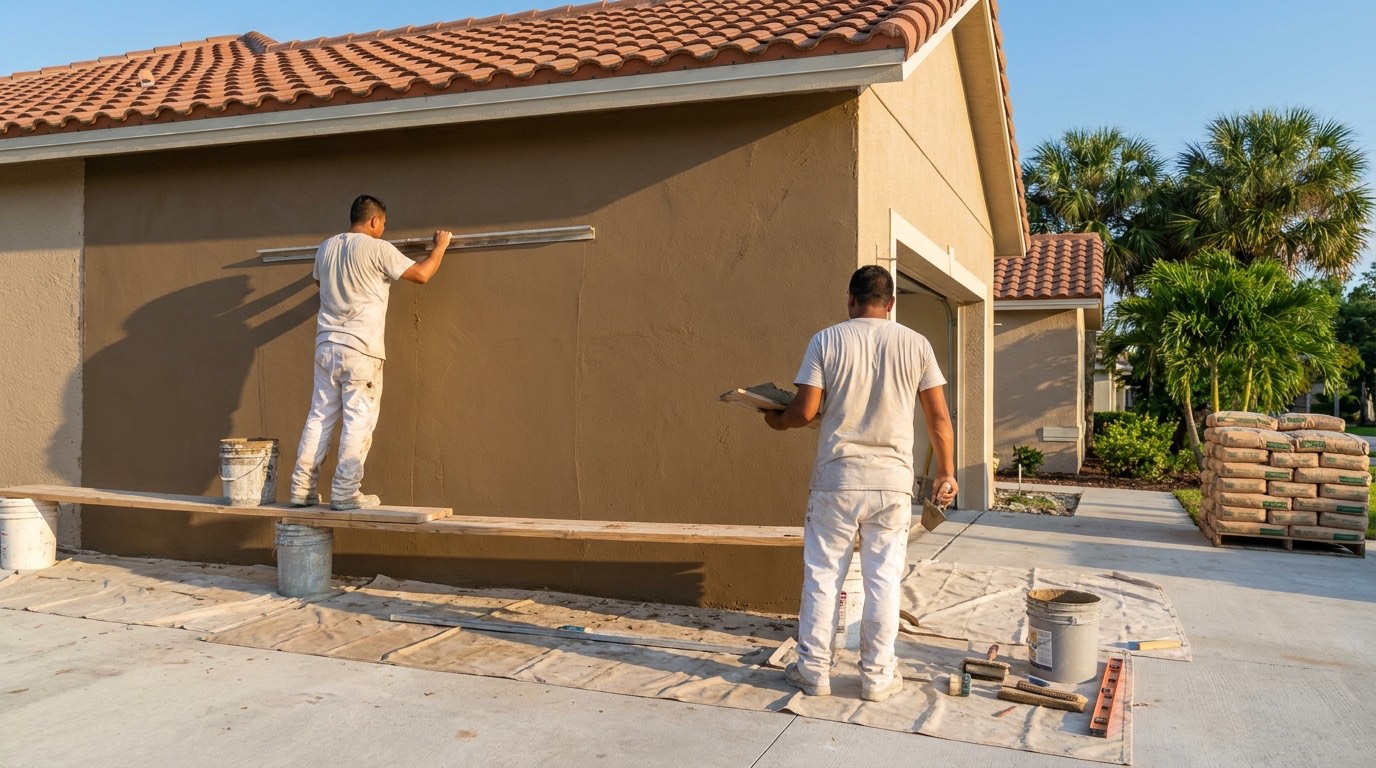
Our own part is narrow and we like it that way. We inspect the wall, sound it, photograph it, measure it, take moisture readings, and write a scope with a price attached. You can hand that to anyone you like.
We do not read policies, advise on coverage, tell you what you are owed, or take part in a dispute over a claim. That is licensing rather than modesty. Insurance is a regulated field in Florida and there are people who do it properly: your agent, your carrier's staff, licensed public adjusters, and attorneys who practice in the area. If a question in this article is not about plaster, they are the ones to ask.
Related questions
What photographs are actually worth taking?
Full elevations from fixed viewpoints you can stand on again, then closer frames placing each damaged area next to a window, door or corner, then tight shots with something in frame for scale. Do the interior staining the same day. The set that earns its keep most often is the one taken in a quiet spring before anything happened.
Should I repair the damage before an adjuster sees it?
That is a question for your carrier and the answer is theirs, not ours. What we can say from the wall side is that stucco has to be dry before permanent repair anyway, so there is rarely a technical reason to rush on the Treasure Coast. Temporary protection to stop further water entry is separate, and worth photographing before and after.
Will you state that the damage was caused by the storm?
We describe what the wall physically shows: fresh fracture faces, debonded areas found by sounding, and moisture readings by location and date. We do not characterise cause for a claim. That determination sits with your carrier and the people they send, and questions about it go to your agent or a licensed public adjuster.
My walls are dark and blotchy since the storm. Is that damage?
Usually not. Block and cement plaster absorb a lot of water and release it unevenly, so patchy darkening for days is normal behavior here rather than a defect. Photograph it anyway, then photograph the same frames after a dry spell. The area still dark once the rest of the house has cleared is the one worth looking into.
Do you provide moisture readings?
Yes, as part of an inspection, recorded by location and date so they still mean something to someone reading them later. We will also say plainly what they cannot show. In the wet season every wall in the county reads damp, so a single number taken the morning after tells you about the weather rather than about your house.
Who do I ask about whether my damage is covered?
Your carrier and the agent who wrote the policy, first. If you want independent help, licensed public adjusters and attorneys practicing in this field are the regulated professionals for it in Florida. We are stucco contractors. We can document and repair the wall, and that is where our part of it ends.
More guides
All guides →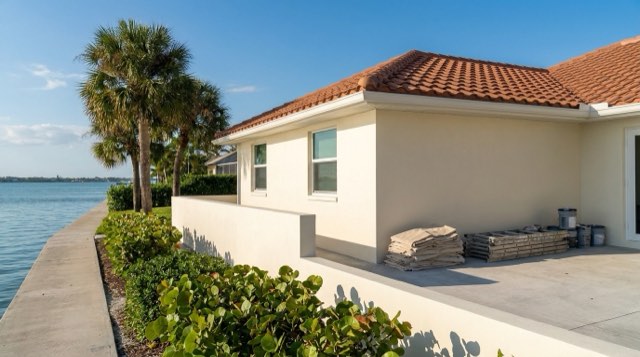 Local guide
Salt Damage to Stucco in Jensen Beach
Jensen Beach has the Atlantic on one side and the Indian River on the other. That geography, not the age of the house, is what decides how long your stucco and sealant last.
Read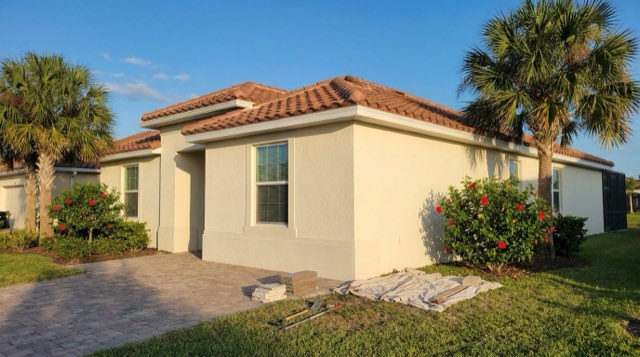 Maintenance
A Realistic Stucco Maintenance Schedule for Florida Homes
Stucco is a low maintenance wall, not a no maintenance wall. Here is the schedule a Port St. Lucie homeowner can actually keep, including the parts where the right answer is to do nothing.
Read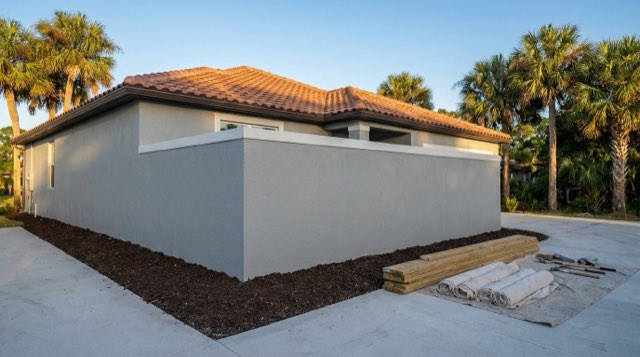 How it works
Block or Frame: Which Stucco Wall Does Your House Have?
Two walls that look identical from the driveway behave nothing alike. How to tell block from frame using the age of your house, the street it sits on and ten minutes with a magnet.
Read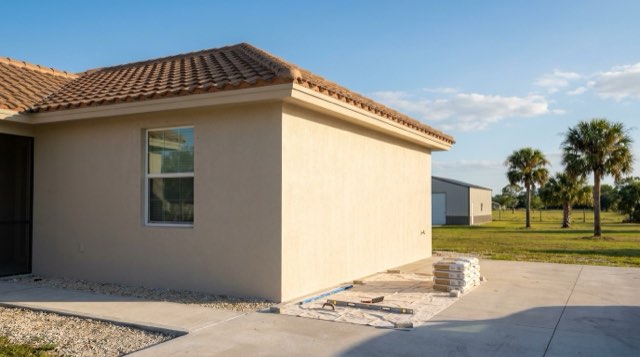 Local guide
Hairline Cracking on Palm City Block Homes
Inland Martin County has no salt problem, so almost everything that goes wrong on a Palm City stucco wall traces back to water and to where it is coming from.
Read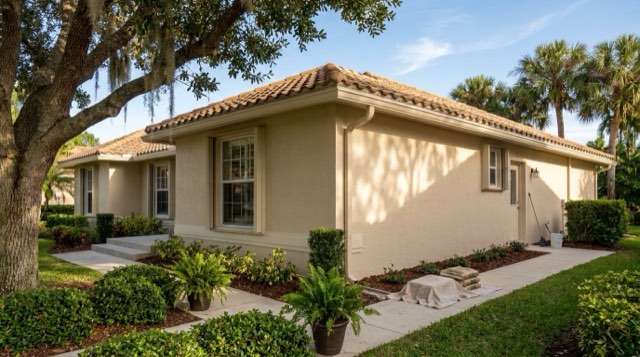 Local guide
Stucco in Port Salerno: A Village Built One Addition at a Time
Port Salerno is not Stuart and it is not Palm City. The houses grew by addition, they carry a full coastal salt load, and the lots are too tight to stage a whole house at once.
ReadStraight answer on your wall.
Call, or send the form and we will get you a written price.