Assessing Stucco Damage After a Storm
The morning after, a soaked wall looks worse than it is. Here is how to work out which elevation actually took the storm, separate fresh impact from cracking that was already there, and document it before anyone starts patching.
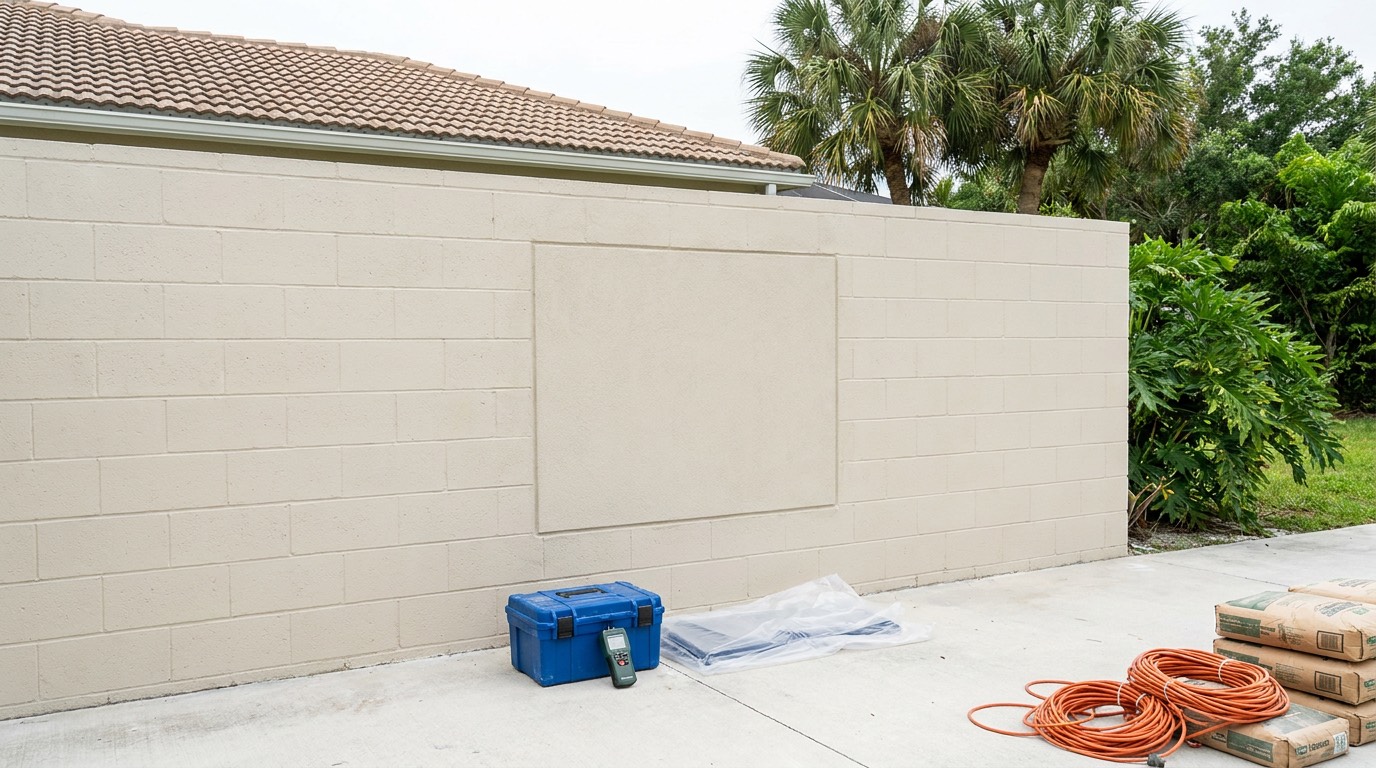
Before you look at the wall at all
Nothing on a stucco wall is urgent enough to justify a ladder on saturated ground the morning after a storm. Downed lines, standing water, loose barrel tile and soft sand under ladder feet cause more injuries in the days after an event than the event itself does on most streets. Sand that held a ladder fine in April will not hold it after a night of heavy rain.
Wait for daylight and dry footing. FEMA coordinates federal disaster assistance and publishes homeowner guidance after declared events, and your county emergency management office is the faster source for what is safe and passable locally. On the Treasure Coast that means St. Lucie County, Martin County or Indian River County depending on where you sit.
Hurricane season runs June through November, so most households here run this routine more than once. The one thing needing attention immediately is an actual opening in the envelope. That is a tarp and a board, not a repair. Permanent work can wait, and waiting usually produces a better repair.
Start with the elevation the storm actually loaded
Damage from a tropical system is almost never spread evenly around a house. Wind direction rotates as a system passes, and one or two elevations take the sustained push while the rest get comparatively little. Work out which before you start walking the property at random.
You can read it off the site. Note which way the debris fell, which side has leaf litter plastered to the wall, which windows are streaked with grit, and which screens are pushed in. Systems reach us from the Atlantic side and also cross the peninsula from the Gulf side, so the loaded elevation changes from storm to storm and differs from your neighbor's if the house is turned another way. A Port St. Lucie house with its long wall facing east and a Palm City house facing north come out of the same event with damage in different places entirely.
That elevation also took wind-driven rain at pressure into every window perimeter, crack and penetration on the face, which is why interior staining after a storm so often shows up on one side of the house and nowhere else.
Then read the breaks themselves. A crack that has been on your house for years does not become storm damage because a storm went past it.
- Work out the loaded elevation first, from debris, streaking and pushed screens
- Fresh: bright broken faces, torn paint film, clean edges, nothing growing inside
- Fresh: matching debris on the ground, or a strike mark on the wall above
- Old: darkened crack lines holding dirt, algae or spider webbing
- Old: rounded, weathered edges, and paint bridging part of the crack
Want a price for your own wall?
Four quick questions and we come back with a written quote. Or call (772) 251-6654 if that is faster.
Request a quote
Four questions, about a minute. We'll call you back.
Sounding the wall tells you the real size of it
Tap along the wall with a knuckle or the plastic handle of a screwdriver. Stucco still bonded to block gives a tight, high, solid note. Stucco that has lost its bond gives a hollow, drummy note that changes the instant you cross the edge of the debonded area.
Work in a grid rather than at random. Tap every eight or ten inches across the elevation and mark the hollow spots with chalk or low tack tape. Step back and the marks usually form a shape with a clear boundary. That shape is the true size of the problem, and it is nearly always larger than the visible damage.
Hollow does not automatically mean storm damage, since delamination develops slowly on some walls for reasons that have nothing to do with weather. What it tells you is that the repair is bigger than filling a chip, because new material cannot bond to stucco that is no longer bonded to the wall.
What is cosmetic and what is not
Plenty of post-storm stucco damage is skin deep. Scuffed paint, a chipped finish coat where a branch hit, a shallow divot from gravel, staining where a gutter overflowed. Those are a fill and coat item on a normal maintenance cycle rather than an emergency.
The line gets crossed when the break goes to full depth. Exposed block or lath, a puncture, a section pushed inward, missing stucco at a corner where the bead now shows, or any opening with a path to the interior. Those change the wall from damaged to open, and open walls get handled first.
A wall covered in small impact marks looks alarming from the driveway and is often nothing more than a resurfacing job later in the year. Work runs year round here, so a cosmetic repair booked for the dry season gets better weather, better prices and a contractor who is not being pulled off your job every afternoon.
- Cosmetic: scuffs, shallow chips, lost paint, staining, marks that stop at the finish coat
- Cosmetic: hairline cracking that was already there and has not changed
- Not cosmetic: full depth breaks showing block, lath or sheathing
- Not cosmetic: anything with a continuous path from outside to inside
Photograph it before anyone touches it
Do this before the first patch, the first pressure wash and before a crew arrives. Once material moves, the record of what the wall looked like is gone.
Shoot in three ranges. Wide, so each elevation is in one frame and the house is identifiable. Medium, so a damaged area sits next to a window or door and anyone can find it again. Close, with a tape or a coin in frame for scale. Label the folders by elevation while you still remember which wall faced the wind. Then repeat inside for staining on ceilings, sills and drywall.
Keep the originals in one folder with the date and do not crop or filter them. If you tarp or board anything, shoot the wall before the covering goes on and again after. If a claim is involved, your carrier sets what it needs and when. We are plasterers rather than adjusters, and coverage questions belong with the people who wrote the policy.
Let the wall dry before you judge it, and before you repair it
A stucco wall after a tropical system is saturated all the way through. It will be dark, blotchy and cool to the touch for days. That is a reservoir cladding doing exactly what it does, not damage.
Drying takes longer here than people assume, and longer still in the wet season when humidity stays high and another band of rain lands most afternoons. A block wall in Port St. Lucie or Fort Pierce that soaked for twelve hours will not give the water back in twenty four, and a shaded north elevation under deep eaves stays dark days after the west wall looks normal.
Judging a soaked wall leads to two mistakes. The smaller one is calling normal saturation a failure. The bigger one is patching over trapped water, because new material bonds poorly to a wet substrate and sealed-in water comes back out as efflorescence, blistered paint or a patch that lets go within a year.
So give it dry weather and airflow, then look again. A band still dark long after the rest of the house has cleared is a genuine finding, and it points at a path still feeding water in. Moisture readings taken a week later say far more than readings taken the morning after, when every wall in the county reads wet.
What actually needs doing this week
Temporary protection is the whole job in week one. Cover openings, keep water out, clear debris leaning against walls, and stop anything getting worse. Permanent repair belongs to a later week when the wall is dry and the schedule is sane.
One job is worth doing early on the coast. A storm drives salt spray a long way inland, and walls along the Indian River Lagoon, through Jensen Beach and out on Hutchinson Island can carry a heavy salt film for weeks afterwards. Once the weather settles, rinse it off with fresh water at low pressure and a wide fan, before it sits on coated stucco and around corner bead.
Be careful who you hire in that first stretch. After a storm crosses the Treasure Coast there are crews working from Fort Pierce to Stuart who were not here the week before. Ask for a Florida license and verify it yourself, get a written scope rather than a number on the back of a card, and do not hand over a large deposit for work that has not started. If the repair needs a permit, that is a question for your county building department.
A stable stucco wall can wait two weeks for the right contractor. It cannot un-hire the wrong one.
- This week: tarp or board any opening, and photograph before and after
- This week: clear debris resting against walls before it stains or abrades them
- This week: rinse salt film off coastal walls at low pressure once conditions settle
- This week: note interior stains and where they sit relative to outside damage
- Later: sounding, full assessment and a written scope once the wall is dry
- Later: permanent patching, texture matching and coating
Related questions
How can I tell whether a crack is new?
Look inside it. A fresh break has clean bright faces, torn paint at the edges and nothing growing in it. An older crack is darkened, holds dirt or algae, and often shows paint bridging from a previous cycle. Finding the damage concentrated on the elevation that took the wind is another strong sign it is recent.
Should I rinse the salt off my walls after a storm?
On the barrier island and near the lagoon, yes, once it is safe to be outside with a hose. Storm spray leaves a salt film well inland of the beach, and salt holds moisture against coated stucco and any exposed metal. Use low pressure and a wide fan, because this is a rinse rather than a wash.
How long should I wait before repairing?
Long enough for the wall to dry, which after a saturating event means several days of dry weather, and longer on a shaded elevation or in the middle of the wet season. Patching a wet wall gives poor adhesion and traps moisture in the assembly. Temporary protection goes on immediately, permanent work waits.
My stucco is dark and blotchy since the storm. Is it damaged?
Probably not. Cement stucco absorbs a great deal of water and gives it back unevenly, so patchy darkening for several days is normal behavior rather than a defect. The area worth investigating is the one that stays dark long after the rest of the house has cleared, because something may still be feeding it.
Someone knocked on my door offering immediate repairs. Should I use them?
Slow down before you commit. Post-storm demand pulls crews in from outside the Treasure Coast, and you have no recourse later if they are gone. Ask for a Florida license and verify it, insist on a written scope, and avoid large upfront deposits. Any reputable contractor expects all three.
Do I need a structural engineer?
For most stucco damage, no. Stucco is a cladding, not structure. An engineer becomes the right call when the damage involves the wall itself rather than the skin on it, such as cracks with vertical offset, a section of block wall out of plane, or damage to a tie beam or lintel.
More guides
All guides → How it works
The Best Time of Year for Stucco Work on the Treasure Coast
There is no freeze shutdown in Florida, so stucco runs all twelve months. What actually moves the calendar here is the afternoon storm pattern, storm season staging, and how fast a wall can take its next coat.
Read Diagnosis
Inspecting Commercial EIFS: Drainage vs Barrier Systems
EIFS is uncommon on Treasure Coast block construction, so finding it on your building tells you something before the inspection even starts. Here is how a manager or board works out which assembly they have, and what that changes.
Read Maintenance
Building a Facade Maintenance Plan for Commercial Stucco
Facade spending is either a planned line item or an emergency. On the Treasure Coast two calendars decide which one it becomes: the storm season and the occupancy year.
Read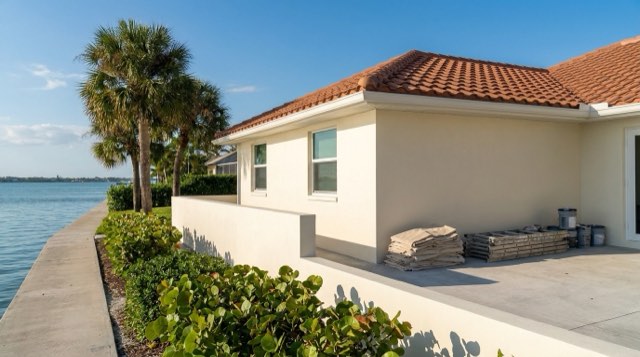 How it works
Assessing Stucco on a Coastal Condo Building
An island tower and a three story garden building both get called a condo, and they need different surveys. How exposure, access and the season decide what a board can actually learn.
Read How it works
DIY Stucco Repair: What Is Reasonable and What Is Not
Some stucco jobs are genuinely worth doing yourself, and paying somebody to do them is a waste of money. Here is that list, how to do it properly in this climate, and where the line sits.
ReadStraight answer on your wall.
Call, or send the form and we will get you a written price.