Building a Facade Maintenance Plan for Commercial Stucco
Facade spending is either a planned line item or an emergency. On the Treasure Coast two calendars decide which one it becomes: the storm season and the occupancy year.
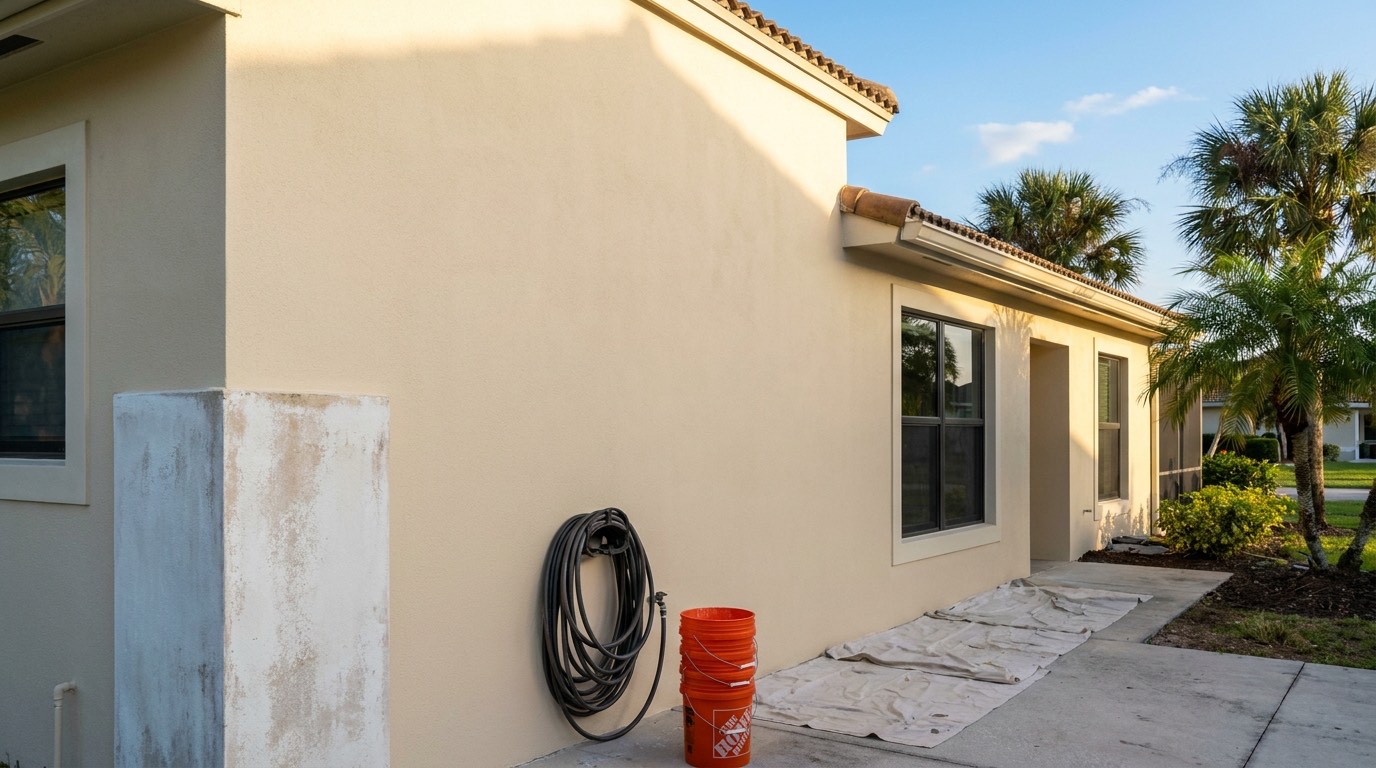
Two calendars decide this plan, and neither is the fiscal year
Buildings do not get expensive because stucco is fragile. They get expensive because facade work is treated as an event. Nothing happens for twelve years, a tenant reports water in a suite, and now there is an unbudgeted repair and an assessment to explain.
A plan turns that into an annual line. What most templates get wrong down here is the timing, because a Treasure Coast building runs on two calendars that have nothing to do with the accounting year. Hurricane season runs June through November and it sets when you look at the building. The occupancy year, which for a lot of property in Port St. Lucie, Stuart and Vero Beach is heavy in winter and light in summer, sets when you are allowed to make noise on it.
Get those two right and the rest is arithmetic. The document itself is three pages. What gets looked at and when, what gets replaced on a cycle, what it costs per year, and where the records live.
Two walks a year, bracketed around the season
One annual inspection is the usual advice. On this coast, two is better, and the dates pick themselves. Walk the building in spring before June, and walk it again once the season is over in late autumn. Same route, same order, same photo positions both times.
The two answer different questions. The spring walk is the one with money behind it, because anything found in March or April can still be cut out, replaced and cured under settled weather before the wet months arrive. The autumn walk is a condition check. It tells you what six months of driven rain, heat and afternoon storms did, while the evidence is still on the wall.
Add a walk after any significant storm, and do it while the building is still wet if it is safe to be outside. Water finds joints that have quietly failed, and the trail shows for a day or two before the wall dries and hides it again. That is the one inspection genuinely better done in bad conditions.
Photograph the same views every time from the same positions. Six years of dated frames from one vantage point show drift no single walk ever catches.
- Sealant at openings, control joints and every material junction
- Cracking, with new lines marked and known ones checked for growth
- Hollow-sounding areas, coating condition, chalking, fade and blistering
- Staining patterns, a drainage story before they are a cleaning one
- Roof to wall junctions, parapets, copings, scuppers, downspout discharge
- Base of wall, grade, mulch, irrigation spray, anything stacked against it
- Penetrations, signage anchors, light fixtures, conduit, shutter hardware
Want a price for your own wall?
Four quick questions and we come back with a written quote. Or call (772) 251-6654 if that is faster.
Request a quote
Four questions, about a minute. We'll call you back.
Rank the elevations by exposure before you budget anything
The most common budgeting mistake here is treating a building as one surface. It is four or more surfaces on different clocks, and the gap between them is wide enough to change the plan.
Salt is the first sorter. A building on Hutchinson Island, along the Indian River Lagoon, or near the water in Fort Pierce, Jensen Beach or Sebastian takes airborne chloride continuously, and the faces pointed at the water take most of it. Salt film holds moisture against a surface, so those elevations spend more hours wet than any data sheet assumed, and sealant, exposed fasteners and metal trim age visibly faster there. A comparable building inland at Tradition or St. Lucie West sees far less, and one out toward Okeechobee effectively none.
Sun is the second sorter, and it does not care how far you sit from the water. South and west faces take the ultraviolet load on any building in St. Lucie County, so they chalk and fade first even where salt is not a factor.
Write the ranking down once and let it drive the money. On a coastal property that usually means the water-facing faces get the work and the sheltered ones get a monitoring date. Inland it usually means south and west lead. Either way, a plan that funds all four faces equally is overspending on one and underspending on another.
Sealant has the shortest clock, and exposure sets it
Everything else on a stucco facade outlives the sealant. Joints keep water out of the assembly at every opening and transition, and they are elastic material sitting in Florida ultraviolet, moving with the building, and on the coast, sitting under a salt film that keeps them damp.
Schedule replacement as a cycle rather than a reaction. By the time a joint has visibly split, water has been getting behind it for a while. Use the manufacturer's published service life as the starting number, then shorten it for the exposed elevations you just ranked and let the sheltered ones run longer.
Replacement is a real scope and not a re-caulk. Old material out completely, joint cleaned and primed where the sealant maker calls for it, backer rod setting the depth, new bead tooled to the correct depth-to-width geometry so it can stretch. Cycling by elevation across several years usually beats doing the whole building at once, and it fits the exposure ranking exactly.
- Full removal of existing material, never an overlay
- Joint cleaned to sound substrate and primed per the manufacturer
- Backer rod sized to set the correct joint depth
- Bead tooled to the specified depth-to-width ratio
- Product, color and installation date recorded per elevation
- Exposed faces scheduled ahead of sheltered ones, not alongside them
Coating and repair timing in a wet-season climate
Exterior coating does two jobs. It is the look of the building and it is part of the water management. When it goes, both go, and the second one is the expensive half.
The signals arrive well before failure. Chalking, where a hand run down the wall comes back with pigment. Fade worse on the south and west faces. Loss of sheen and lifting at edges. Catch it there and a recoat is a wash, a prep and a coating. Miss it and the wall starts drinking. Two rules hold on block: never coat a wall that is wet, and do not keep stacking layers, because a wall carrying many old coats cannot dry outward and eventually the whole stack has to come off.
Between recoats there is a trickle of small work, and this is where a plan earns its keep. Routing a crack while it is still a crack costs very little. Leaving it until water has run behind the wall through three wet seasons turns it into a patch, a texture match and a coating repair on that whole elevation. Not everything needs fixing, though. Fine hairline and map cracking is normal shrinkage and can honestly be monitored.
Book coating for the drier stretch of the year if the schedule allows. There is no winter shutdown here, but afternoon storms from roughly June to September cost hours off a coating day and stretch the recoat window.
- Fix now: anything loose, anything letting water in, anything over a walkway
- Fix at next cycle: cosmetic damage and small isolated patches
- Monitor: stable hairline cracking, no staining, no hollow sound
- Investigate: hollow areas, unexplained staining, anything changed since last year
Book the disruptive work when the building can take it
The cheapest month to do the work is rarely the cheapest month to disrupt the people in the building, and a plan that ignores that generates complaints instead of savings.
Read your own occupancy curve first. Seasonal residential and hospitality property along this coast is fullest through the winter and quietest through the summer. Medical, professional and retail tenancies run flatter but have their own bad weeks. A plaza in St. Lucie West with a tax practice in it has a season too, and it is not the same season as a beachfront building in Jensen Beach.
Then match the work type to the window. Chipping out failed stucco is the loudest thing that will happen and there is no quiet way to do it, so put demolition into the emptiest stretch you have. Coating and finishing are comparatively quiet and tolerate a busier building. Inspection is invisible and can happen any time.
That cuts against the weather in the obvious way. Decide the trade on purpose rather than taking whatever start date a contractor has open. Many owners here run noisy repair through the quiet months and hold the coating until the wet season eases.
Fund it by cycle, and leave a file the next manager can use
Facade costs are lumpy, which is why budgets built one year at a time hit a cliff. Inspection is small and annual. Crack and patch work is small and irregular. Sealant is moderate and periodic. Recoating is large and rare. Re-stuccoing an elevation is larger and rarer still.
Build it the other way round. Take the expected cycle length for each component, take a cost range for that scope on your building, divide by the years in the cycle, and fund that every year. Keep the units separate while you do it. Inspection is a fixed fee, sealant is priced per lineal foot of joint, coating per square foot of wall, patching per square foot at many times the coating rate. Blending them into one rate hides the line that is actually moving, and only a measured takeoff produces a real number.
Then protect the knowledge, because it walks out the door as managers change accounts, boards turn over and buildings sell. One file, organized by building and elevation. Product data, color formulas, dates, quantities, inspection photographs, survey maps, warranties, and a short history of what was done and what was left as monitor. Photograph anything that gets covered up.
One caution. Where an inspection obligation, reserve funding requirement or disclosure duty attaches to your building, confirm the specifics with counsel and with your county building department rather than working from a template.
- Annual inspection, funded every year
- Minor crack and patch work, funded as a running allowance
- Sealant replacement, funded across its cycle by elevation
- Coating recoat, funded across its cycle
- Major repair contingency, sized against your last survey rather than guessed
- Access equipment, a real line on anything above one story
Related questions
Is one inspection a year really not enough on the Treasure Coast?
One is a defensible minimum and two is better here, because the June to November season splits the year cleanly. Spring finds what you can still fix under good curing weather; autumn records what the season did. Add a walk after any significant storm. If a required inspection interval applies to your building, that is a separate legal question for counsel or the county.
How much difference does the coastal location actually make to the budget?
Mostly to the short-cycle items rather than the wall itself. Sealant, exposed metal, fasteners and coating on the water-facing elevations of a Hutchinson Island or lagoon-side building run on a noticeably shorter clock than the same products on an inland building in Tradition. Budget those faces separately instead of averaging them into a building-wide number.
Should we recoat the whole building at once or one elevation at a time?
All at once gives the most consistent appearance and better pricing per square foot, since mobilization and access spread across more area. By elevation spreads the cost and puts money where exposure is worst. If you phase it, hold the exact product, color formula and sheen across every stage, and expect a visible difference at a corner where two faces were coated years apart.
How do we start a plan with no records at all?
Commission a baseline survey. Someone walks and sounds the building, measures wall area per elevation, records sealant joint lengths and documents coating condition. That becomes year zero. Everything after it is a comparison, and two or three seasonal walks later you will have real trend data for setting cycle lengths on your specific building.
When in the year should the actual work happen?
Weather favors the drier months for coating, since afternoon storms from roughly June to September cost hours and stretch recoat windows. Occupancy often favors the opposite. Decide the trade deliberately for your building rather than taking the first available start date, and consider running noisy repair in the quiet season and coating once the wet months ease.
Who should carry out the routine walks?
A trained maintenance staff member or property manager with a fixed checklist catches most of what matters, and consistency counts for more than credentials at that level. Bring in a contractor or consultant for the periodic deeper survey, for anything at height, and any time a walk turns up hollow areas, unexplained staining or growth in existing cracking.
More guides
All guides → How it works
Assessing Stucco on a Coastal Condo Building
An island tower and a three story garden building both get called a condo, and they need different surveys. How exposure, access and the season decide what a board can actually learn.
Read How it works
DIY Stucco Repair: What Is Reasonable and What Is Not
Some stucco jobs are genuinely worth doing yourself, and paying somebody to do them is a waste of money. Here is that list, how to do it properly in this climate, and where the line sits.
Read Diagnosis
That White Chalky Residue on Your Stucco, Explained
White powder on a block wall is usually efflorescence, and it is a moisture symptom rather than a surface problem. Here is how to identify it and read what it is telling you.
Read Cost guide
What Elastomeric Coating Costs on a Florida Block Home
Elastomeric is not paint and it is not priced like paint. Most of the money is in preparation, and on a Port St. Lucie block home that prep is what decides whether the coating lasts.
Read How it works
Running a Community-Wide Stucco Project
Twenty buildings under one contract is a program, not a big repair job. Here is how boards and managers on the Treasure Coast survey, scope, price and document community-wide stucco work.
ReadStraight answer on your wall.
Call, or send the form and we will get you a written price.