DIY Stucco Repair: What Is Reasonable and What Is Not
Some stucco jobs are genuinely worth doing yourself, and paying somebody to do them is a waste of money. Here is that list, how to do it properly in this climate, and where the line sits.
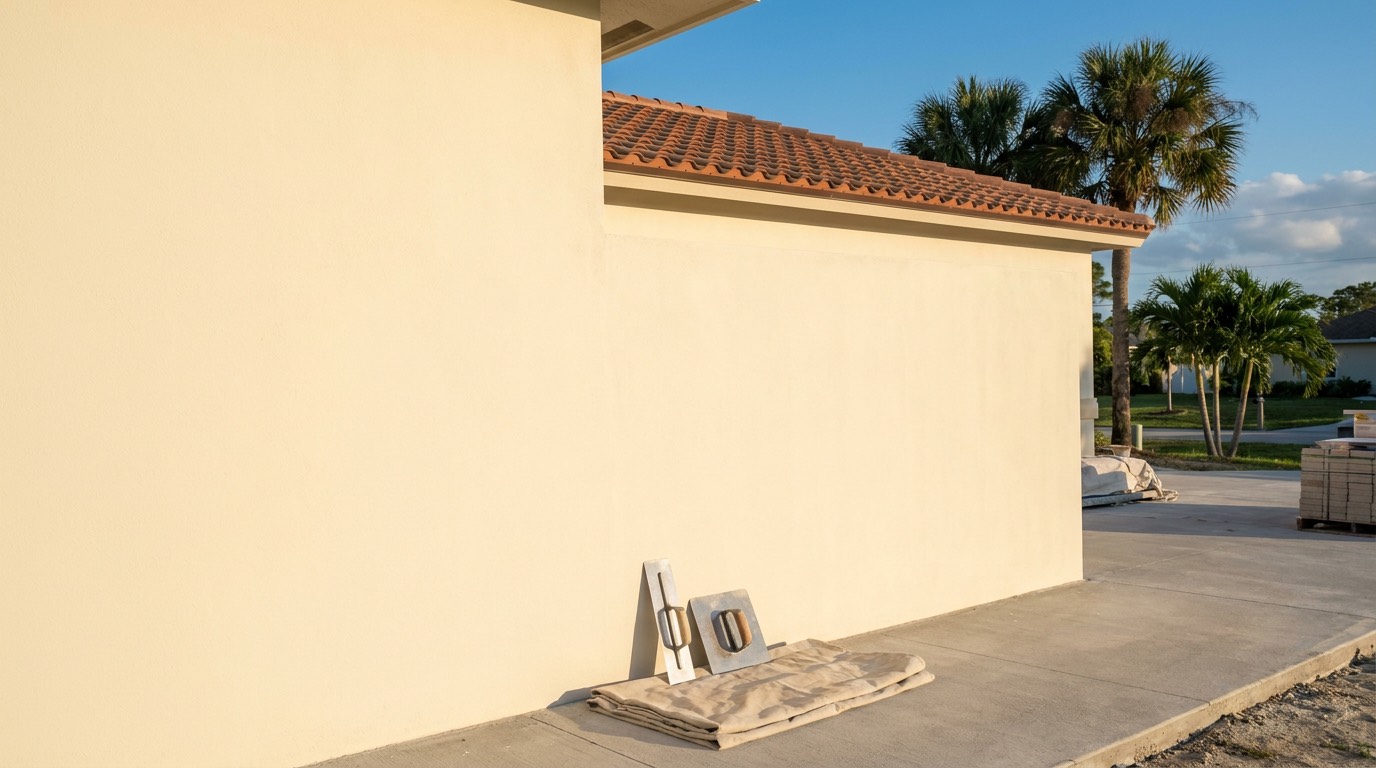
The honest version, from people who sell the alternative
We are a stucco company, so give what follows the scepticism it deserves. It is still true. There is a set of small stucco jobs a homeowner can do properly with hardware store materials and one free morning, and paying a crew to drive out and do them wastes your money.
There is also a set of jobs where somebody starts with a tube of sealant and finishes with a bigger repair than they began with. The line between them has almost nothing to do with skill or nerve. It comes down to three things. Whether the damage is only in the surface, what is behind the wall, and whether you can reach it safely.
Jobs a homeowner can genuinely do
These are surface jobs on a wall that is otherwise sound. None of them need a contractor, and all are worth doing before your next repaint.
The most valuable is the sealant at window and door perimeters. That joint is a leading water entry point on a Florida house, wind-driven rain finds it every wet season, and sealant only lasts a handful of years in this sun. Cut the old bead out, clean the joint, lay a fresh bead of exterior polyurethane.
The housekeeping items barely feel like repairs and they do more for a wall here than most products sold for the purpose. Pull the mulch back off the base of the wall. Turn the sprinkler heads. A head soaking the same three feet of stucco every morning for six years does more damage than any crack on your house, and on well or reclaimed supply it leaves an iron stain that stops washing off.
- Sealing hairline cracks with an elastomeric patching compound before a repaint
- Cutting out and replacing failed sealant at window and door perimeters
- Filling small holes from satellite brackets, old fixtures and screws
- Washing mildew and algae off the wall at low pressure
- Touching up coating where the finish underneath is still intact
- Pulling mulch and soil back to give clearance at the base of the wall
- Redirecting sprinkler heads that hit the stucco every morning
Want a price for your own wall?
Four quick questions and we come back with a written quote. Or call (772) 251-6654 if that is faster.
Request a quote
Four questions, about a minute. We'll call you back.
Start early, because the wall decides your working window
Method matters more than product on jobs this size, and here the first part of the method is what time you start.
A wall in direct sun in June or July gets far hotter than the air does. Fresh patching material on a surface like that loses its water before the cement hydrates, so you get shrinkage cracking inside your own repair and a patch that releases from the edges within a season. The test is your hand. If you cannot hold a palm flat against the wall for a slow count of five, it is too hot to patch.
So the summer working window on a Port St. Lucie house is the morning, and it moves around the house. East and south walls take the sun first, which leaves the west and north elevations comfortable early. Follow the shade and stop when it runs out. From about November through April the window is most of the day, which is why homeowners here do their patching in the cooler months and let it sit before a repaint. No freeze is coming, so the wall will not get worse in the four days you wait for a decent morning.
For the repair itself, do not smear filler across the top of a hairline crack. Open it slightly with the corner of a scraper so material has somewhere to sit, brush the dust out, dampen the surface, and work the compound in with a putty knife rather than laying it on. Build a bigger fill in two thin passes rather than one thick one, so it does not shrink and crack as it dries.
- Work early and follow the shade around the house
- No patching on a wall you cannot keep a flat hand against
- Open the crack slightly instead of filling it flush from the surface
- Brush the dust out, then dampen the substrate before filling
- Watch the radar from June through September and never start with a storm two hours out
Sound the wall, and know what is behind it
Before you buy anything, tap the wall. This is the most useful five minutes available to a homeowner and it costs nothing. Use a knuckle or the plastic handle of a screwdriver, work across the wall in a grid, and listen to the sound rather than feeling the impact. Do it around every crack you meant to fill and carry on two or three feet either side.
What a hollow note means depends on what your house is made of, and here that splits cleanly. Most houses in Tradition, St. Lucie West and the newer parts of Port St. Lucie are concrete block with plaster applied straight to it, and on those walls the sound is the whole story. Bonded stucco rings tight and bright, debonded stucco gives a dull flat thud, and the note changes the instant you cross the edge of it. If everything rings solid, your repair is a surface repair and it is yours to do.
Older stock in Fort Pierce and Stuart, and the framed gable ends on plenty of newer houses, is stucco over wire lath with a cavity behind it. Those walls read slightly hollow everywhere, so you are comparing one area against the rest of the same wall rather than hollow against solid.
That distinction changes the repair, not just the diagnosis. A chip in stucco over block is shallow, and once you clean it out you are looking at gray block and filling a dish. If you open a hole and find wire mesh, felt paper or wood behind it, you are through the cladding on a framed wall and this is no longer a homeowner job. Stop there, because what comes next is lath work and it wants closing up properly before the next rain.
Texture matching, where most DIY repairs come undone
The structural part of a small patch is easy. Making it vanish is not, and that is the honest reason most homeowner repairs look like homeowner repairs.
Walls here carry knockdown, lace, sand and dash finishes, weathered by hard sun and, closer to the water, by salt film. So matching means matching three things at once. The pattern, the coarseness of the sand, and the age of the surface. Aerosol texture can work on a small patch in a coarse finish if you practice on cardboard and knock it down at the right moment. On a fine or smooth finish it reads as a blob from the driveway.
Two things make a homeowner match far more likely to pass. Keep the patch small, and coat the whole wall afterwards rather than spot painting, because a color edge shows from the street long before a texture edge does. One local caution on that. If your community sits under architectural control, and many in Tradition and St. Lucie West do, repainting an elevation usually needs approval even when the repair itself does not. Your association is the only authority on that, so ask before you open a gallon of anything new.
Hollow areas, and anything with water behind it
Two categories are not DIY at any skill level, and neither is a judgment call.
The first is delamination. If the wall sounds hollow against its neighbors, the plaster has released from the block or the lath, and no product sold anywhere reattaches it. It has to be cut back to sound material and rebuilt in coats. Patching over it hides the failure and borrows time you pay back with interest.
The second is anything with a water source or corroding metal behind it. Orange bleed out of a crack means steel inside the wall is rusting and swelling, and rust takes several times the volume of the metal it came from, so it pushes your patch straight back off. That gets more common the closer you are to the water, and houses in Jensen Beach, Port Salerno and along the Indian River Lagoon sit in salt air year round. Same answer for a bulge you can feel with a flat palm, blistering paint, damp drywall inside that wall, or a musty smell in a closet on an exterior wall.
This is not a scare list. Most walls we look at have none of it, and plenty of homeowners get told their crack needs nothing more than sealing at the next repaint.
- Hollow sound anywhere near the area you meant to patch
- Orange or brown staining bleeding out of a crack
- A ridge or bulge you can feel with a flat hand
- Paint blistering or lifting away in sheets
- Damp drywall, staining or a musty smell inside the same wall
- Cracks returning in the same line after you already repaired them
Height, and the honest money argument
The last limit has nothing to do with stucco. It is the ladder.
Work you can reach from the ground, or from a step ladder set square on level footing, is reasonable. Gable ends, second stories, anything above a pool cage and anything that has you leaning sideways off an extension ladder with a bucket in one hand is not. That rules out more of a Treasure Coast house than people expect, because the framed gable end is exactly the part that cracks and exactly the part you cannot reach. Screen enclosures make it worse, since the wall above a cage has nowhere to put a ladder foot.
The money argument cuts both ways. Paying a crew with a service minimum to seal one hairline crack you could have sealed yourself is poor value, and any honest contractor will say so on the phone. Spending three weekends on a patch that has to be ground off and redone is worse. When you cannot tell which you have, sound the wall, take a photo in good morning light, and ask.
- Reachable from the ground or a stable step ladder: reasonable
- Gable ends, second stories, or anything above hardscape: not
- Any wall above a pool cage or screen enclosure: not
- Anything that needs scaffolding or a lift: not
- Any wall where the ladder cannot sit level and square: not
Related questions
What should I use to fill a hairline crack?
An elastomeric patching compound or a textured masonry sealant made for stucco. Both stay flexible, which matters because a wall here moves daily with the swing between a sunlit afternoon and a storm that cools it in ten minutes. Avoid rigid fillers and general purpose spackle, since they crack again along the same line within a season.
Can I patch the hole where a satellite dish was mounted?
Yes, that is a good homeowner job. Pull the anchors, clean out each hole, dampen it, fill in two thin passes, then texture and coat. The fastener holes matter as much as the bracket footprint, because they run straight through the plaster and give wind-driven rain a direct path.
Can I match a knockdown texture with a spray can?
Sometimes, on a small patch in a coarse finish. Practice on cardboard until the spatter size matches your wall, hold the same distance, then knock it flat with a clean trowel once it loses its shine. Expect to sand it off and repeat at least once.
Do I need HOA approval to patch and touch up my stucco?
For a small repair in the existing color and texture, usually not. For repainting an elevation or changing color in a community under architectural control, which covers a lot of Tradition and St. Lucie West, approval is commonly required. Only your own documents settle it, so ask the association before you buy paint.
I filled a crack and it came back within a year. What went wrong?
Usually one of three things. The filler was rigid and the wall kept moving, the crack sat over a hollow area that needed removal, or something is still driving it such as water entry or corroding metal. Repeat cracking along one line means stop filling and find the cause.
How do I know when to stop and call somebody?
Four triggers, and any one of them is enough: hollow sound, rust staining or a bulge, moisture inside that same wall, or a repair that needs more than a step ladder to reach. Short of those, small surface work on a sound wall is fair game. Do it yourself and spend the money you saved on the sealant joints instead.
More guides
All guides → Diagnosis
That White Chalky Residue on Your Stucco, Explained
White powder on a block wall is usually efflorescence, and it is a moisture symptom rather than a surface problem. Here is how to identify it and read what it is telling you.
Read Cost guide
What Elastomeric Coating Costs on a Florida Block Home
Elastomeric is not paint and it is not priced like paint. Most of the money is in preparation, and on a Port St. Lucie block home that prep is what decides whether the coating lasts.
Read How it works
Running a Community-Wide Stucco Project
Twenty buildings under one contract is a program, not a big repair job. Here is how boards and managers on the Treasure Coast survey, scope, price and document community-wide stucco work.
ReadHow it worksGetting HOA Approval for Stucco Work in Tradition and St. Lucie West
Most master planned communities on the Treasure Coast run exterior work through an architectural review process. Here is how that generally works, what a submittal usually contains, and why you check with your own association before anyone mixes material.
Read How it works
How Long Stucco Takes to Cure in Florida Humidity
Cement stucco does not dry, it cures. Here is what happens coat by coat, why Florida humidity helps the chemistry and hurts the schedule, and why coating a wall early is the most expensive week you can save.
ReadStraight answer on your wall.
Call, or send the form and we will get you a written price.