What Elastomeric Coating Costs on a Florida Block Home
Elastomeric is not paint and it is not priced like paint. Most of the money is in preparation, and on a Port St. Lucie block home that prep is what decides whether the coating lasts.
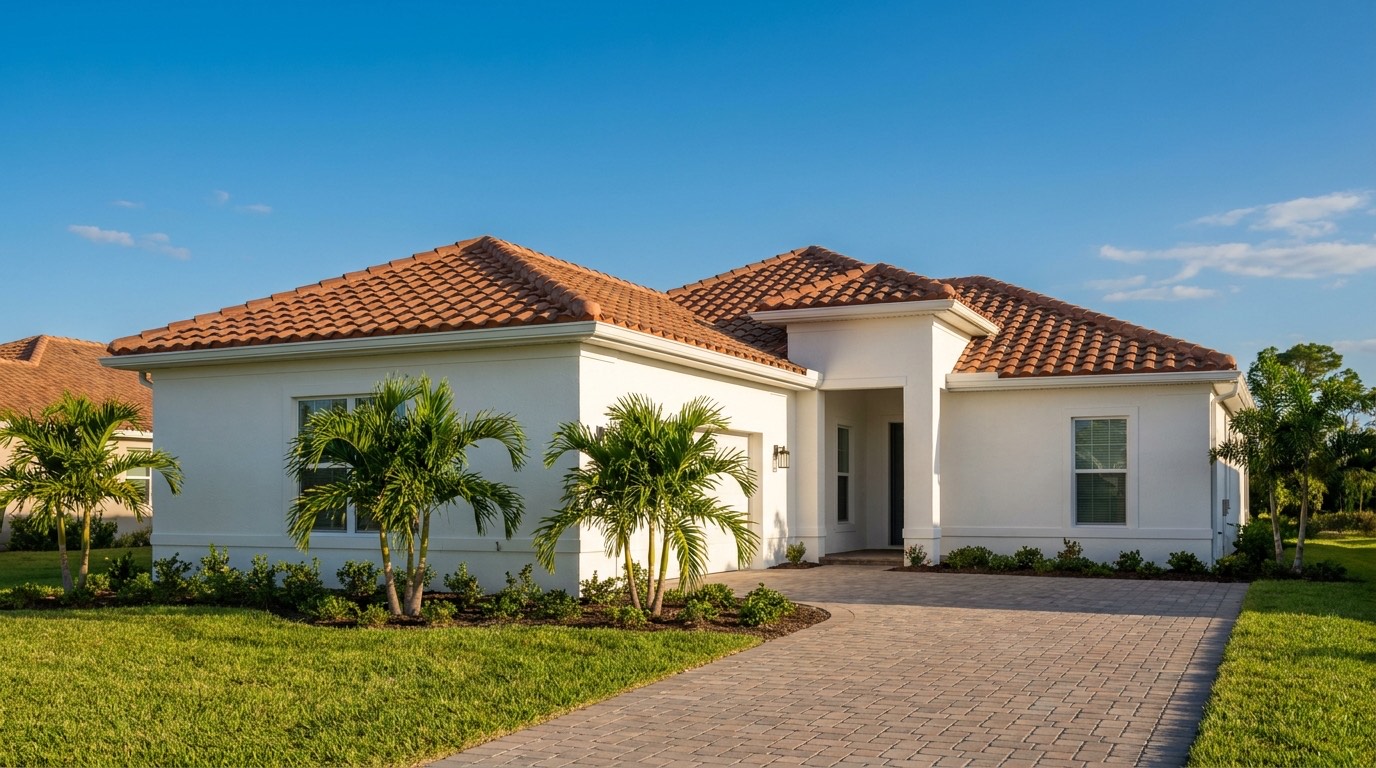
What elastomeric actually is
Elastomeric is a thick, flexible, water resistant coating built for masonry. Applied correctly it goes on far heavier than house paint and cures into a continuous membrane that stretches across hairline movement instead of splitting over it.
That stretch is the whole point on a Florida block home. Block and cement stucco crack. They crack from shrinkage, thermal movement, settlement and stress at window and door corners. Every one of those cracks is a path for wind driven rain, which is exactly what hurricane season delivers to the Treasure Coast.
A regular paint film is thin. It bridges nothing. It follows the wall into the crack and splits along it. Elastomeric answers that specific problem on that specific type of house, which is why it is so common from Fort Pierce down to Hobe Sound.
It is not paint, and it is not priced like paint
The most common shock on an elastomeric quote is the comparison to a standard repaint. Coating a block house typically runs around one and a half to two and a half times a conventional exterior repaint of the same house, and there are real reasons for that.
The material is thicker, covers far less area per gallon, and usually goes on in two coats to reach the film thickness it needs. Product data sheets specify a dry film thickness and hitting it is not optional. A thin elastomeric coat is just expensive paint that has lost the one property you paid for.
It also takes longer to apply, needs spray and back roll technique to work it into the texture, and demands more preparation than a repaint. A quote that prices coating like paint has not planned to apply it properly.
- Higher film build, meaning far fewer square feet covered per gallon
- Usually two coats to reach specified thickness
- Spray and back roll application into the wall texture
- Longer cure and recoat windows, especially in summer humidity
Want a price for your own wall?
Four quick questions and we come back with a written quote. Or call (772) 251-6654 if that is faster.
Request a quote
Four questions, about a minute. We'll call you back.
The ranges on a Treasure Coast block home
Elastomeric is priced by wall area, not by the floor area of the house. Get your own rough number first. Walk the perimeter, multiply by wall height, and take off fifteen to twenty percent for windows, doors and the garage. A typical single story block home here lands between 1,600 and 2,400 square feet of wall.
With that number in hand, the market ranges below become usable. Treat them as a frame for a budget and for reading quotes, not as a price for your house.
The spread is almost entirely preparation. Two identical houses in the same St. Lucie West cul de sac can sit at opposite ends of that range, because one has clean sound walls and the other has cracking, chalking and a failing previous coating that has to come off.
- Straightforward single story block home, clean walls, commonly $2.00 to $3.50 per square foot of wall
- Significant crack routing, patching and surface repair, commonly $3.50 to $6.00 per square foot
- Two story or heavy access requirements, add for staging, scaffold or lift
- Removing a failed prior coating, priced separately and it is not a small line
- A common single story block house often lands in the $4,000 to $9,000 total range once wall area and prep are combined
Prep is most of the money
This is where a cheap bid is usually cheap. Elastomeric bonds to what is under it. If what is under it is chalk, dirt, salt residue, mildew or a coating that has already lost its grip, the new membrane fails at that layer no matter how good the product is.
Real preparation means pressure washing off chalking and biological growth, letting the wall dry, routing and sealing moving cracks rather than smearing coating across them, patching spalled areas, priming bare or porous stucco, and masking windows, tile roof edges, soffits, pool cages and landscaping.
Homes near the coast and the Indian River Lagoon also carry salt deposits on the walls, which is a bonding problem specific to this part of Florida. Washing that off is not padding the invoice. It is the difference between a coating that holds and one that peels in sheets.
- Pressure wash and full dry time before anything is applied
- Route, seal and treat moving cracks individually
- Patch spalled, hollow and previously repaired areas
- Prime bare, patched or highly porous surfaces
- Remove any prior coating that is already failing
- Mask barrel tile edges, soffits, windows, screen enclosures and landscaping
- Wash off salt deposits on homes near the coast and the lagoon
When elastomeric is the wrong answer
Coating is not a repair and it is not a waterproofing system on its own. There are situations where spending money on elastomeric makes things worse, and a good contractor will say so before selling it.
If a wall is hollow or delaminated, coating seals the failure in and hides it. If water is entering at a window flashing or a roof to wall junction, coating the wall field does not touch the actual leak. If moisture is moving through the wall from inside, a heavy exterior coating can trap it and push the failure somewhere else.
So sound the walls before you coat them. Tap across each elevation and listen for the change from a solid ring to a dull thud. Anything that thuds gets repaired first.
- Hollow or delaminated stucco, repair before coating
- Active leaks at flashings, penetrations or roof to wall junctions
- Rust staining and spalling, the steel has to be treated first
- Walls that are still wet, coating traps the moisture
- A previous coating that is peeling, it has to come off first
Color, sheen and HOA approval
Color has a practical dimension here beyond taste. Deep saturated colors absorb more heat, and heat drives more thermal movement in the wall behind the coating. Lighter colors are the norm across most Treasure Coast neighborhoods for reasons that are partly aesthetic and partly physics.
Sheen matters too. Flat and low sheen finishes hide wall imperfections and texture variation, and stucco walls have plenty of both. Higher sheen picks up every trowel line and every patch under afternoon sun.
If you are in a community such as Tradition or St. Lucie West, or any neighborhood with an active association, exterior color usually goes through architectural review. Submit before you buy material and before you schedule the crew. Approval timelines are set by your association, not your contractor, and repainting a whole house in an approved color afterward is the most expensive avoidable mistake in this work.
What to get in writing before you sign
Elastomeric quotes are easy to compare once you know what to ask for, because most of the variation sits in prep and film thickness rather than in the product.
Get the scope written down. Measured wall area, number of coats, target film thickness, exactly what preparation is included, how cracks are treated, and what happens if hollow areas turn up during washing. A quote that specifies those things is comparable to another that specifies them. A one line quote is not comparable to anything.
Then get the site visit. Every range here is a market frame for Florida block homes. Your number depends on your wall area, your access and what is found once the walls are washed, and nobody can produce it honestly from a phone call.
- Measured wall area and how it was calculated
- Number of coats and the target dry film thickness
- Written preparation scope, washing, cracks, patching and priming
- Whether a prior coating is being removed and how that is priced
- Access plan, ladders, staging or lift
- Protection and cleanup, including pool cage, tile roof edges and plantings
- What happens to the price if hollow areas turn up during prep
Related questions
How long does elastomeric coating last on a Florida block home?
Applied at the correct thickness over properly prepared walls, it generally outlasts a conventional exterior repaint by a wide margin. What shortens it is thin application, poor preparation, and coating over a wall with unresolved problems. Homes near the coast and the Indian River Lagoon face harsher salt and sun exposure and usually need attention sooner than inland homes.
Will elastomeric coating stop my stucco from cracking?
It bridges hairline cracks and hides fine map cracking well. It will not stop a structural or stress crack that is actively moving, and it will eventually split over one. Those cracks need to be routed and treated individually before the coating goes on, which is why crack work is a separate line on a good estimate.
Can elastomeric be applied over existing paint?
Only if that paint is sound and well bonded. Chalking, peeling or blistering paint has to be removed, because the new coating is only as strong as the layer it sits on. A contractor should test adhesion in several places on each elevation before deciding, and that test result should be reflected in the quote.
Is elastomeric worth the extra cost over regular exterior paint?
On a crack prone block or stucco wall in a wind driven rain climate, most homeowners here find it is. On a wall in excellent condition with no cracking history, a quality exterior masonry paint may be adequate for less. It depends on the condition of your specific walls, which is a site visit question.
What time of year is best for coating in Port St. Lucie?
There is no closed season on the Treasure Coast, which is a genuine advantage. Winter and spring generally give lower humidity and more reliable dry and recoat windows. Summer work is routine but afternoon storms and high humidity extend drying time between coats, so expect weather days in the schedule.
How long does the job take on an average house?
A single story block home with clean walls is commonly a few days, including washing, dry time, prep and two coats. Heavy crack work, patching, removing a failed prior coating, or a two story elevation needing staging can push it past a week. Most of that time is preparation and drying rather than application.
More guides
All guides → How it works
Running a Community-Wide Stucco Project
Twenty buildings under one contract is a program, not a big repair job. Here is how boards and managers on the Treasure Coast survey, scope, price and document community-wide stucco work.
ReadHow it worksGetting HOA Approval for Stucco Work in Tradition and St. Lucie West
Most master planned communities on the Treasure Coast run exterior work through an architectural review process. Here is how that generally works, what a submittal usually contains, and why you check with your own association before anyone mixes material.
Read How it works
How Long Stucco Takes to Cure in Florida Humidity
Cement stucco does not dry, it cures. Here is what happens coat by coat, why Florida humidity helps the chemistry and hurts the schedule, and why coating a wall early is the most expensive week you can save.
Read Hiring
How to Hire a Stucco Contractor in Florida
Most of what protects you on a stucco job happens before anyone touches your wall. Here is how to verify a license and insurance yourself, read a scope, and check references that actually apply to your house.
Read Storm season
A Pre-Season Stucco Checklist for Treasure Coast Homeowners
Forty minutes in April is worth more than a week of worry in September. Here is what to look at on a Treasure Coast stucco wall before hurricane season starts, and what you can honestly leave alone.
ReadStraight answer on your wall.
Call, or send the form and we will get you a written price.