That White Chalky Residue on Your Stucco, Explained
White powder on a block wall is usually efflorescence, and it is a moisture symptom rather than a surface problem. Here is how to identify it and read what it is telling you.
What the white stuff actually is
Efflorescence is salt. Concrete block, mortar, and stucco all contain soluble mineral salts from the day they are made. When water moves through that masonry it dissolves those salts and carries them along. When the water reaches the surface and evaporates, the salt cannot evaporate with it, so it is left on the face of the wall as a white powder or a light crust.
That means three things are true wherever you see it. There are salts in the material, which is always the case. There is water moving through the wall. And there is a surface where that water is leaving. This is the useful part to understand. Efflorescence did not land on your house and it is not growing on it. It came out of the wall, which is why scrubbing the surface treats the evidence and leaves the mechanism running.
Why block homes on the Treasure Coast produce so much of it
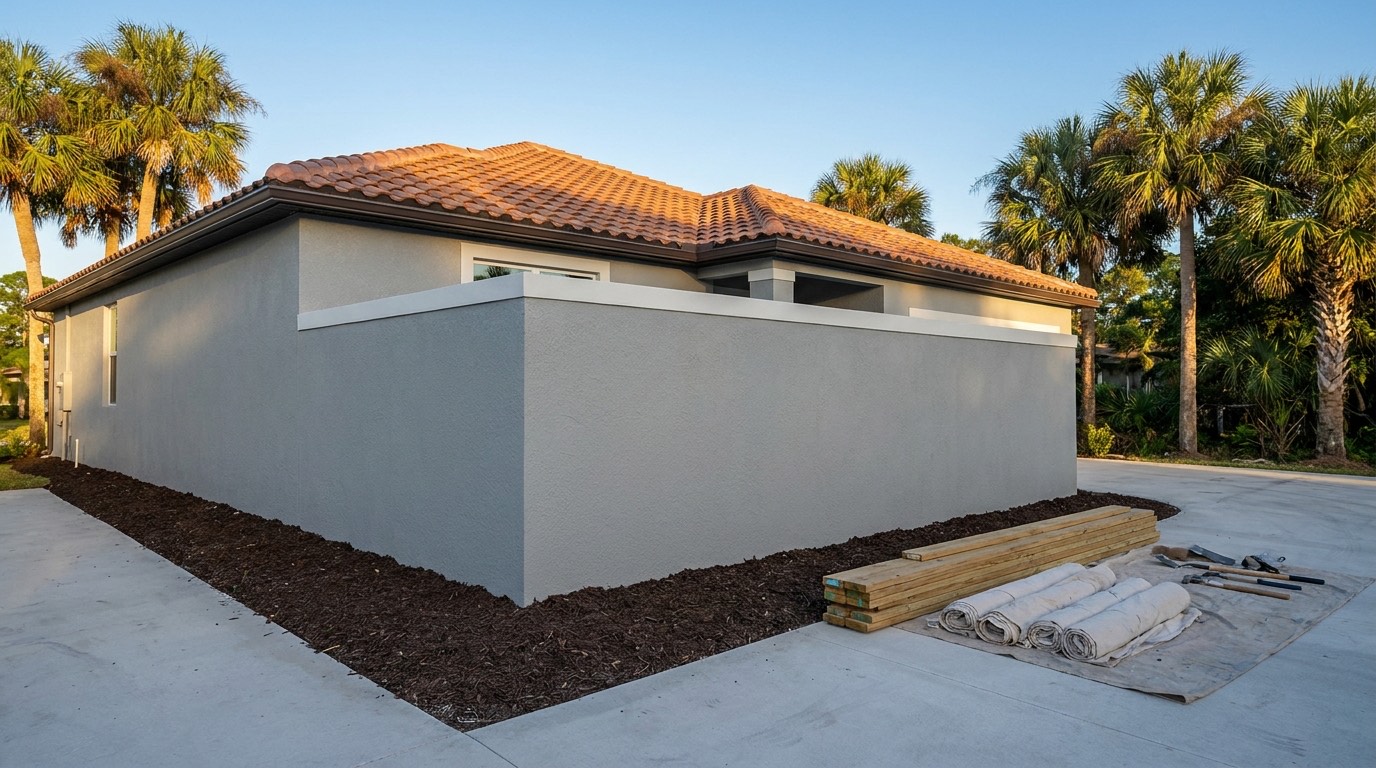
Nearly everything built here in the last few decades is concrete block, and CMU is porous, salt bearing, and full of internal surface area. Stucco is bonded directly to that block on most homes in Port St. Lucie, St. Lucie West, and Tradition, so there is a continuous path from inside the wall to the outside face.
Then add our water. Heavy summer rain, wind driven rain that pushes into joints that would shed a normal shower, high humidity most of the year, sandy soil that stays damp, and irrigation running regardless of what fell out of the sky. A block wall here rarely gets a long dry spell to release what it holds. Closer to the ocean and the Indian River Lagoon, salt spray adds supply from outside too, so homes in Jensen Beach, Hobe Sound, Port Salerno, Vero Beach, and Sebastian tend to show more of it than homes toward Okeechobee.
Want a price for your own wall?
Four quick questions and we come back with a written quote. Or call (772) 251-6654 if that is faster.
Request a quote
Four questions, about a minute. We'll call you back.
Telling efflorescence from the other white things
Several unrelated conditions look the same from ten feet away and call for completely different responses. A few seconds of hands on testing separates them.
Rub the deposit with a dry finger. Fresh efflorescence is a loose powder that comes off easily and feels gritty. Then wet a small area with plain water. Efflorescence dissolves and largely disappears while wet, then often returns as the wall dries, and that reappearance is the confirmation. Chalking paint behaves differently: a fine even powder on your palm, spread across whole sun exposed elevations, which is the coating breaking down under our ultraviolet load rather than anything coming out of the wall. Hard calcium or lime deposits are the third possibility, crusty and stony, and they will not dissolve in plain water.
- Efflorescence: loose or lightly crusted, gritty, dissolves in plain water, returns as the wall dries
- Chalking paint: fine even powder on the palm, across whole sunny elevations, no water source needed
- Calcium or lime deposit: hard, stony, will not dissolve in water, forms along a drip or run path
- Salt spray residue: on the windward face near the water, rinses off with fresh water, returns after windy days
- Mildew: speckled and dark rather than white, and lightens fast under diluted bleach
- Mortar smear from construction: rough and irregular, tied to a joint line, does not spread or return
Where it shows up, and what each spot means
Location is the diagnosis. Efflorescence marks the exit point, so trace back from where it shows and ask what could be delivering water to that part of the wall. The bottom two feet of an exterior wall is the most common spot and usually points at ground water, splash back, irrigation, or grade sloping toward the house.
- Low on the outside wall: grade, splash back, irrigation, or a buried weep screed
- In a band under a window: the sill detail or failed perimeter sealant above it
- Fanning out from one crack: that crack is a drainage path for the wall
- At a roof to wall junction: often missing kick-out flashing dumping a roof plane behind the stucco
- On the inside face of a block wall or in the garage: water is moving fully through the wall
- Evenly across a new house: normal curing of new masonry and stucco
- On a chimney or parapet: a cap or coping letting water into the top of the assembly
New stucco is a different conversation
A newly stuccoed house holds an enormous amount of mix water, and that water leaves over the following months, carrying salts with it on the way out. Light, even efflorescence on new stucco or new block during the first year is common and usually resolves on its own as the wall finishes drying.
You see this regularly on newer construction in Tradition and St. Lucie West, and it is not by itself a defect. The pattern is the giveaway. Curing efflorescence is even across large areas, it fades as the months pass, and it does not concentrate at one window or corner. What is not normal is a deposit heavy in one location, or getting worse rather than lighter over a year. That is a water source, and it is worth documenting with dated photos and reporting in writing before the builder warranty period closes.
Removing it, and why removal is not the fix
Light deposits come off dry. Use a stiff bristle brush, not a wire brush, which will burnish and scratch the finish. Brush before wetting anything, because water pushes the salts back into the surface and makes the job harder. Heavier deposits need washing at low pressure with plenty of rinse water, and occasionally a masonry cleaner.
Acids will remove stubborn deposits, but they also etch stucco, damage the finish texture, kill plants, and can leave the wall looking worse than the salt did. Whatever method you use, none of it is the repair. If the water path is still open the deposit returns, usually in the same shape. The fix is upstream: redirect the sprinkler heads, correct the grade, uncover the weep screed, replace the sealant at the openings, or get the flashing detail right. Do that first and the wall often cleans itself over the following seasons.
When it means more than housekeeping
Efflorescence sitting alone on an otherwise sound wall is a maintenance item and can be monitored honestly. Photograph it, date the photo, deal with the obvious water sources, and look again after a few good storms. Plenty of walls never need more than that.
It becomes a reason to look inside the wall when it arrives with company. Sound the area with a knuckle or a screwdriver handle and listen for the change from a hard ring to a dull thud. Press with a flat palm for flex. Look for bulging, for rust bleed, and for a patch that stays dark days after everyone else's wall has dried. Efflorescence plus hollow sound means the water moving through that wall has already cost you the bond between stucco and block, and that is where a small test cut earns its keep.
- Monitor it: light deposit, solid sound, no bulging, no staining, no growth over time
- Fix the water first: irrigation, grade, buried weep screed, failed sealant, missing flashing
- Look closer: a deposit that returns quickly in the same shape after cleaning
- Open the wall: efflorescence with hollow sound, a bulge, rust bleed, or a wall that never dries
Related questions
Is efflorescence harmful to my house?
The deposit itself is cosmetic and it is not dangerous to touch. What it indicates can matter, because it confirms water is moving through the masonry and evaporating at that spot. On a well drained wall that is often routine. Combined with hollow sound, bulging, or rust staining, it points at a wall that is staying wet and losing bond.
Why does it keep coming back after I clean it?
Because cleaning removes the salt and leaves the water path untouched. As long as water keeps moving through the wall and evaporating in the same place, more salt arrives at the same spot. A deposit that returns quickly in the same shape is useful information about where the water is going, not a cleaning failure.
Can I just paint over it?
Paint over efflorescence and you are bonding the coating to loose salt rather than to the wall, so it usually peels or blisters. The salt also keeps arriving and can push the coating off from behind. Brush the deposit off, deal with the water source, let the wall dry, then use a primer suited to masonry.
Is the white powder mold?
No. Efflorescence is mineral salt from inside the masonry, not a living organism. Mold and mildew on stucco are usually dark or speckled rather than white, and they lighten quickly under diluted bleach while efflorescence does not react. Efflorescence dissolves in plain water, which mold will not do.
Why is it on the inside of my garage wall?
That deposit means water has traveled all the way through the block and is evaporating on the interior face. Common causes are grade or irrigation soaking the outside of that wall, a slab edge sitting low, or a leak above. It is a stronger signal than the same deposit outside and is worth tracing rather than simply wiping down.
Does efflorescence mean I have a leak?
Not necessarily. It means water is moving through the wall, which on a block home can be normal absorption from rain and humidity followed by ordinary drying. It becomes a leak question when the deposit is heavy in one location, keeps returning in the same shape, or appears alongside hollow sound, bulging, or staining.
More guides
All guides → Cost guide
What Elastomeric Coating Costs on a Florida Block Home
Elastomeric is not paint and it is not priced like paint. Most of the money is in preparation, and on a Port St. Lucie block home that prep is what decides whether the coating lasts.
Read How it works
Running a Community-Wide Stucco Project
Twenty buildings under one contract is a program, not a big repair job. Here is how boards and managers on the Treasure Coast survey, scope, price and document community-wide stucco work.
ReadHow it worksGetting HOA Approval for Stucco Work in Tradition and St. Lucie West
Most master planned communities on the Treasure Coast run exterior work through an architectural review process. Here is how that generally works, what a submittal usually contains, and why you check with your own association before anyone mixes material.
Read How it works
How Long Stucco Takes to Cure in Florida Humidity
Cement stucco does not dry, it cures. Here is what happens coat by coat, why Florida humidity helps the chemistry and hurts the schedule, and why coating a wall early is the most expensive week you can save.
Read Hiring
How to Hire a Stucco Contractor in Florida
Most of what protects you on a stucco job happens before anyone touches your wall. Here is how to verify a license and insurance yourself, read a scope, and check references that actually apply to your house.
ReadStraight answer on your wall.
Call, or send the form and we will get you a written price.