Why Stucco Colour Fades on the Treasure Coast
Three different things get called faded stucco, and only one of them needs new colour on the wall. Where your house sits, and which way the wall faces, usually tells you which one you have.

Three different problems share one name
When somebody calls and says their stucco has faded, it turns out to be one of three things. The first is real pigment loss, where ultraviolet light has broken down the colourant in the coating. The second is chalking, where the binder at the top of the film has eroded and left loose pigment powder on the surface. The third is a deposit sitting on top of a colour that is still perfectly good underneath, whether that is dirt, biological growth, mineral staining or the salt film that coats everything near the water.
Only the first genuinely needs new colour on the wall. The second sometimes does and sometimes only needs washing. The third almost never does, and we have talked plenty of people out of a repaint they were ready to pay for.
So the useful order is diagnosis, then cleaning, then coating. Ten minutes with a hose and a dark rag usually tells you which of the three you have. Where the house sits narrows it further before you touch the wall, because a house in Sebastian and a house in Okeechobee arrive at a faded look by different routes.
The ultraviolet load a wall carries down here
Port St. Lucie sits far enough south that the sun climbs high overhead, the sky is clear for much of the year, and there is no off season in the weathering. A coating on the Treasure Coast works every month, and the wet season adds a second mechanism on top of the sun, because a wall that is hot at two and soaked at four is cycled hard as well as lit hard. That is why a repaint schedule borrowed from a house up north does not transfer.
Ultraviolet does two separate things to a coating. It breaks down the resin holding the film together, and it attacks the pigment particles themselves. Pigments are not equal on the second point. Iron oxide pigments, which give you the earth tones, are minerals and very stable. Strong reds, corals, bright yellows and some blues lean on organic pigments, and those go first.
Depth of colour matters as much as hue. A deep saturated colour carries more colourant and less white base, and it runs hotter in direct sun, which speeds the whole process up. That is much of why an accent band looks tired while the body colour still reads acceptable, and why the light earth tones that dominate the newer subdivisions in Tradition and St. Lucie West hold up as long as they do.
- Most stable: light and mid earth tones built on iron oxide pigments
- Middling: greys, greens and muted blues, depending on the colourant used
- Fades first: deep saturated colours, strong reds and corals, bright yellows
- Ages fastest of all: a deep accent colour on a wall that takes afternoon sun
Why the south and west walls go first
Walk your own house and the fading is almost always uneven. The sun tracks across the southern sky here, so the south elevation collects the most sun over a full year. The west elevation collects the hottest sun, because it takes full exposure in the afternoon when the air temperature has already peaked, so that surface runs hotter than any other wall on the property.
Those two age first and often age together. East walls get morning sun on a cool wall and dry the overnight dew off early, which is easy duty. North walls barely fade at all, which is precisely why they grow algae and mildew instead. On a shaded lot in an older Fort Pierce or Stuart neighbourhood, under live oaks, it is common for the north side to look the worst on the house while being in the best condition.
The deep eaves and barrel tile overhangs on so much of the housing stock here help you read it. A sharply faded band low on a west wall with a cleaner strip protected under the eave is the normal pattern, and it tells you the sun did that rather than a coating defect. Fading that ignores exposure, or that shows up as a blotch on one elevation only, is usually a deposit or a moisture problem wearing a fading costume.
Chalking, and the thirty second test for it
Rub a dry hand firmly across a faded area. If your palm comes back with fine powder in your wall colour, that is chalking. It is the binder at the top of the film wearing away under ultraviolet light and rain, releasing loose pigment as it goes. A dark rag shows it more clearly than skin does, and test each elevation rather than only the one that bothers you, because the west wall will usually be chalking while the north wall is not.
Chalk scatters light, so a chalked wall reads lighter and flatter than the colour actually still is. Wet the same patch with a hose and watch the colour come back strong while it is wet. That tells you the pigment down in the film is still there and the wall may need cleaning rather than coating.
Chalk is also the leading reason a repaint fails early in Florida. New coating applied over chalk is bonded to loose powder rather than to the wall, and it lets go in sheets a year or two later. Any honest repaint on a chalked wall includes a proper wash to remove it and a primer or conditioner that binds whatever is left.
Integral colour ages by a different route
If your finish coat was coloured in the mix rather than painted, none of the film behaviour above applies. There is no film to erode away, and the pigment runs through the whole finish coat, so as the outer surface weathers there is more pigmented material right behind it.
What integral colour does instead is lighten and mottle, and cement based coloured finishes carry on lightening for months as they cure. Lime and soluble salts travel to the surface with water and leave a pale bloom, sometimes as a haze and sometimes in the shape of whatever leaked. On a mission or Santa Barbara wall some of that variation is the point. On a flat modern wall it reads as a defect.
The practical difference is repairability. A painted wall can be spot primed and coated back to a match. An integrally coloured wall cannot, because any new material is a different batch mixed with a different amount of water and floated at a different hour of the day. When an integral wall needs colour work, the smallest sensible unit is wall to wall between corners.
Coastal film, inland staining, and when a wash is the whole answer
A large share of the faded stucco calls we take are not fading at all, and what is sitting on the wall depends a great deal on where the wall is.
Near the water the culprit is usually film. Houses on Hutchinson Island, in Jensen Beach, and along the Indian River Lagoon up through Vero Beach and Sebastian carry a constant deposit of airborne salt and fine mineral dust. It settles on the coating, holds humidity against the surface, and scatters light in exactly the way chalk does, so the wall reads flat and washed out while the pigment underneath is intact. A hose test on a coastal wall is dramatic, because the colour returns the moment the film is wet. That same film feeds algae in the shaded corners, which is the argument for washing coastal elevations on a cycle rather than waiting until the house looks tired.
Inland the deposits are different. Out toward Okeechobee, in Palm City and across western St. Lucie County, irrigation drawn from a well is the common one, and it leaves a rust coloured band where the heads throw and a chalky white band where hard water dries. Mulch splash marks the bottom two feet of a wall, and dust off dry ground settles on everything through the drier months. None of it is fading and all of it comes off.
The right way to clean stucco is low pressure and correct chemistry, not a pressure washer turned up until it works. High pressure on cement plaster erodes texture, drives water into cracks, and strips chalked coating unevenly so the wall finishes blotchier than it started. A soft wash with a proper cleaning solution, a soft brush on the stubborn areas and a thorough rinse does more with far less risk.
Wash first, then judge. It costs a fraction of a recoat and it is the only way to see what colour you actually still have.
- A wash fixes: salt and mineral film, dirt, algae and mildew, chalk, irrigation iron staining, mulch splash
- A wash helps but does not finish it: heavy chalking on an old film, light overall pigment loss
- A wash will not fix: real pigment loss, peeling film, efflorescence with a live water source behind it
Recoating, and matching a wall that already faded
A recoat earns its place when colour loss is real and even across the elevations, when chalk returns quickly after a wash, when the film is peeling rather than simply tired, or when you want a different colour. Repair cracks and replace failed sealant at the openings first, because coating over a live crack just means it telegraphs back through fresh paint inside a year.
Matching a faded wall is the part people underestimate. Match the faded colour as it reads today and the new coating starts its own life at that shade and drifts from there. Match the original and fresh work sits against weathered work with an obvious line between them. There is no version where a partial repaint on an aged wall vanishes.
So we do two things. We find the original colour from a protected spot the sun never reached, behind a downspout, under a shutter, behind the plate of a light fixture. Then we put test patches about two feet square on each elevation that matters and look at them across a few days at different hours. A fan deck under store lighting has misled a lot of people. Daylight on the actual wall does not.
Two local details belong in the plan. If your community is under architectural control, and a great many are in Tradition, St. Lucie West and the newer parts of Port St. Lucie, the colour has to clear the association first, and only your own documents say what that takes. And schedule for settled weather, since coating applied in the drier months gets a full working day instead of a race against an afternoon storm.
- Repair cracks and replace window and door sealant before any coating goes on
- Wash, let the wall dry properly, then check for chalk again
- Prime or condition chalked and repaired areas so the coating bonds to something solid
- Test patch each elevation and view it morning, midday and late afternoon
- Clear the colour with your association before ordering material
- Box the batches together so a batch difference does not land mid wall
- Stop the new coating at a corner, a control joint or a change of plane, never in open wall
Related questions
How often does a Florida stucco house need repainting?
There is no fixed number, and anyone giving you one over the phone has not seen your house. Most homes here land in the five to ten year band. Light earth tones on shaded walls run long, deep colours on a west wall run short, and prep quality on the last job moves the number more than the brand of paint did.
Does a house near the water fade faster than one inland?
It looks faded sooner, which is not quite the same thing. Coastal walls in Jensen Beach or on Hutchinson Island collect a salt and mineral film that dulls the surface and holds moisture, so the colour reads flat well before the pigment has actually gone. Inland homes lose that film to a good rain and stay looking sharper for longer. Wash a coastal wall before you price a repaint on it.
Why does one wall look completely different from the rest?
Usually exposure. South and west walls take far more sun and heat than north and east walls, so they age visibly faster on the same house with the same paint. If the odd wall is the north one and it reads darker and patchy rather than lighter, that is growth rather than fading, and it washes off.
Can I just repaint the faded wall and leave the others?
Yes, provided you stop at a natural break. A corner, a control joint or a change of plane will hide the transition. Feathering fresh paint into aged paint mid wall does not work, because the aged surface differs in both sheen and texture. Check whether your association treats a single elevation differently before you plan it that way.
There is a white haze on my wall. Is that chalk, mildew or salts?
Three quick tests separate them. Rub it with a dark rag, and coloured powder means chalk. Wet it, and a white deposit that vanishes while wet and returns as it dries is efflorescence. Dab on a little household bleach solution, and biological growth lightens within a minute or two. Near the coast, a haze that rinses straight off with plain water is usually salt film.
Which colours hold their look longest down here?
Light to mid earth tones built on mineral pigments, by a wide margin. Deep saturated colours and bright accents carry more organic colourant and absorb more heat, so they shift first and shift most on the south and west elevations. If you want a strong colour, put it somewhere shaded and accept a shorter cycle on it.
More guides
All guides →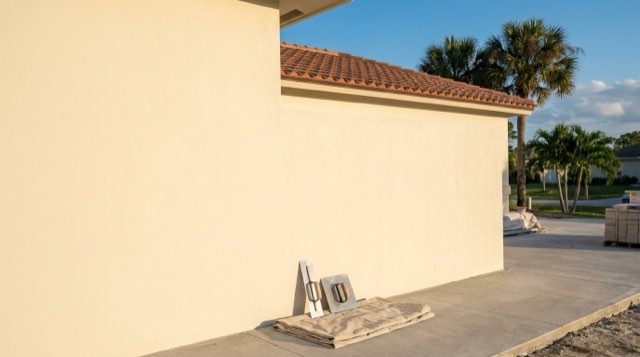 Hiring
Warning Signs When Hiring for Stucco Work
None of these prove anybody is dishonest. They are patterns that turn up often enough on the Treasure Coast to be worth a pause, and each one has a check you can finish in a few minutes.
Read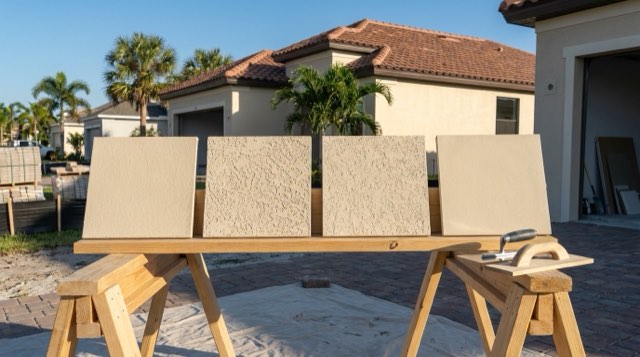 Local guide
Stucco Work in Hobe Sound: Estate Homes and Older Cottages
Hobe Sound is two housing markets under one name. A custom home with a hand applied finish and a 1960s cottage need very different stucco work, and very different pricing.
Read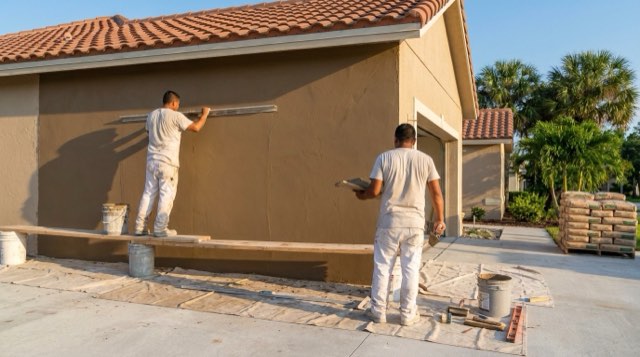 Storm season
Stucco Damage and Insurance Claims: What to Document
We are stucco contractors, not insurance advisers. What we can explain is how a wall gets recorded properly here, because a soaked block wall photographed on the wrong day tells the wrong story to everyone.
Read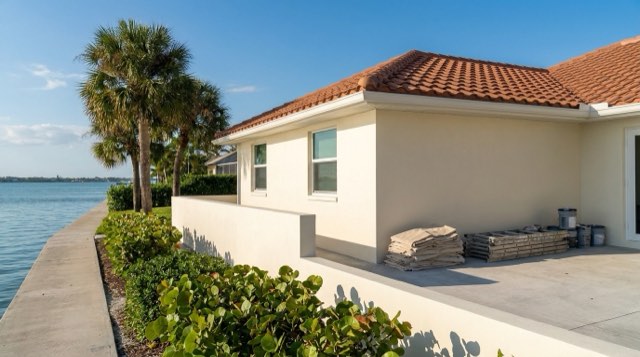 Local guide
Salt Damage to Stucco in Jensen Beach
Jensen Beach has the Atlantic on one side and the Indian River on the other. That geography, not the age of the house, is what decides how long your stucco and sealant last.
Read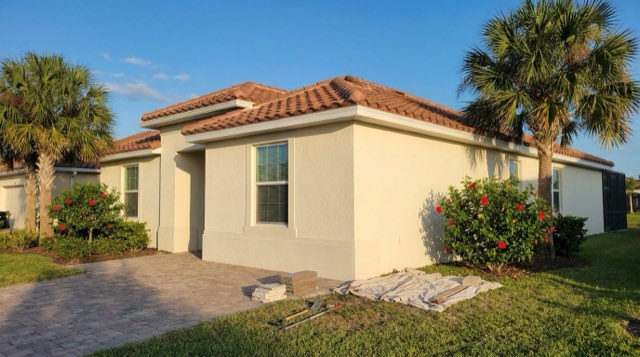 Maintenance
A Realistic Stucco Maintenance Schedule for Florida Homes
Stucco is a low maintenance wall, not a no maintenance wall. Here is the schedule a Port St. Lucie homeowner can actually keep, including the parts where the right answer is to do nothing.
ReadStraight answer on your wall.
Call, or send the form and we will get you a written price.