A Realistic Stucco Maintenance Schedule for Florida Homes
Stucco is a low maintenance wall, not a no maintenance wall. Here is the schedule a Port St. Lucie homeowner can actually keep, including the parts where the right answer is to do nothing.
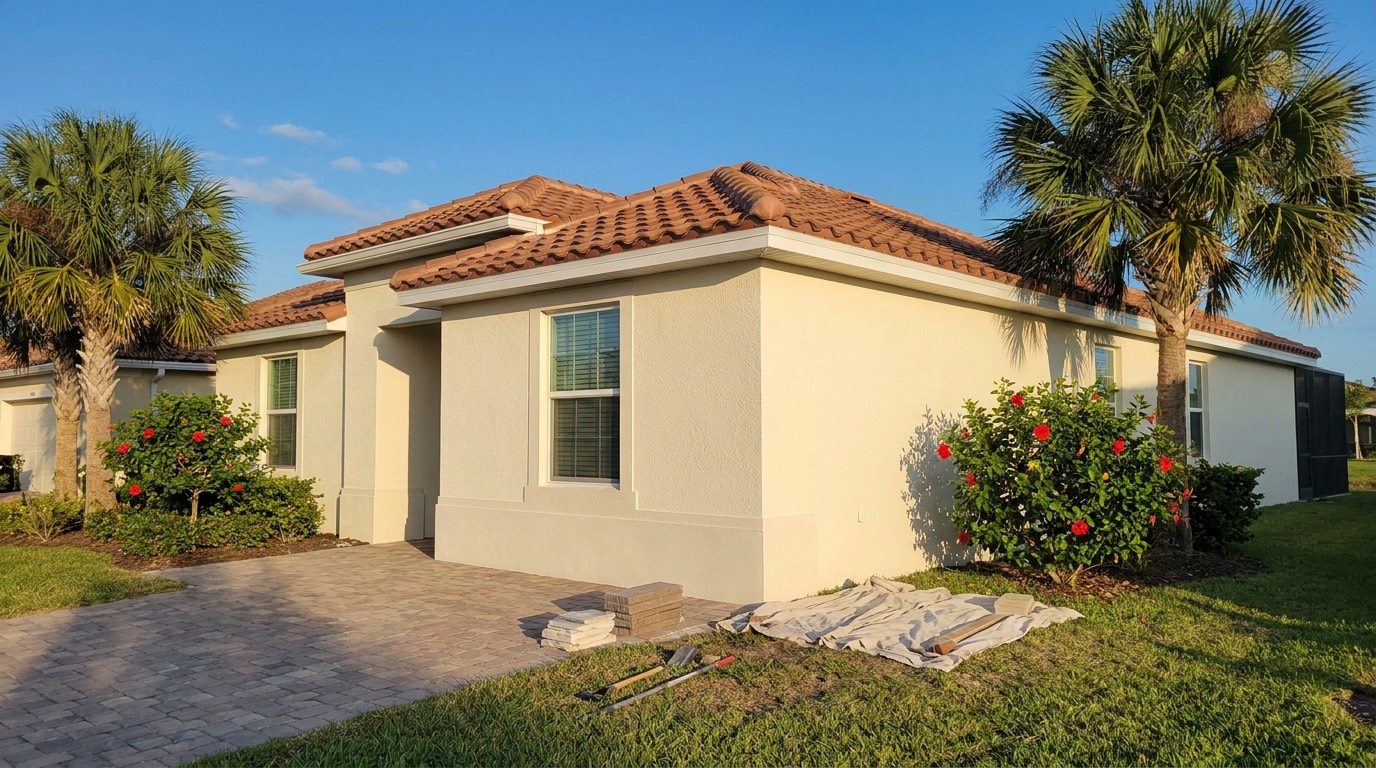
Low maintenance is not the same as no maintenance
A stucco wall on a block house will outlast almost everything attached to it. The roof, the screens, the gutters and the paint all come due before the plaster does. That is a fair reason to own it.
The catch is that the parts which fail early are not the stucco itself. They are the joints around it, the coating over it, and whatever is throwing water at it. All three are cheap to look after and expensive to ignore.
So the schedule below is mostly your own eyes, a stepladder and a garden hose. Two items run on a multi year clock. Everything else is either a look or a response to something you found on that look.
- Once a year: a slow lap of all four elevations
- Twice a year: the base of the wall and the joints you can reach
- Every five to ten years: sealant at windows, doors and penetrations
- Every seven to twelve years: paint or elastomeric coating
- After any storm that drove rain sideways: the elevation that took it
The once a year look, and what makes it worth doing
Do it early in the morning while the sun is still low. Raking light across a wall shows a bulge, a wave or a shadow line that noon light hides completely. Give yourself twenty minutes and take one elevation at a time.
Use your hands as much as your eyes. Run the back of your knuckles along the bottom three feet of wall, around every window, and under any roof line that dumps water at one spot. Sound stucco answers dull and tight. Stucco that has let go of what is behind it answers hollow, like a drum, and the change is obvious once you have heard both.
Photograph anything you are unsure about with your phone, with a coin or a tape held next to it for scale, and let the file keep the date. A year later the same photo from the same spot settles the argument about whether something is moving. That habit is worth more than any single repair you will make.
Want a price for your own wall?
Four quick questions and we come back with a written quote. Or call (772) 251-6654 if that is faster.
Request a quote
Four questions, about a minute. We'll call you back.
What each part of the year is good for
Our calendar does not run on freeze and thaw. It runs on water. Roughly June through September the afternoon storms arrive, and from November into spring a wall finally gets long enough between wettings to tell you the truth about itself.
That gives four natural moments, and none of them takes real time.
- Dry season, November to April: the honest time to judge staining, because anything still dark after two dry weeks is wet from something other than weather
- Late spring: the annual walk, and any sealant work, while the wall is dry and the mornings are still workable
- Wet season: after a heavy blow, look at the elevation the wind hit and check window corners from inside
- Late summer: cut back anything that has grown into the walls, because dense planting keeps a wall from ever drying
- Whenever you repaint or reroof: handle the wall details then, while access is already paid for
Sealant joints run on a five to ten year clock
Every hole in a stucco wall is closed with a flexible sealant, and that sealant has a much shorter life than the wall. Window and door perimeters, hose bibs, dryer vents, meter cans, light boxes, and the points where a screen enclosure or a handrail is fastened back into the house.
In Treasure Coast sun a quality polyurethane usually gives five to ten years. Cheap acrylic tube caulk can be finished in two or three, and houses close to the water in Jensen Beach or Vero Beach sit at the short end of any range. Test it with a fingernail. Sound sealant is still rubbery and still stuck on both sides. Failed sealant is hard, chalky, split along its length, or released on one face so a business card slides behind it.
A released joint is worse than no joint. It collects water at the top and holds it against the opening instead of letting it run off. On a single story house this is genuine homeowner work: cut the old bead out, clean both faces, run new sealant rated for masonry.
Coating runs on a seven to twelve year clock
Paint on stucco is not decoration. Cement plaster absorbs water, and the coating is what turns that from a problem into a non issue while bridging the fine cracking every wall here develops.
Plan on seven to twelve years from a quality exterior system, and expect the west and south elevations to reach the end first. Sun does more damage to a coating on the Treasure Coast than rain ever will. It is completely normal for one wall to look tired while the north side still looks new.
Two tests tell you the clock has run out. Wipe a dry hand down the wall; if it comes back with pigment on it, the binder is spent and the surface is chalking. Then look at color depth in flat light, since a coating at the end of its life reads thin and washed out before it reads faded. Repair cracks before you recoat. Coating over an open crack only means the crack prints back through your new paint, usually inside a year.
The habits that quietly shorten both clocks
Most failed stucco we look at did not fail on its own. Something put water on it every single day, or held water against it, and the wall lost a fight it was never meant to be in.
The list is short and every item is a homeowner fix that costs nothing but a Saturday. None of them show up as a problem in year one. They show up in year five as a stained band, a soft patch, or rust bleeding out of a bottom corner, and by then you are paying for repair rather than adjustment.
- Irrigation heads that touch the wall at any point in their rotation
- Downspouts or gutter ends discharging right at the foundation
- Mulch, fresh sod or new hardscape raised up against the base of the wall
- Shrubs planted tight to the stucco, holding humidity against it all night
- Air conditioner condensate or pool equipment discharge aimed at plaster
- A leaking hose bib or a dripping window unit nobody has looked at in years
When to call, and when to leave it alone
Plenty of what people call about does not need a truck in the driveway. Hairline cracking in the middle of a wall, a chalky patch on the sunny side, light mildew on a shaded north elevation, one joint that needs recaulking. Those are maintenance items and they can wait for your normal cycle. Nobody should sell you a repair because a hairline made you nervous.
What earns a call is evidence that water is already behind the plaster or that something in the wall is moving. Hollow sound over an area bigger than your hand. Rust staining. Bulging. A crack that reopens in the same line after a proper repair. Or interior signs at a window corner, meaning a stain, a soft baseboard, or paint that will not stay put.
The other good time to call is before you spend money on something else. If the house is due for paint, a new roof or a screen enclosure, get the walls looked at first. Repairs are always cheapest while somebody else's access is already standing there. Whoever you call should be Florida licensed and insured, and should walk you to the wall and show you the thing they are pricing.
Related questions
How do I know when my stucco house is actually due for paint?
Run a dry hand down the sunniest wall. Pigment on your palm means the coating is chalking and is near the end. Most quality systems here give seven to twelve years, with the west and south walls finishing first. Repair any open cracks before the painter starts, not after.
Does stucco need to be sealed?
On a painted house the coating is already doing that job, and a separate clear sealer is rarely useful. On a wall with moisture behind it a sealer can make things worse by slowing how fast the wall dries out. If the stucco is bare or badly chalked, the answer is a proper primer and coating system, not a clear coat over the top.
What maintenance does a brand new stucco home need?
Very little in the first year beyond looking at it. New stucco keeps shrinking for months and fine cracking is common rather than a defect. Take dated photos of anything you notice, keep irrigation off the walls from the day the sod goes in, and find out what your builder warranty covers on stucco before the term runs out.
How often should the caulking around my windows be replaced?
Five to ten years is the realistic window for a quality polyurethane in this sun, and closer to five if you are near the water in Jensen Beach, Port Salerno or Sebastian. Do not replace it on a calendar. Check it with a fingernail twice a year and replace the joints that have gone hard, split or released.
Is there anything on this list I can honestly skip?
Yes. Filling every hairline crack is optional and often a waste of a weekend, since a coating handles them at the next repaint. Annual chemical cleaning is optional on elevations that stay clean. What you should not skip is the twice yearly look at the base of the wall and the joints, because that is where the expensive problems start quietly.
What should I not try to do myself on a two story house?
Anything that puts you on a ladder with a tool in both hands. Sealant work on second floor windows, washing upper walls with a wand that kicks back, and any repair over a pool deck or a slope. The material cost of those jobs is small and the fall is not. Hire the height and keep the ground floor work for yourself.
More guides
All guides → How it works
Block or Frame: Which Stucco Wall Does Your House Have?
Two walls that look identical from the driveway behave nothing alike. How to tell block from frame using the age of your house, the street it sits on and ten minutes with a magnet.
Read Local guide
Hairline Cracking on Palm City Block Homes
Inland Martin County has no salt problem, so almost everything that goes wrong on a Palm City stucco wall traces back to water and to where it is coming from.
Read Local guide
Stucco in Port Salerno: A Village Built One Addition at a Time
Port Salerno is not Stuart and it is not Palm City. The houses grew by addition, they carry a full coastal salt load, and the lots are too tight to stage a whole house at once.
Read Cost guide
How Much Does Stucco Repair Cost in Port St. Lucie?
Stucco repair is priced off what the wall turns out to be, not off the crack you can see. Here are the ranges homeowners on the Treasure Coast run into and what pushes a job to the top of them.
ReadLocal guideStucco Repair in Fort Pierce: Older Homes, Older Problems
Fort Pierce housing is decades older than the block subdivisions south of it. That changes what is behind the stucco, how it fails, and what a real repair involves.
ReadStraight answer on your wall.
Call, or send the form and we will get you a written price.