Hairline Cracking on Palm City Block Homes
Inland Martin County has no salt problem, so almost everything that goes wrong on a Palm City stucco wall traces back to water and to where it is coming from.
What the Palm City subdivisions were actually built with
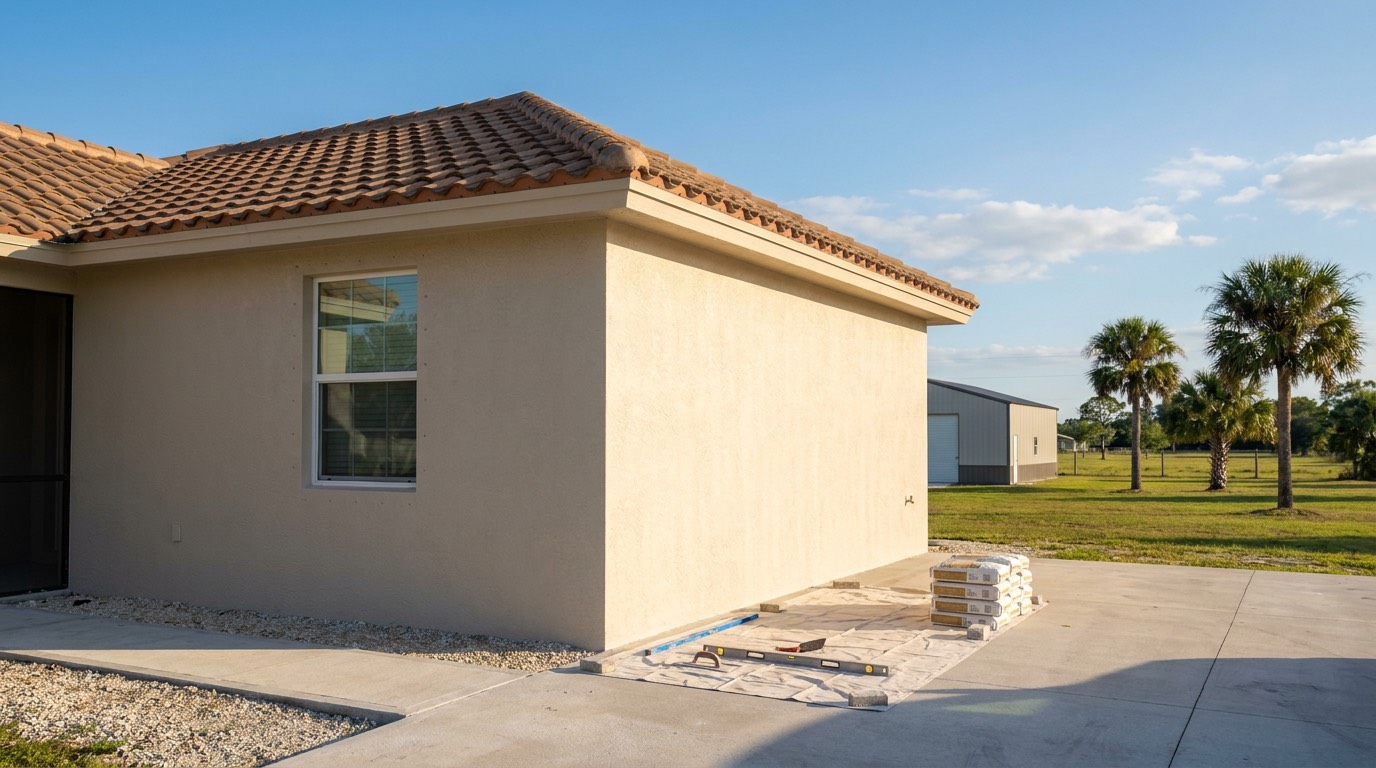
The bulk of residential Palm City went up from the early 1990s through the 2000s, and the construction is remarkably consistent street to street. Concrete block for the main walls, wood framing with metal lath at the gable ends and any second story bump out, barrel or dimensional shingle roof, deep eave, single story or one and a half.
The stucco on these homes is thinner than what went on houses built forty years earlier. That is not a shortcut, it is how direct applied systems over block are built, and they perform well. What a thinner skin means is that the wall behind it drives what you see on the surface. Block joints, lintels and tie beams all telegraph.
Knowing the era tells you what to expect before you look at a single wall. These houses are old enough to be well past initial curing and into their second or third paint cycle, and young enough that the underlying assembly is almost always sound. Which is why nearly every call we take here is about cracking and staining rather than structure.
The cracks show up in the same places on every plan
Walk a Palm City street and the cracking is close to predictable. Diagonals leaving the upper corners of windows and sliders, because stress concentrates at the corner of any opening. Straight verticals following a control joint. A level line high on the wall tracing the tie beam, or under a sill.
The gable ends behave differently from the block below them, and that transition is a common line too. Framed walls move with humidity and temperature on a different schedule than masonry, so the joint between the two systems works a little every day of the year.
Because the pattern is so consistent, an owner can do most of the triage. A crack sitting in one of those expected locations, thin, dry, with no staining or hollow sound around it, means the house is behaving normally. Cracks somewhere unexpected, or arriving with a stain, are the ones worth a phone call.
- Diagonals off window and slider corners, the most common pattern by far
- Straight verticals following a control joint in a long wall
- Horizontal lines at the tie beam, lintels or under sills
- The seam where a framed gable meets the block wall below
- Fine map cracking across a field, which is usually a coating issue rather than a stucco one
Want a price for your own wall?
Four quick questions and we come back with a written quote. Or call (772) 251-6654 if that is faster.
Request a quote
Four questions, about a minute. We'll call you back.
Inland, the only real question is whether water is getting in
Palm City is far enough inland that salt is not driving anything. No chloride attack on embedded metal, no coatings chalking on a coastal clock, no sealant giving up early. That removes the whole category of problems that dominates our work in Jensen Beach.
What is left is rain, and we get plenty. Summer afternoons deliver heavy volume in short bursts with wind behind it, which pushes water sideways into anything open on a wall rather than letting it run down the face. A crack that would drain harmlessly in a gentle rain takes water under those conditions.
So the useful test is width, not appearance. A hairline you have to stand close to see holds very little water and gets handled by a decent coating on your normal repaint. A crack you can catch a fingernail in, or one with a stain washing down from it, is admitting water into block that then holds it. That one is a repair, cheap now and expensive later.
Sprinkler overspray is the most fixable cause on the street
We see it on almost every block. A rotor or spray head that clips the house, wetting the same two feet of wall every cycle, year after year. That wall never gets a chance to dry, and the water carries minerals that leave a hard band of staining.
The signs are easy to read once you know them. A stain line that stops at a consistent height above grade rather than following the shape of the wall. A dark band that is worse under the windows the irrigation reaches. Coating failing along the bottom of one elevation while the top of the same wall looks fine.
This is the rare exterior problem with a free fix. Turn the head, change the arc, or move it back. Then let the wall dry for a few weeks before anyone evaluates the staining, because much of what looks permanent lightens once the constant wetting stops. Repairing that wall while the sprinkler still hits it is money thrown away.
Efflorescence and what the white deposit is telling you
The chalky white bloom on block and stucco is efflorescence. Water moves into the masonry, dissolves the natural salts in the cement and the block, carries them to the surface, then evaporates and leaves the mineral behind. The deposit is harmless. What it tells you is not.
Efflorescence is evidence of water moving through a wall, and the pattern points at the source. A band low on the wall points at irrigation or splash back from grade. A plume under a window points at the opening. A patch on one elevation points at roof runoff. Read the shape before you clean it off.
There is also a difference between an old deposit and an active one. Historic efflorescence brushes off and stays gone, which means whatever caused it has stopped. A deposit that returns within weeks of cleaning means water is still moving, and that is worth investigating rather than washing.
Fix the water path before you fix the crack
A crack that keeps reopening in the same spot after a competent repair almost always has help. Something is loading that part of the wall with more water than the rest of it, and until that changes the repair is a temporary measure.
The usual culprits are boring and cheap to correct. A downspout discharging against the foundation instead of away from it. A roof valley dumping a whole slope onto one section of wall. Grade that has crept up until soil sits against the stucco with no clear termination above it. Mulch piled to the same effect. A window head with no functional flashing.
We fix stucco, and we are not going to regrade your yard. But we will point at the source, because sealing a crack while leaving the cause running is the kind of work that brings us back in two years and makes the homeowner think stucco repair does not last.
- Downspouts discharging at the foundation rather than away from the house
- Roof runoff concentrating on one wall section at a valley
- Grade or mulch built up against the base of the stucco
- Sprinkler heads striking the wall on every cycle
- Missing or failed sealant above and around openings
The inland maintenance rhythm, and dealing with your HOA
Palm City work is easiest to schedule in the drier stretch from late fall through spring. Crews get full days and coatings cure without a three o clock storm chasing them off the wall. Summer work happens constantly here and there is no seasonal shutdown, but the days are less predictable.
Most Palm City neighborhoods have an association, and most of those have architectural rules covering exterior color and sometimes finish texture. We do not guess at what any specific community requires. Get your color approved in writing before the crew is scheduled, because a repaint that has to be redone is the most avoidable expense in this trade.
Related questions
My Palm City house is only twenty years old. Why does it have cracks?
Because cement plaster shrinks slightly as it cures and the building moves every day with heat and humidity. Fine cracking at window corners and along joints is normal behavior on a block home of that age, not a defect. What earns attention is a crack wide enough to catch a fingernail, or one with staining running out of it.
How do I get rid of the white powder on my wall?
Light efflorescence usually brushes off dry, and stubborn deposits respond to a masonry cleaner used according to its label. The important step is what happens next. If it returns within a few weeks, water is still moving through that wall and the source needs finding, because cleaning it again just resets the clock.
Can sprinkler water really damage stucco?
Yes, though usually as staining and coating failure rather than structural harm. The problem is constant rewetting of the same area plus mineral deposits left behind. Turning the head away is free, and the wall often lightens noticeably on its own once it can finally dry.
Should I fill hairline cracks myself before painting?
For very fine cracking a quality coating bridges it without any filler at all, and a homeowner smear of caulk often looks worse than the crack did because it sits proud and holds dirt. Anything you can catch a fingernail in deserves a proper routed repair. Below that, prep and coat.
Does my HOA need to approve stucco repair?
Repair of an existing surface in a matching color is generally less involved than a color change, but rules vary by community and we do not assume. Check your association's architectural guidelines and get any color approval in writing before scheduling. It prevents a repaint you pay for twice.
When is the best time of year for exterior work in Palm City?
Late fall through spring gives the most reliable weather and cleaner scheduling, since afternoon storms are less likely to interrupt a coating day. That said, work runs year round here with no seasonal shutdown. Summer jobs just need earlier starts and closer attention to the forecast.
More guides
All guides → Local guide
Stucco in Port Salerno: A Village Built One Addition at a Time
Port Salerno is not Stuart and it is not Palm City. The houses grew by addition, they carry a full coastal salt load, and the lots are too tight to stage a whole house at once.
Read Cost guide
How Much Does Stucco Repair Cost in Port St. Lucie?
Stucco repair is priced off what the wall turns out to be, not off the crack you can see. Here are the ranges homeowners on the Treasure Coast run into and what pushes a job to the top of them.
ReadLocal guideStucco Repair in Fort Pierce: Older Homes, Older Problems
Fort Pierce housing is decades older than the block subdivisions south of it. That changes what is behind the stucco, how it fails, and what a real repair involves.
Read Local guide
Stucco Work in Stuart: Historic District and Waterfront Homes
In Stuart the repair itself is rarely the hard part. Getting it to disappear into an older, carefully kept house is, and the decorative profiles are what separate a good crew from an average one.
Read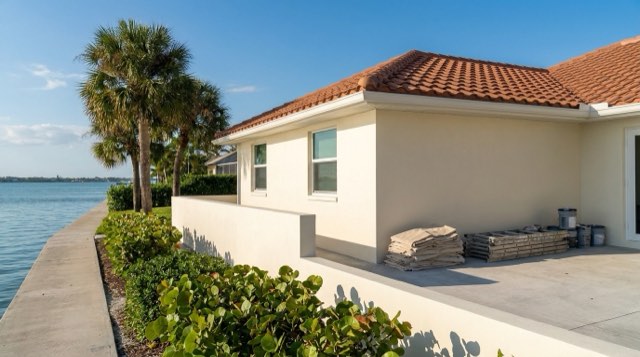 Local guide
Stucco Repair in Sebastian and the Indian River Lagoon
In Sebastian almost every stucco repair traces back to the lagoon. Salt corrodes the metal buried in the wall, and the coarse original sand finishes take real effort to match.
ReadStraight answer on your wall.
Call, or send the form and we will get you a written price.