Stucco Repair in Fort Pierce: Older Homes, Older Problems
Fort Pierce housing is decades older than the block subdivisions south of it. That changes what is behind the stucco, how it fails, and what a real repair involves.
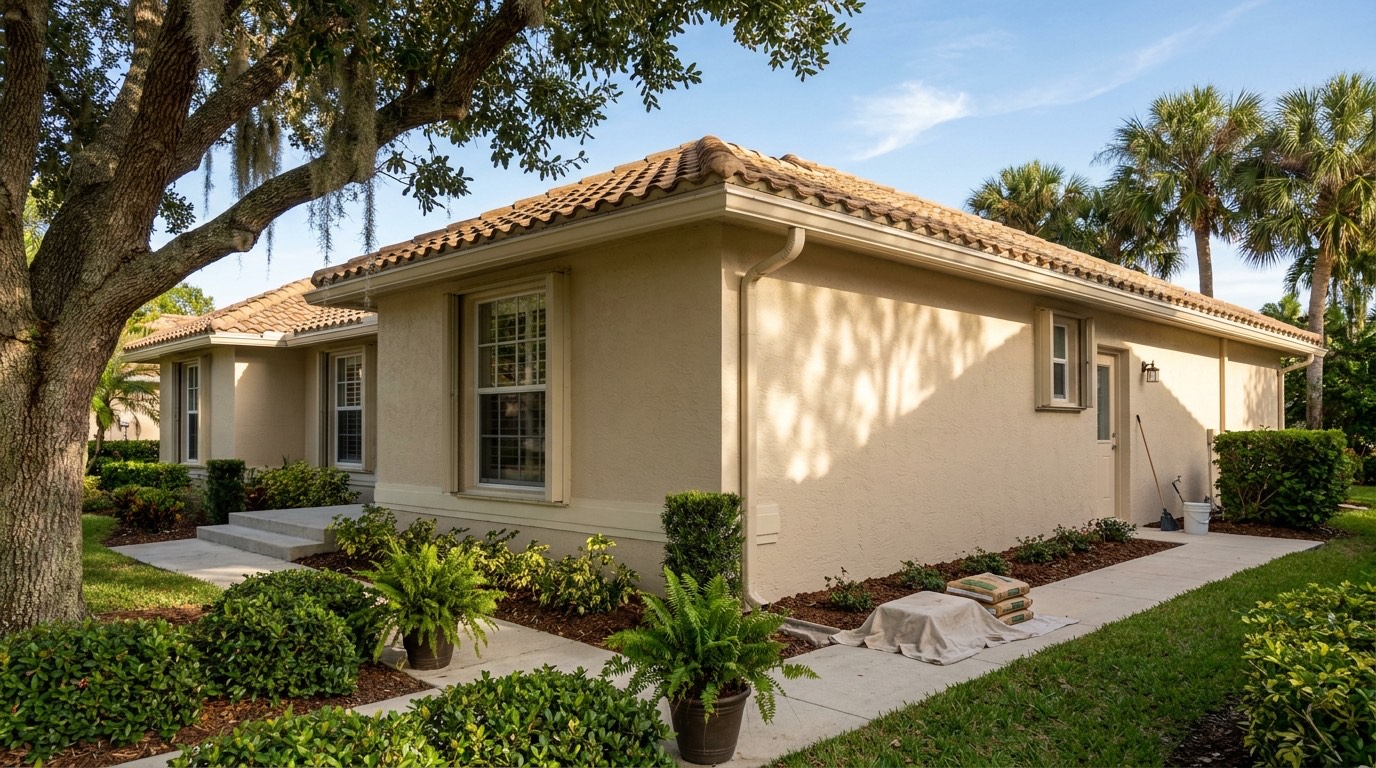
The first question on a Fort Pierce house is block or frame
Before we price anything in Fort Pierce we need to know what the stucco is attached to. In the newer subdivisions south of us the answer is nearly always concrete block. Here it depends on the street and the decade. Plenty of the older neighborhoods went up as wood frame with stucco carried on metal lath, and block walls with framed gable ends above them are common.
You can learn most of it with your knuckles. Stucco over block gives back a dull, dense knock. Stucco over lath sounds lighter and a little springy, and a firm palm sometimes finds a fraction of give. The two assemblies fail for different reasons, get repaired with different materials, and land at different numbers, so anyone quoting a Fort Pierce repair without settling that question first is guessing at the scope.
Rusted lath is the defining problem on older frame walls
On a frame wall the stucco is not bonded to masonry. It is keyed into metal lath, fastened through building paper into sheathing or studs. The lath is the structure of the plaster. When it corrodes, the wall loses the thing holding it up.
Salt air, decades of wind driven rain and a few open cracks are all it takes. Water finds the paper, the paper tears, the lath goes orange, and the fasteners lose their bite. From the street the wall can still look fine. Up close it moves, it sounds hollow over broad areas, and rust weeps out of the crack lines.
ASTM International publishes the standards the trade uses for lathing installation, ASTM C1063 being the familiar one, and modern lath and accessories are specified with corrosion in mind. Much of what we open in Fort Pierce predates that thinking. When we find corroded lath we replace it. Fresh stucco over rusting metal buys a season or two, then the same failure comes back through your new work.
- Hollow sound spread over large areas rather than isolated spots
- Wall movement under hand pressure, especially near the bottom of a run
- Rust colored bleeding out of cracks or from fastener lines
- Vertical cracking on a regular spacing, following studs or lath edges
- Soft or spongy sheathing found once a small test area is opened
Want a price for your own wall?
Four quick questions and we come back with a written quote. Or call (772) 251-6654 if that is faster.
Request a quote
Four questions, about a minute. We'll call you back.
Hand troweled textures from the fifties through the seventies
The finishes on these houses were put on by hand, by plasterers who each had their own rhythm. Sand float, worn knockdown, old Spanish lace and troweled skip patterns all show up around the older parts of town, softened now by fifty years of weather and repainting.
A spray rig does not reproduce hand work. The particle pattern is too even and the shadow lines fall wrong, so the patch reads as a rectangle from the driveway even when the color is perfect. We work matches up on a sample board held against the actual wall, in daylight, until it disappears at normal viewing distance.
The other half of matching is knowing where to stop. A repair that ends at an outside corner, a trim band or a control joint reads as part of the house. One that dies in the open middle of an elevation almost always shows. Sometimes the honest answer is to refinish the whole elevation rather than chase a blend that will never quite land.
Hutchinson Island adds salt on top of age
The barrier island homes are their own category. Out at Hutchinson Island the wall sits in salt spray year round, and the ocean facing elevation will be measurably further along than the sheltered side of the same house. Owners are often surprised that one wall needs work while the other three look fine. That is normal here.
Salt accelerates everything metal. Corner bead, casing bead, lintels, window frames, anchors, light fixture boxes and lath all corrode faster, and corroding metal swells and pushes the stucco apart from behind. It also shortens the life of sealant joints and chalks coatings sooner than the same product would fade a few miles inland.
Repair on the island leans toward replacing metal rather than sealing over it, and toward shorter maintenance intervals than a mainland house needs.
Five or six coats of paint and a wall that cannot dry
Any house that has stood since the sixties has been painted repeatedly. Each coat is thin on its own, but the stack adds up, and older elastomerics were often applied heavy. Eventually the film is tight enough that moisture moving out through the wall cannot get past it.
Then you see peeling in sheets rather than flaking, blistering that lifts a coin sized disc with dry powder underneath, and edges curling where a previous patch was cut in. The wall is not failing because of what is on the paint. It is failing because of what is trapped behind it.
The fix depends on how much of the elevation is involved. Scattered blisters get cut back to sound film, feathered and recoated. A wall that lets go across most of its area needs stripping before anything new goes on. We would rather tell you that at the estimate than discover it with a pressure washer on the first morning.
Where patching stops and rebuilding an elevation starts
The decision point is how much of the existing system is still doing its job. We sound every elevation and chalk the hollow areas before writing anything down. When the failed area is scattered and small, localized cut outs plus a full recoat is the sensible job. When the marks join into one large connected zone, patching is throwing money at a wall that is already gone.
On frame houses we also want to open one small test area, usually low on the worst elevation where the repair will be invisible. What is under there tells us whether the paper and sheathing are sound. That single hour changes the scope more often than anything else we do.
Where we cannot know until the wall is open, we price unit rates instead of a lump sum. So many dollars per square foot of lath replacement, so many for sheathing, agreed in advance. The number then moves with what is found instead of becoming a negotiation.
What moves the price on an older Fort Pierce house
We give ranges rather than numbers over the phone, because the same square footage can be a modest recoat or a full tear off depending on what the sounding turns up. Small crack and sealant work sits at the low end. Rebuilding lathed elevations with new paper, lath and three coat plaster sits at the top, with finish labor on unusual textures added on.
The drivers below are what actually move a Fort Pierce estimate, and none of them can be judged from a photograph. A real number comes from a site visit. Any contractor giving you a firm price sight unseen on a seventy year old house is either padding it heavily or planning to change it later.
- Block versus frame and lath construction, the single biggest variable
- How much of the wall sounds hollow once the whole house is checked
- Condition of the building paper and sheathing on frame walls
- Difficulty of matching a hand applied original texture
- Salt exposure, which is heaviest on the island and the eastern streets
- Access, two story elevations, tight side yards and mature landscaping
- Whether the coating stack has to be stripped before recoating
Related questions
How do I tell whether my Fort Pierce house is frame or block?
Knock on an exterior wall away from a window. Block reads dull and solid, frame with lath reads lighter and slightly hollow. Interior clues help too, since block walls are usually thicker at window returns. If it is not obvious, a contractor can settle it in a couple of minutes on site.
Can a 1960s hand troweled texture actually be matched?
Usually yes, close enough that a stranger cannot find the repair from the street. It takes hand application, a sample board worked against the real wall in daylight, and a sensible stopping point at a corner or joint. Perfect invisibility in raking light on a heavily weathered wall is not always achievable, and we say so up front.
My house is on Hutchinson Island. Does that change the repair?
It changes the metal. Anything corroded gets removed and replaced rather than sealed over, sealant joints get renewed as part of the work, and coating selection favors products that hold up to salt and UV. It also shortens your maintenance interval compared with a mainland house.
Do I need to strip the old paint before recoating?
Only if the existing film is failing. Sound coating gets cleaned, prepped and recoated. Coating that is peeling in sheets or blistering across an elevation is trapping moisture and has to come off, because anything new applied over it will fail on the same schedule.
Does stucco repair in Fort Pierce need a permit?
It depends on the scope, and cosmetic patching is treated differently from replacing an elevation. Requirements differ between the City of Fort Pierce and unincorporated St. Lucie County. Check with the building department covering your address before work starts, and expect your contractor to pull anything required.
Is it worth repairing old stucco, or should I replace the whole elevation?
If most of the wall still sounds solid, repair plus a full recoat gives you a uniform result for far less money. Once a large connected area has debonded, or the lath behind a frame wall has corroded through, replacement is cheaper over any real time horizon. Sounding the walls tells you which situation you are in.
References
Standards bodies and agencies referenced above. We are not affiliated with them.
More guides
All guides →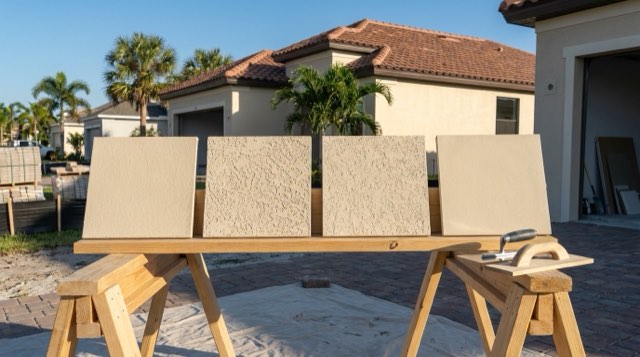 Local guide
Stucco Work in Stuart: Historic District and Waterfront Homes
In Stuart the repair itself is rarely the hard part. Getting it to disappear into an older, carefully kept house is, and the decorative profiles are what separate a good crew from an average one.
Read Local guide
Stucco Repair in Sebastian and the Indian River Lagoon
In Sebastian almost every stucco repair traces back to the lagoon. Salt corrodes the metal buried in the wall, and the coarse original sand finishes take real effort to match.
Read Local guide
Stucco in St. Lucie West: Villas, Townhomes and Color Matching
Attached villas and townhomes make stucco a shared problem. Matching a neighbor's twenty year old color, repairing foam bands and getting an architectural submittal right all decide the result.
Read Diagnosis
Dark Streaks and Staining on Treasure Coast Stucco
Most stucco staining is a drainage problem wearing a disguise. Read where the streak starts and what shape it takes, and the cause usually names itself.
ReadHow it worksA Plain Guide to Florida Stucco Textures
Six textures cover almost every stucco wall between Vero Beach and Hobe Sound. Here is how to tell them apart, which ones hide a patch, and what integral color changes.
ReadStraight answer on your wall.
Call, or send the form and we will get you a written price.