Stucco Work in Stuart: Historic District and Waterfront Homes
In Stuart the repair itself is rarely the hard part. Getting it to disappear into an older, carefully kept house is, and the decorative profiles are what separate a good crew from an average one.
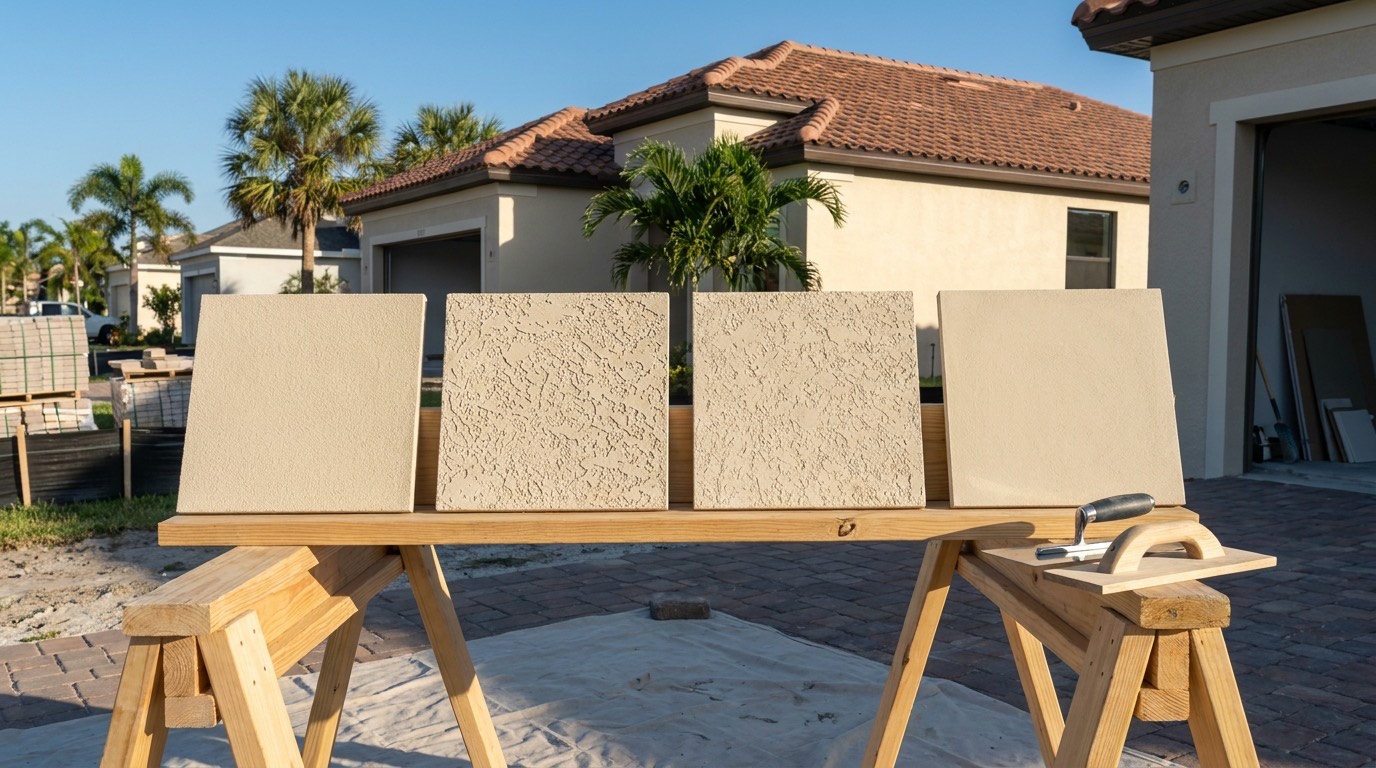
In Stuart the finish is the whole deliverable
Structurally, a crack repair on a Stuart bungalow is the same work as a crack repair anywhere on the Treasure Coast. Route it, fill it, mesh it where the width earns it, cure it, finish it. What is different is the standard the result gets held to.
These are older, settled neighborhoods where people have owned the same house for a long time and know exactly what their exterior looks like. Neighbors notice. So do buyers, and so do the people who maintain the surrounding houses. A patch that would vanish into a tract elevation in a newer subdivision gets spotted here from the sidewalk.
That changes how we bid. We put more hours into the finish stage than the repair stage on most Stuart jobs, and we write that into the number instead of finding out halfway through that the match is going to take three attempts. If a match looks difficult, the estimate is the time to say so.
Older downtown housing and what you should check before work starts
The core of Stuart has genuinely old building stock, and older houses in Florida are a mix. Frame with metal lath, early block, additions built in different decades with different systems, and porches that were enclosed at some point using whatever was normal that year. One house can carry three eras of stucco on four elevations.
That mix matters because the repair follows the substrate. We check each elevation separately rather than assuming the whole house is one assembly, and we sound the walls before quoting so the hollow areas are on paper rather than discovered later.
There is also a paperwork side. Depending on your address and the scope, exterior work on older Stuart properties can involve review beyond a standard permit, and some neighborhoods carry their own architectural rules. We do not guess at what applies to a given street. Check with the City of Stuart building department, or Martin County if you are outside the city, and with your association before color and texture get decided.
Want a price for your own wall?
Four quick questions and we come back with a written quote. Or call (772) 251-6654 if that is faster.
Request a quote
Four questions, about a minute. We'll call you back.
Decorative profiles are where most repairs go wrong
Plenty of Stuart houses have more than flat wall. Banding under the eave, window surrounds, sills, quoins at the corners, keystones over an arch, a corbel or two on a porch. These were run in place with a template or cast in a shop, and they are the first thing a repair gets wrong.
The usual failure is somebody filling a broken band with patching compound and shaping it by eye. From ten feet away the profile is flat where it should be crisp, the shadow line under the band goes soft, and the whole run reads wrong even though the color matches. Profiles live or die on their shadow.
The right way is slower. We take a template off a sound length of the original, then either run the new section in place along a screed or cast it on a bench and set it. The joint goes at a natural break where the eye expects one. That is the difference between a repair nobody sees and one everybody does.
- Eave and belt banding, usually the most visible run on the house
- Window and door surrounds, sills and drip edges
- Quoins and corner blocks, where damage tends to cluster
- Arch keystones and porch details
- Cast columns, pilasters and porch skirting
Riverfront exposure works one elevation harder than the rest
Homes along the St. Lucie River and the creeks feeding it sit in a wetter, saltier band than a house a mile back from the water. Wind off the river carries moisture and salt onto the water facing elevation almost every day, and that wall ages on a different clock than the other three.
You see it in the order things fail. Sealant on the river side hardens and pulls first. Coating chalks there first. Rust staining shows at lintels and fixture boxes there first. The sheltered elevation can look nearly new while the water side is due for real work.
We price waterfront houses elevation by elevation for that reason. Recoating all four sides when only one is spent wastes your money, and repairing only the bad wall without a color plan leaves a house that reads in two shades. Usually the answer is full work on the exposed side and maintenance elsewhere.
Color and coating decisions on a house that has been painted many times
Old paint has faded, and it has faded unevenly. Matching a color chip to what is on your south wall gives you a match to a weathered surface, not to the original color. Put that on a fresh patch and it will drift apart from the wall over the next few years as the new work ages differently.
So we take the match from a protected area, under an eave or behind a downspout, and then talk about whether to blend or to recoat. On a house that already has a full paint cycle coming, recoating the elevation is often cheaper than the labor of chasing an invisible blend into aged film.
Sheen matters as much as color on older stucco. A flat or low sheen product hides surface irregularity, which is what you want on a hand troweled wall with sixty years of history in it. Anything with gloss picks out every ripple and every old patch line, especially in low sun off the water.
Sequencing with roofers, window crews and painters
Half the stucco damage we repair in Stuart was created by another trade. Window replacement leaves the perimeter opened up. Roof work disturbs the stucco at the wall to roof transition. A soffit or fascia repair leaves a rough edge at the top of the wall. None of that is anyone behaving badly. It is just what happens when you cut into a rigid skin.
The order to run trades in is roof, then windows, then stucco, then paint. Do stucco before the windows go in and you will be back. Paint before the stucco is fully cured and the finish suffers, because fresh cement plaster needs time before it takes a coating properly.
If you are staging a larger renovation, tell every contractor involved what the sequence is. We are happy to talk directly to your window installer or your roofer about how the transition detail should be left. That conversation takes ten minutes and saves a return trip that somebody has to pay for.
What a Stuart estimate should tell you before you sign it
A proposal on an older home should say which elevations are included, how the hollow areas were identified, what happens if more is found once a wall is open, and how the finish will be matched. Vague scope on a house with decorative work is where disputes come from, because the owner is picturing an invisible repair and the number was written for a functional one.
On price, we give ranges tied to drivers. Sealant renewal and localized crack work sits low. Profile restoration, texture matching on hand applied finishes and full elevation resurfacing sit considerably higher, and waterfront exposure usually means more sealant and more metal work than an inland house of the same size. Only a walk around the property produces a number worth relying on.
Related questions
Can a broken decorative band or window surround be repaired, or does it have to be replaced?
Most profiles can be repaired in place. We take a template off an intact length of the original, run or cast the missing section to match, and place the joint at a natural break. Full replacement only makes sense when the profile has failed along most of its length or the substrate behind it has gone.
Do I need approval before doing stucco work on an older Stuart home?
Sometimes, and it depends on your exact address and the scope of work. Requirements differ between the City of Stuart and unincorporated Martin County, and some neighborhoods have their own architectural rules on top. Check with the building department that covers your property and with your association before finalizing color or texture.
Why does my river facing wall look worse than the rest of the house?
Because it is doing more work. Wind off the water carries salt and moisture onto that elevation almost daily, so sealant, coatings and any exposed metal age faster there than on the sheltered sides. It is normal on waterfront property and it is the reason we price these houses one elevation at a time.
Will a patch on my older home be visible?
Done properly on a flat wall field, it should disappear at normal viewing distance. What makes it visible is spraying over a hand troweled original, matching color to faded paint, or stopping the repair in the open middle of a wall. Terminating at a corner, joint or trim line is what sells the match.
Should I paint at the same time as the stucco work?
Usually yes, and it is the most efficient way to do it. The access, the prep and the masking are already in place. The one caution is timing, since fresh cement plaster needs to cure before it takes a coating well. Your contractor should build that wait into the schedule rather than rushing it.
How long does stucco work on an older Stuart house take?
A localized crack and sealant job is usually a few days. A full elevation with profile restoration and a texture match runs longer, because curing time between coats is fixed and cannot be compressed. Weather moves the schedule too, especially through the summer storm months when afternoons are unreliable.
More guides
All guides →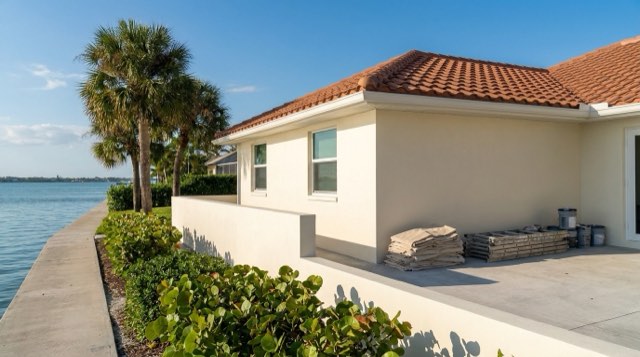 Local guide
Stucco Repair in Sebastian and the Indian River Lagoon
In Sebastian almost every stucco repair traces back to the lagoon. Salt corrodes the metal buried in the wall, and the coarse original sand finishes take real effort to match.
Read Local guide
Stucco in St. Lucie West: Villas, Townhomes and Color Matching
Attached villas and townhomes make stucco a shared problem. Matching a neighbor's twenty year old color, repairing foam bands and getting an architectural submittal right all decide the result.
Read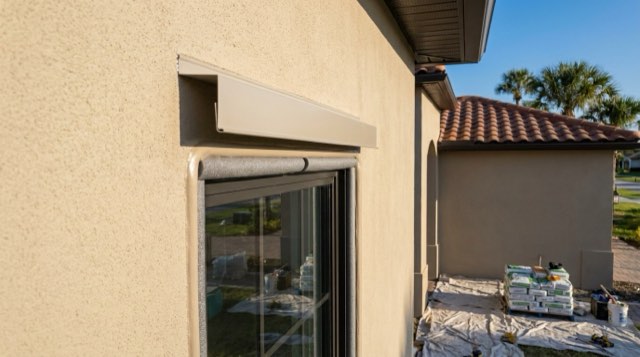 Diagnosis
Dark Streaks and Staining on Treasure Coast Stucco
Most stucco staining is a drainage problem wearing a disguise. Read where the streak starts and what shape it takes, and the cause usually names itself.
Read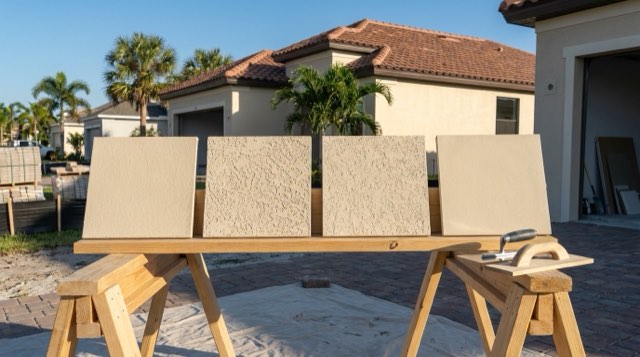 How it works
A Plain Guide to Florida Stucco Textures
Six textures cover almost every stucco wall between Vero Beach and Hobe Sound. Here is how to tell them apart, which ones hide a patch, and what integral color changes.
Read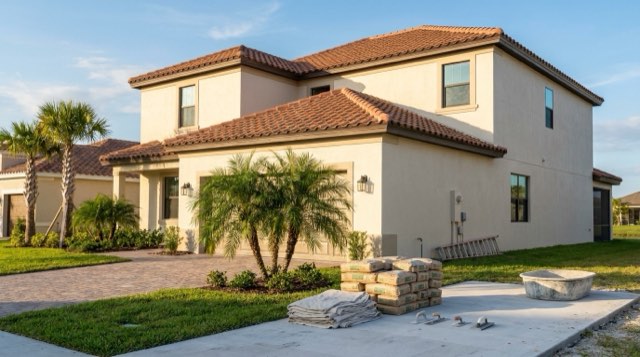 Local guide
Stucco on Newer Tradition Homes: Settlement Cracks and Warranty
New houses crack while they finish curing and settling. On a recent Tradition build the first call should be to the builder's warranty line, not to a contractor.
ReadStraight answer on your wall.
Call, or send the form and we will get you a written price.