Dark Streaks and Staining on Treasure Coast Stucco
Most stucco staining is a drainage problem wearing a disguise. Read where the streak starts and what shape it takes, and the cause usually names itself.
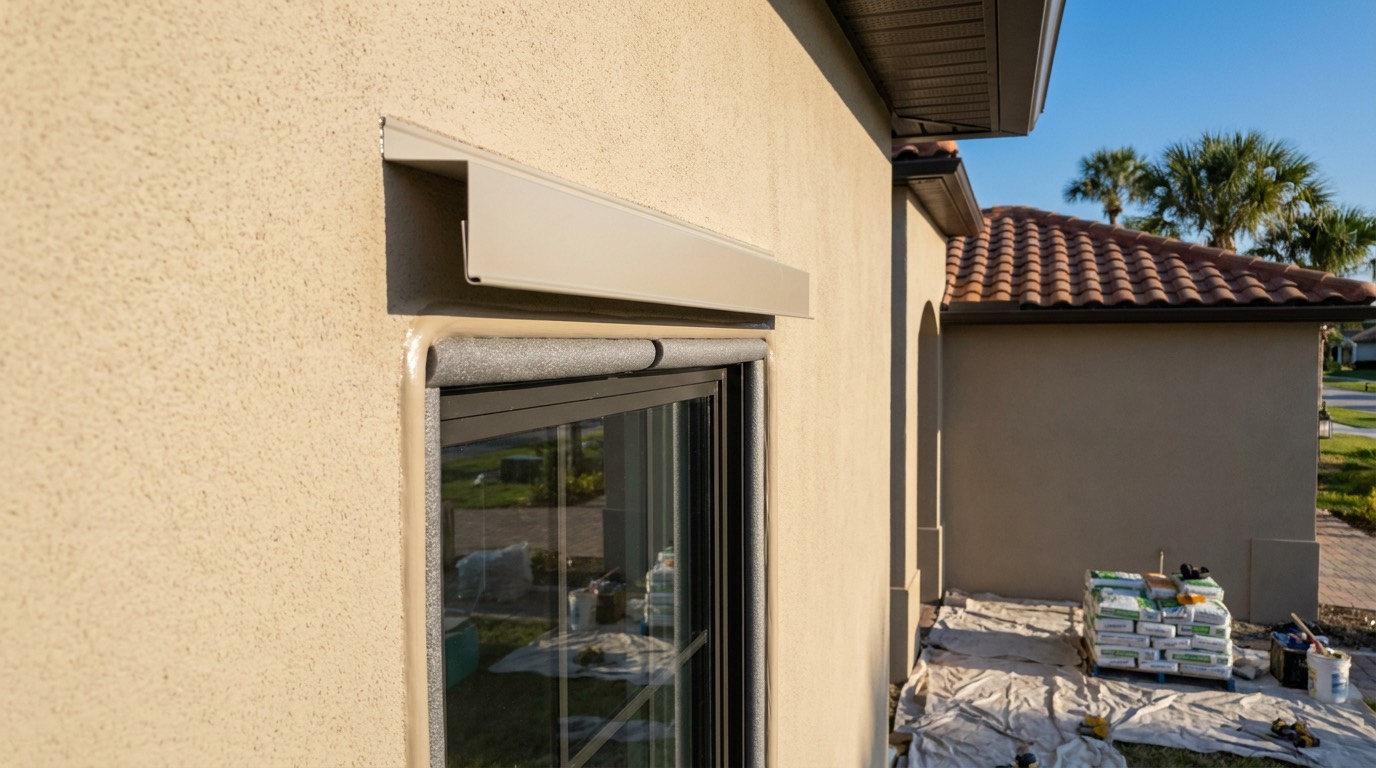
Staining is a drainage story
Almost every stain on a stucco wall was drawn there by water. Something concentrated the flow, the water ran down the face carrying dirt or minerals or spores, and the wall kept a record. That is why the shape of a stain tells you more than its color.
Look at a streaked wall and ask three things. Where does the mark begin, what sits directly above that point, and does it spread or stay narrow as it runs down. A stain with a clear starting point almost always has hardware, a joint, or a roof edge above it doing the concentrating. Most staining on Treasure Coast homes is a drainage issue rather than a failure of the stucco, but a few patterns do mean water is getting into the wall, and those are worth separating out before you erase the evidence with a pressure washer.
Reading the pattern before you clean anything
Take photos first, on a dry day, in flat morning light. Once a wall is washed you lose the map, and the map is the useful part. Photograph each elevation whole, then close up on anything with a defined starting point. A handful of patterns come up again and again on homes here, and each points somewhere specific.
- A narrow streak running down from a single point: a fixture, fastener, bracket, or hose bib is shedding water and whatever it carries
- Twin streaks from the bottom corners of a window: water is running off the sill and over the edges instead of dripping clear
- A wide even band under the eave: roof runoff washing dirt down the fascia and onto the stucco
- Repeating vertical stripes along a whole elevation: tile roof runoff concentrating at the same points every storm
- A stained band about two feet up from grade all the way around: rain splashing soil and mulch back onto the wall
- A fan spreading downward out of a crack: water is leaving the wall through that crack rather than entering it
- Growth confined to one shaded wall with no defined source: biological, not a leak
Want a price for your own wall?
Four quick questions and we come back with a written quote. Or call (772) 251-6654 if that is faster.
Request a quote
Four questions, about a minute. We'll call you back.
Green and black growth, and why the shaded wall always loses
Our climate is close to ideal for algae, mildew, and lichen. Humidity stays high most of the year, and shade from live oaks, deep overhangs, or a neighboring house means some surfaces never see enough sun to dry properly. The north side of a house in Palm City or Stuart goes green before any other wall on the property, every time.
Algae reads green to nearly black and grows in soft, spreading patches. Mildew looks like fine dark speckling and is easy to confirm: put a drop of diluted bleach on it and wait a minute, and mildew lightens quickly while dirt does not. Lichen is the crusty gray disc that sticks hard and needs real dwell time to release. None of it is eating your stucco. Growth becomes a diagnostic signal only when it concentrates in one patch on a wall that gets the same sun as everything around it, because that patch is staying wetter for a reason.
Rust bleed and metal staining
Orange and brown staining means metal, and on stucco that metal is one of three things. It is a fastener or accessory on the surface, it is corner bead or lath inside the wall, or it is iron in the water hitting the wall.
Surface sources are the easy version. A rusting light fixture screw, a shutter bracket, a bolt on a railing. The stain starts exactly at the hardware and runs straight down in a narrow line. Replace the fastener with stainless, seal the penetration, clean the wall.
Rust from inside the wall is the version that matters. It shows up along a crack rather than under a fixture, most often on an outside corner where the corner bead runs, and usually with a raised ridge you can feel with a flat palm. That is corroding metal expanding and pushing the stucco off the wall. Salt air off the ocean and the Indian River Lagoon makes it far more common in Jensen Beach, Hobe Sound, Port Salerno, Vero Beach, and Sebastian than inland. Cleaning that stain does nothing. The metal has to come out.
Sprinklers, well water, and the splash zone
Irrigation is the most common staining cause we see on Port St. Lucie homes, and it leaves two marks. The first is a rust colored band where heads throw water onto the wall, because iron in well water and in much of the local irrigation supply oxidizes on contact with stucco. The second is a chalky white band from mineral content in hard water drying on the surface.
The fix is aim, not chemistry. Walk the yard while the zones are running, at the hour they actually run, and watch what hits the house. Heads settle and get bumped by mowers, so one that was fine at install can be soaking the same eight feet of wall twice a day for years.
Then there is the splash zone at the base. Rain off the roof hits mulch, sand, or bare soil and bounces dirt back onto the stucco, which is why so many houses carry a dirty band about knee high. That part is cosmetic. What is not cosmetic is a wall base kept wet because grade slopes toward the house or mulch is piled over the weep screed.
Cleaning without wrecking the wall
Stucco does not need high pressure, and high pressure is how walls get damaged. A pressure washer in the wrong hands cuts lines into the finish, blows water past the sealant at windows, and strips the texture off a sand finish in one pass. We have repaired more walls damaged by cleaning than by dirt.
The right approach is low pressure with chemistry doing the work, which is what soft washing is. Wet the wall and the plants below it, apply a diluted sodium hypochlorite solution with a surfactant, give it dwell time, agitate stubborn areas with a soft brush, then rinse at hose pressure. Work early or in shade, because our sun dries the solution before it can work. If the wall carries an elastomeric coating, stay well back, because a lifted edge turns a cleaning day into a repair.
- Low pressure and dwell time instead of high pressure
- Pre-wet and post-rinse all plants, hard surfaces, and screen enclosures
- Never aim up under a weep screed, a soffit vent, or a window head
- Soft brush the lichen rather than trying to blast it off
- Test any solution on a small, low, out of sight area first
- Do not clean a wall you already suspect of holding water until it has been looked at
When a stain is telling you about water inside the wall
A handful of stains are worth acting on rather than washing. The clearest is one that returns in the same shape within weeks of a proper cleaning, because something keeps delivering water to that exact spot.
Rust bleeding out of a crack, especially with a ridge you can feel, means corroding metal in the wall. White crusty deposits mean water is moving through the masonry and carrying salts out with it, which is a moisture story rather than a surface one. A patch that stays dark two or three days after rain while the wall around it dries is holding water. In each case, sound the wall around the stain with a knuckle, listen for the change from a hard ring to a dull thud, then look up. Something above it is putting water where it should not be.
Related questions
Will pressure washing damage my stucco?
It can, easily. High pressure cuts texture, opens hairline cracks, and forces water past window sealant and behind the weep screed. Stucco should be soft washed: low pressure, with a cleaning solution given time to work. If a cleaner talks about PSI rather than dwell time, keep looking.
Why does one side of my house go green and the others stay clean?
Sun and drying time. The shaded side, usually the north wall or anything under a big oak, stays damp far longer after our afternoon storms, and that is all algae needs. It is a normal maintenance item in this climate, not a sign your stucco is failing. Trimming vegetation off the wall buys real time between cleanings.
Will painting cover the stains for good?
It covers them, but it does not fix them. If the cause is still there the stain comes back through the new coating, sometimes within a season, and rust bleed in particular will come through most paint. Find and stop the source, clean the wall properly, then paint.
What are the orange stains along the bottom of my walls?
Almost always iron in irrigation water. Many wells and irrigation supplies here carry enough iron to oxidize on the wall and leave a stubborn orange band exactly where the heads reach. The permanent answer is to redirect or renozzle those heads, because cleaning without changing the water pattern just resets the clock.
Do black streaks under my roof edge mean the roof is leaking?
Usually not. Streaks under an eave are typically runoff carrying dirt and organic debris off the fascia and the tile, which is cosmetic. What is worth investigating is a stain concentrated where a roof edge dies into a wall, since that is exactly where kick-out flashing is often missing and where a whole roof plane can drain behind the stucco.
How often should stucco be cleaned on the Treasure Coast?
It depends far more on shade and exposure than on any schedule. A sunny south wall may go years while a shaded north wall near the water wants attention annually. Clean when growth is visible rather than on a calendar, and treat a wall that dirties much faster than its neighbors as a clue.
More guides
All guides → How it works
A Plain Guide to Florida Stucco Textures
Six textures cover almost every stucco wall between Vero Beach and Hobe Sound. Here is how to tell them apart, which ones hide a patch, and what integral color changes.
Read Local guide
Stucco on Newer Tradition Homes: Settlement Cracks and Warranty
New houses crack while they finish curing and settling. On a recent Tradition build the first call should be to the builder's warranty line, not to a contractor.
Read Local guide
Stucco Contractors Serving Vero Beach and Indian River County
Vero Beach is a different county from the rest of the Treasure Coast, and a lot of its owners are not in town when the work happens. Both facts should shape how you hire.
Read Cost guide
Stucco vs EIFS in Florida: Cost, Lifespan and Which Your Home Has
From the street they look the same. In price, repair cost and how they handle Florida water they are not close. Here is how to identify what is on your walls before you spend anything.
Read Hiring
Stucco Warranties: Workmanship, Materials and What Neither Covers
A stucco warranty is two separate promises from two different companies, and the useful reading is always in the exclusions. Here is what each one covers on a Florida block house.
ReadStraight answer on your wall.
Call, or send the form and we will get you a written price.