A Plain Guide to Florida Stucco Textures
Six textures cover almost every stucco wall between Vero Beach and Hobe Sound. Here is how to tell them apart, which ones hide a patch, and what integral color changes.
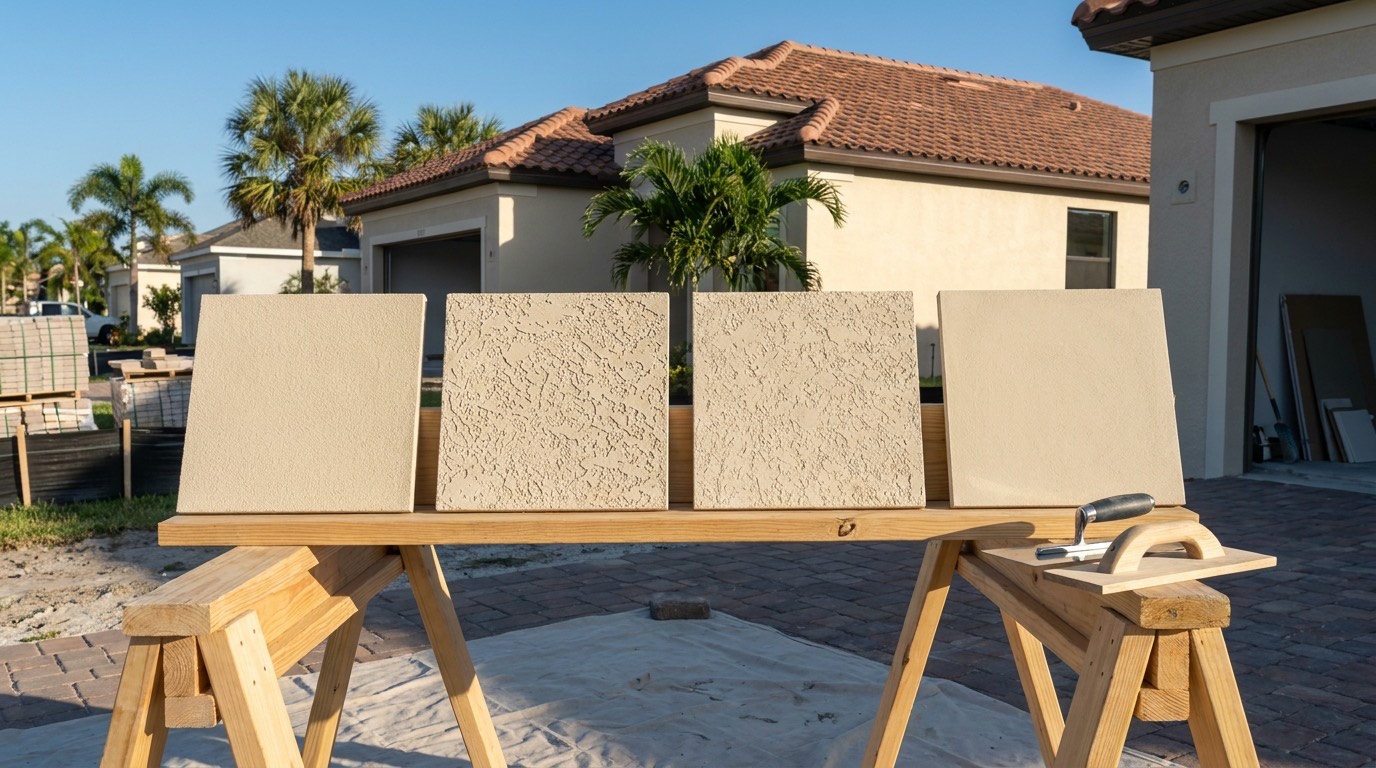
Texture lives in the last eighth of an inch
Everything you see when you look at a stucco wall is the finish coat. It is thin, often around an eighth of an inch, and it carries all of the texture and most of the color. Under it sits the brown coat, which is the layer that was rodded and floated flat, and under that is either bare block or a scratch coat over wire lath.
That order matters, because texture cannot rescue a wall that is out of plane. A heavy pattern hides a slight wave. A flat finish hands it to anyone in the driveway. When a crew talks about the texture on your house, they are describing the last hour of a job that took several days.
Portland cement plaster has real standards behind it. ASTM C926 covers how cement plaster gets applied, and the Portland Cement Association publishes plain guidance on the material. Neither one will tell you which texture you like the look of.
Sand float, the Florida default
If your house was built in Florida in the last forty years, the odds favor a sand float finish. Material goes on with a trowel or a pump, gets cut back flat, and then a plasterer works it in small circles with a sponge float or a rubber float. That float action drags the sand grains in the mix and leaves the even, granular surface you can feel with a flat palm.
It comes in grades, set by the size of the aggregate in the bag and by how hard the float is worked. A fine sand reads almost flat from ten feet away. A medium sand is the standard builder texture across St. Lucie County. A heavy or coarse sand shows individual grains from the street, and there is plenty of it on 1980s and 1990s stock around Port St. Lucie.
It is the default for practical reasons rather than fashion. It goes on fast across the wide flat block walls that Florida builds, it forgives a brown coat that is not perfectly true, and it has almost no upward facing ledges, so it collects less dirt and less algae than a high relief pattern in our humidity. It also takes paint evenly.
- Fine sand: nearly flat past a few feet, common on newer builds and remodels
- Medium sand: the standard builder finish across most of St. Lucie and Martin County
- Heavy or coarse sand: visible grain from the driveway, common on older Port St. Lucie stock
- Swirl float: the circular float pattern is left visible on purpose
- Straight or directional float: worked one way, and it shows lap lines if the crew rushed
Want a price for your own wall?
Four quick questions and we come back with a written quote. Or call (772) 251-6654 if that is faster.
Request a quote
Four questions, about a minute. We'll call you back.
Lace, skip trowel and knockdown
These three belong to one family. Material is thrown or sprayed onto the wall in blobs, left to stiffen for a few minutes, then flattened with a clean trowel. What separates them is how much material went on and how hard it got flattened afterwards.
Lace is the heaviest of the three. The thrown material stays proud and the trowel only kisses the high points, which leaves raised islands with flat tops and a shadow line around each one. Skip trowel is the same idea with a lighter hand, fewer islands and more open field between them. Knockdown usually goes on through a hopper gun and gets flattened harder, so the result is a low mottled pattern rather than distinct islands.
Timing is the whole trick with this family. Flatten too early and the trowel smears it into mud. Wait too long and the trowel tears the tops off instead of laying them over. On a block wall in Tradition in July, the window between those two mistakes can be a few minutes wide, which is why these are harder to match on a hot afternoon than a sand float is.
Dash, and the older Fort Pierce and Stuart stock
Dash is material thrown at the wall and left alone. Nothing gets flattened. Old crews flicked it off a stiff brush, later crews used a hand cranked hopper, and the result is a sharp, rough, gravel like surface you would not want to brush a bare arm against.
You still find it on older homes in Fort Pierce, in the older parts of Stuart, and on mid century block cottages near the water. Most have been painted several times since, and every coat softens the peaks, so an old dash reads as a heavy sand from the sidewalk and only gives itself away up close.
Dash has one honest advantage and one honest drawback. It hides a repair better than any texture on this list, because the pattern is random and the eye has nothing to line up against. It also has thousands of small upward facing surfaces that hold dirt, spores and salt, so shaded elevations green up faster and washing it takes a gentler hand and more patience.
Smooth and Santa Barbara, the two that punish mistakes
Smooth is a steel trowel finish, usually with a very fine aggregate or an acrylic based material, worked until the surface is closed and flat. It is popular right now on new coastal builds and modern remodels, and it is the least forgiving finish there is. Every hollow in the brown coat, every trowel lap and every hairline crack shows up on it in raking light.
Santa Barbara, sometimes sold as a mission or old world finish, is the relaxed cousin. It is troweled thin in passes, left with gentle undulations, softened edges at the openings and some deliberate mottling in the color. Done well it looks handmade. Done badly it looks like a smooth finish that went wrong.
Both are worth wanting, and both change the maintenance conversation before you ever have it. On a textured wall a repair is a patch. On a smooth or a Santa Barbara wall a repair is a plane and a sheen, and the eye catches a break in a flat plane instantly. Budget those walls for corner to corner work rather than spot patching.
Which textures hide a repair, and which advertise it
Randomness conceals work and uniformity exposes it. A dash or a heavy lace will swallow a two foot patch. A fine sand float will show the same patch as a faint shadow in late afternoon light, because grain density and float direction on the new work never match the old exactly.
Stacked on top of that is a color problem. Fresh stucco cures lighter and keeps shifting for weeks. A patch that matches on the day it is troweled will not match a month later, which is why any honest repair plan includes coating a whole elevation afterwards rather than dabbing color on the patch itself.
So we break repair work where the wall offers a break. An inside corner, a control joint, a change of plane, a trim band, the edge of a bay. Stopping a patch in the middle of an open wall is the single most common reason a sound structural repair still looks wrong from the driveway.
- Easiest to hide: dash, heavy lace, coarse sand
- Manageable with care: medium sand float, knockdown, skip trowel
- Difficult: fine sand float, especially where the float swirl is visible
- Plan on a full elevation: smooth, Santa Barbara, and any integrally colored wall
Integral color or paint
Color reaches a stucco wall one of two ways. Integral color is pigment blended into the finish coat itself, so the color runs all the way through that last eighth of an inch. Paint is a film applied over a gray finish coat once it has cured.
Integral has real appeal. There is no film to peel, a chip does not expose a different color underneath, and the surface holds a depth that a rolled coating cannot copy. Acrylic based integral finishes in particular hold up well under our sun. The catch is that the color is now part of the wall, so batch to batch variation, the water in the mix and even the hour the wall was floated all move the shade, and a spot repair cannot be made to disappear.
Paint costs you a recoat cycle and buys you flexibility in return. It bridges hairline cracking, it touches in, and it can be changed when a palette changes. Most homes on the Treasure Coast are painted, and once a wall has been painted the integral color underneath is not coming back. Whichever you have, talk to your HOA before changing a color or a texture. Architectural control in Tradition and St. Lucie West is real, and approval is easier before the work than after.
Related questions
How do I work out which texture is on my house?
Stand a foot away, then step back twenty feet, and ask whether the pattern is random or worked. Thrown and left alone is dash. Thrown and then flattened is lace, skip trowel or knockdown. Even grain with no pattern at all is a sand float.
Can you match my existing texture exactly?
Close, usually. Identical, rarely. Aggregate size, float pressure and the age of the surrounding wall all pull against a perfect match. On dash and lace the difference vanishes into the pattern, and on a fine sand float or a smooth wall we would rather finish out to a corner than promise an invisible patch.
Can I change the texture on just one wall?
Physically yes, visually no. A texture change reads as a mistake unless it stops at a natural break like an inside corner, a control joint or a change of plane. The smallest honest unit of work is a whole elevation.
Does the texture change what the job costs?
Yes, mostly through labor. Sand float is quick, while lace and knockdown need a second pass and tight timing. Smooth and Santa Barbara need a truer base coat and far more hand work, so they sit at the top. Any range only means something once someone has seen the walls, the height and the access.
Which texture holds up best in Florida weather?
Any of them, if the wall under it was built properly. Portland cement plaster is durable here regardless of the pattern on its face. The real differences are how much dirt and algae a texture collects on shaded walls, and how easily it hides a repair later. On both counts a medium sand float is the practical answer.
Does an integrally colored wall ever need painting?
Not on a schedule the way a painted wall does. Integral color lightens and mottles rather than peeling, and a wash often brings back more than people expect. Painting it is a one way decision, so try cleaning first and live with the result for a season.
References
Standards bodies and agencies referenced above. We are not affiliated with them.
More guides
All guides →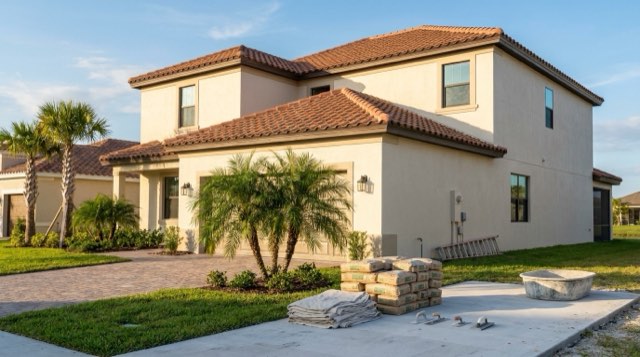 Local guide
Stucco on Newer Tradition Homes: Settlement Cracks and Warranty
New houses crack while they finish curing and settling. On a recent Tradition build the first call should be to the builder's warranty line, not to a contractor.
Read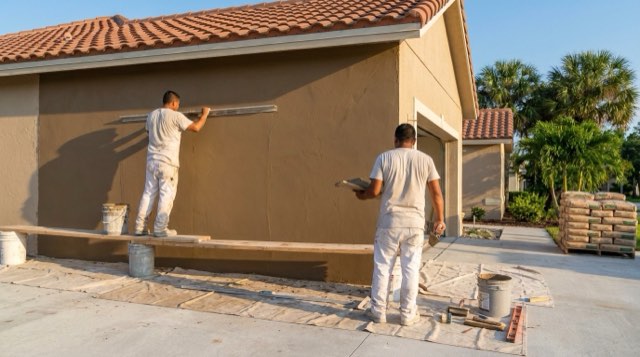 Local guide
Stucco Contractors Serving Vero Beach and Indian River County
Vero Beach is a different county from the rest of the Treasure Coast, and a lot of its owners are not in town when the work happens. Both facts should shape how you hire.
Read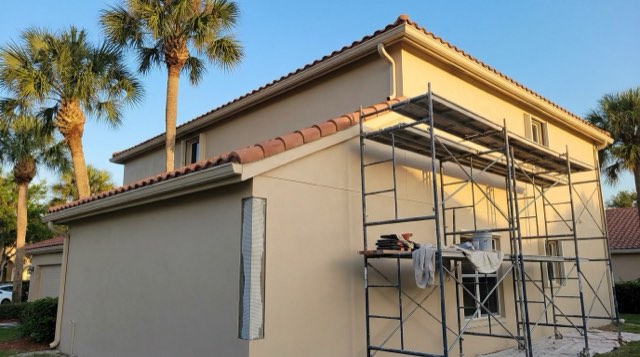 Cost guide
Stucco vs EIFS in Florida: Cost, Lifespan and Which Your Home Has
From the street they look the same. In price, repair cost and how they handle Florida water they are not close. Here is how to identify what is on your walls before you spend anything.
Read Hiring
Stucco Warranties: Workmanship, Materials and What Neither Covers
A stucco warranty is two separate promises from two different companies, and the useful reading is always in the exclusions. Here is what each one covers on a Florida block house.
Read Maintenance
Weep Screed and Control Joints: The Two Details That Save a Wall
Two small pieces of bent metal decide how long a stucco wall lasts. The usual ways they get ruined on the Treasure Coast are a bag of mulch, a paver patio and a tube of caulk.
ReadStraight answer on your wall.
Call, or send the form and we will get you a written price.