Stucco vs EIFS in Florida: Cost, Lifespan and Which Your Home Has
From the street they look the same. In price, repair cost and how they handle Florida water they are not close. Here is how to identify what is on your walls before you spend anything.
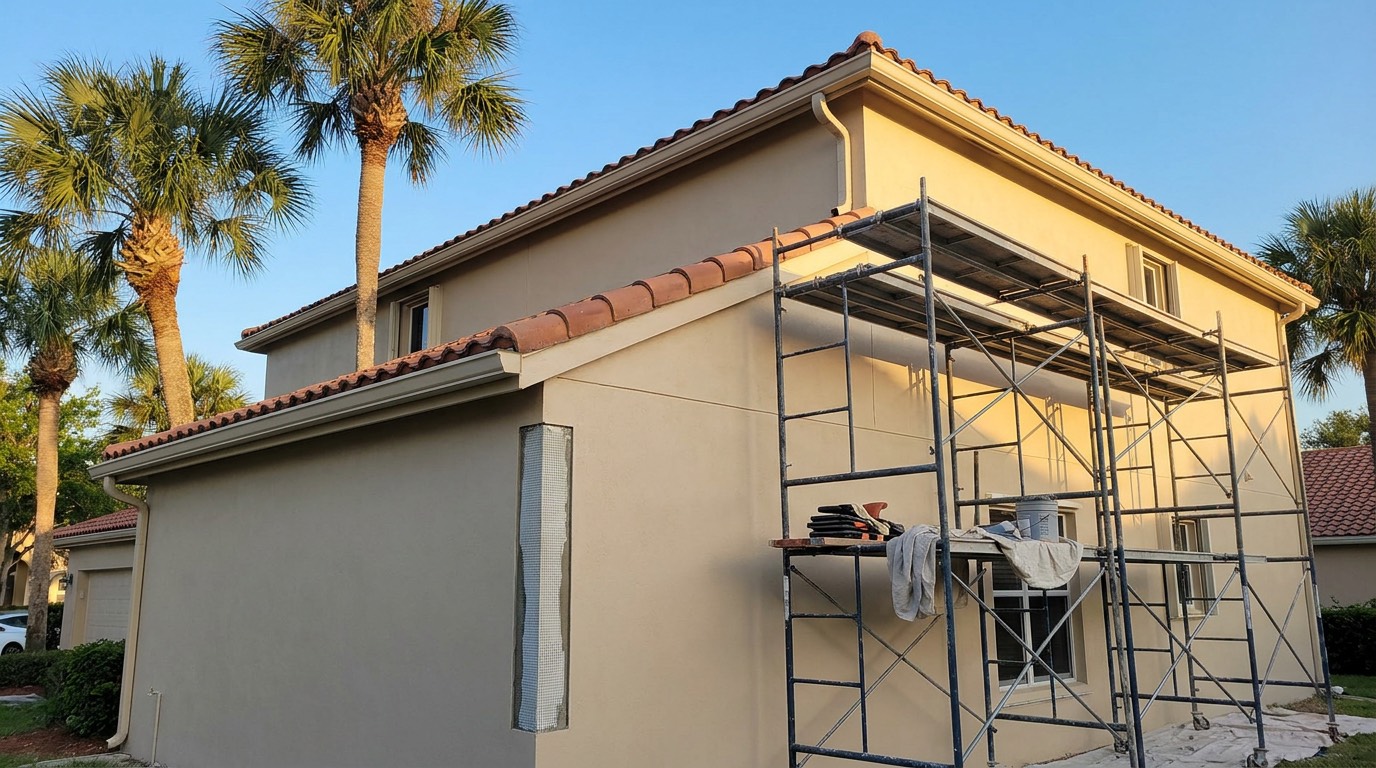
Two very different walls that look identical from the driveway
Traditional stucco is a cement based plaster. Sand, cement, lime and water, applied in coats over concrete block or over lath on a framed wall. It is heavy and hard, basically a thin layer of masonry stuck to your house.
EIFS is a synthetic system. Foam board is attached to the wall, a fiberglass mesh is embedded in a thin base coat over the foam, and a synthetic finish goes over that. It is light, it flexes, it insulates, and the shell is usually under half an inch thick over several inches of foam.
Painted the same color and given the same texture, a homeowner in Stuart or Vero Beach cannot tell them apart at twenty feet. They cost different money to install, very different money to repair, and they behave differently when Florida water gets into them. Identify yours before you get a single quote.
How to tell which one is on your walls
You can usually settle this in five minutes with your hands. Knock on a wall field away from any opening. Traditional stucco over block gives a hard, solid, unforgiving sound. EIFS gives a light hollow knock.
Then press firmly with your thumb. Cement stucco does not give at all. EIFS has a slight cushion under moderate pressure. Next, look at an exposed edge, at a window return, the garage door jamb, or where the wall meets a soffit. Cement stucco reads as a thick hard rind. EIFS reads as a thin shell over thick foam.
Finally, consider the house itself. The dominant construction across St. Lucie, Martin and Indian River counties is concrete block, and block homes here overwhelmingly carry cement stucco. EIFS shows up more on commercial buildings, framed second stories, and decorative bands and trim. Plenty of homes have both.
- Knock test, hard solid ring versus a light hollow tap
- Thumb press, no give at all versus a slight cushion
- Edge inspection at windows and soffits, thick hard rind versus thin shell over foam
- Magnet on the wall field, corner bead and lath often show on framed cement stucco walls
- Foam bands and decorative trim, very often EIFS even on a cement stucco house
Want a price for your own wall?
Four quick questions and we come back with a written quote. Or call (772) 251-6654 if that is faster.
Request a quote
Four questions, about a minute. We'll call you back.
What each costs to install
For new work on a Florida home, the installed ranges are closer than people expect. What separates them is the substrate and the crew.
Traditional stucco on concrete block is efficient. The block is already there, it is stable, and no lath is needed across the wall field. On a framed wall, three coat stucco needs a weather resistive barrier and metal lath first, and that raises the number. EIFS costs more in material and needs a crew trained in that specific system, but it brings continuous insulation with it.
For most Treasure Coast homeowners this is not really a choice. If you own a block house, cement stucco is what your walls are built for. Re-cladding block in EIFS needs a much better reason than price.
- Traditional stucco over block, commonly $6 to $11 per square foot of wall installed
- Three coat stucco over frame with lath, commonly $9 to $15 per square foot of wall
- EIFS on a residential wall, commonly $9 to $18 per square foot of wall
- Add for demolition and disposal of the existing wall covering on any re-clad
Repair cost is where they really separate
This matters more than installed price, because most homeowners meet this question during a repair rather than during new construction.
Repairing cement stucco is mechanical and predictable. Cut back to sound material, undercut the edge, rebuild the coats, match the texture, coat the elevation. The substrate underneath is block, which does not rot. A patch is a patch.
Repairing EIFS is an investigation. Water that gets past the surface at a bad window flashing or an unsealed penetration can travel behind the foam without showing on the outside. By the time it shows, the wet area is often far larger than the visible damage, and on a framed wall the sheathing behind it may have been wet for a long time. That means moisture probing, larger removal areas, and a scope nobody can price from the driveway. Expect EIFS repair to carry a higher per square foot cost and a wider range than cement stucco repair on a comparable house.
Lifespan and how Florida treats each one
Properly installed cement stucco on block is a very long life finish. It is a masonry product on a masonry wall, and decades of service is normal here. Its weakness is cracking, because it is rigid and it moves with the building, and every crack is a potential path for wind driven rain.
Modern EIFS with a drainage plane also performs well and flexes rather than cracking. Its weakness is entirely in the details. Flashings, penetrations, terminations, sealant joints. Get those right and it lasts. Get one wrong and the system hides the consequence until it is expensive.
On the Treasure Coast both systems face the same three pressures: wind driven rain during hurricane season, sustained humidity, and salt air along the coast and the Indian River Lagoon. In Fort Pierce, Jensen Beach and Sebastian, salt exposure corrodes anything metallic in the wall assembly. That shows up as rust staining and spalling on cement stucco, and as fastener and accessory problems on EIFS.
Why block homes here are almost always cement stucco
There is a practical reason the Treasure Coast building stock looks the way it does. Concrete block handles our humidity and storm loads well, it does not rot, and termites do not eat it. Cement plaster bonds directly to block and behaves like part of the same wall.
That is why a homeowner in Port Salerno, Hobe Sound or Okeechobee usually finds cement stucco on the walls, often with EIFS foam trim around windows and along decorative bands. Those foam bands are the most commonly misidentified feature in this trade, and they matter, because they are repaired with EIFS methods and not cement stucco methods.
Getting that right is worth real money. Cement patch material troweled onto a foam band will crack and fall off, and the second repair costs more than the first one should have.
If you are choosing between them
For a block home in St. Lucie County, cement stucco is the default and the reasons to leave it are narrow. For a framed wall, a framed second story, or a house where continuous exterior insulation is a real design objective, EIFS is a legitimate choice that lives or dies on installation quality.
If you go with EIFS, buy the detailing and not just the finish. A drainage system rather than a face sealed one, correct flashings at every opening, correct terminations at grade and at the roof line, proper sealant joints at every penetration. That is the whole ballgame.
Whichever way you go, decide on the site rather than off a page. Have a contractor identify in writing what is on each elevation of your house. Every number here is a market range to frame the conversation, not a quote.
- Block walls, cement stucco unless there is a specific reason not to
- Framed walls and second stories, either system works if detailed correctly
- Existing foam bands and trim, repaired with EIFS methods regardless of the wall system
- Any EIFS work, verify the crew is trained in the specific system being installed
Related questions
Is EIFS the same thing as synthetic stucco?
In everyday use, yes. Synthetic stucco is the common name for an Exterior Insulation and Finish System, which is foam board, a mesh reinforced base coat and a synthetic finish. It is worth being precise when you call a contractor, because the repair method, the materials and the training required are all different from cement stucco.
Does EIFS cause moisture problems in Florida?
The system itself is not the problem. Water entering behind it at a poorly detailed window, penetration or termination is the problem, and older face sealed installations had no drainage path to let that water back out. Modern drainable systems address this. If your home has EIFS, the flashings and sealant joints are what deserve your attention and your maintenance budget.
Can I put cement stucco over existing EIFS?
Not by troweling it over the top. Cement plaster is heavy and rigid, and foam will not hold it. Converting a wall from EIFS to cement stucco is a re-clad, meaning removal down to the sheathing or block, correcting the moisture barrier and flashings, and rebuilding from there. Price it as a replacement project, not a coating.
Which one is cheaper to insure or easier to sell in St. Lucie County?
Insurance underwriting and buyer perception vary by carrier, agent and buyer, and neither is something a contractor can speak to reliably. Ask your insurance agent directly. Then keep the written scope, photos and any moisture findings from wall work, because that documentation is what answers the question later.
How do I know if my foam window bands are EIFS?
Press them. Foam trim gives noticeably under thumb pressure and sounds hollow when tapped, while cast concrete or cement banding does not move at all. Foam bands are extremely common on Treasure Coast homes that otherwise have cement stucco walls. They need EIFS style patching, mesh and base coat rather than sand and cement.
Which system holds up better to hurricane season here?
Both perform when they are installed and detailed correctly, and both fail at the details when they are not. Cement stucco on block is more resistant to impact and does not depend on foam attachment. EIFS flexes rather than cracks. In wind driven rain, what actually decides the outcome on either system is the quality of the flashings, terminations and sealant joints around every opening.
More guides
All guides → Hiring
Stucco Warranties: Workmanship, Materials and What Neither Covers
A stucco warranty is two separate promises from two different companies, and the useful reading is always in the exclusions. Here is what each one covers on a Florida block house.
Read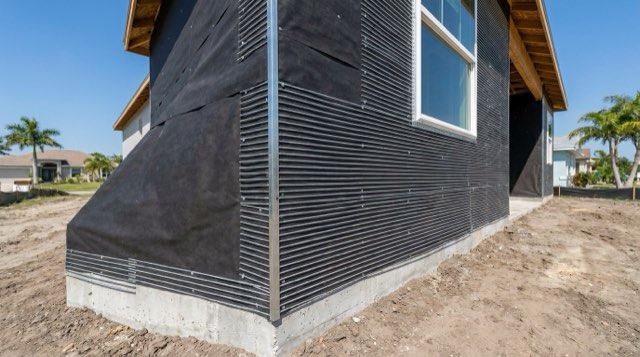 Maintenance
Weep Screed and Control Joints: The Two Details That Save a Wall
Two small pieces of bent metal decide how long a stucco wall lasts. The usual ways they get ruined on the Treasure Coast are a bag of mulch, a paver patio and a tube of caulk.
Read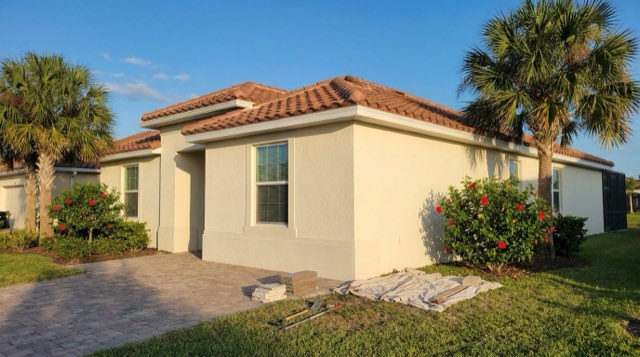 Hiring
What a Good Stucco Quote Actually Contains
A stucco quote is a description of work with a number at the bottom. Here is what belongs in the description, and how to lay two quotes next to each other and see the real difference.
Read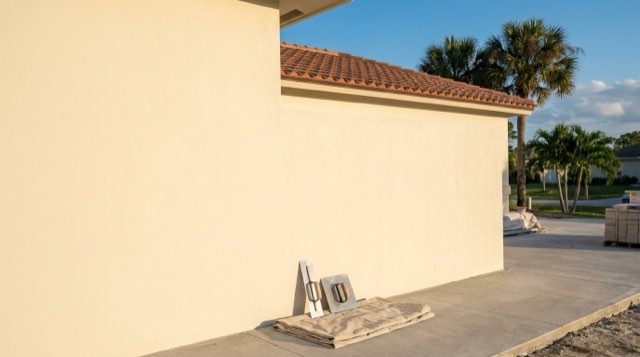 Diagnosis
Why Stucco Cracks on Florida Block Homes, and Which Cracks Matter
Not every crack in a Florida stucco wall means trouble. Here is how to tell hairline shrinkage from a stair-step, a diagonal off a window corner, or a crack being pushed open by rust.
ReadStorm seasonHow Wind-Driven Rain Gets Behind Florida Stucco
A stucco wall is meant to get wet. What matters is whether the water that gets past it can find its way back out. Here is the path wind-driven rain actually takes on a Treasure Coast house.
ReadStraight answer on your wall.
Call, or send the form and we will get you a written price.