How Wind-Driven Rain Gets Behind Florida Stucco
A stucco wall is meant to get wet. What matters is whether the water that gets past it can find its way back out. Here is the path wind-driven rain actually takes on a Treasure Coast house.
Stucco is a reservoir, not a raincoat
Most people assume a stucco wall keeps water out the way a metal roof does. It does not, and it was never built to. Cement plaster is a reservoir cladding. It takes water on during a storm, holds it in the pore structure of the cement, and gives it back to the air over the next day or two.
That is normal. It is why a wall in Port St. Lucie reads two shades darker the morning after heavy rain and looks like itself again by Wednesday. The system works because the wetting is temporary and the wall can dry.
The problem is never the water in the stucco. It is the water that gets past the stucco and then has nowhere to go. Everything below is about that second path.
What wind adds to rain
Rain falling straight down mostly lands on the roof. Rain arriving sideways at forty or sixty miles an hour lands on the walls, and it loads one elevation far harder than the other three. That is why a house in Jensen Beach can have a leak that only ever shows up in storms out of the northeast and never in a July afternoon downpour.
Wind contributes two things. Momentum, which carries droplets into openings gravity would never take them into, including upward under a lap and sideways through a crack. And pressure, because wind pushes on the outside face of a wall while the inside stays near neutral, so any opening between the two becomes a small pump.
This is the reason a joint that shed water for a decade can leak in one event. Nothing about the joint changed. The pressure across it did.
Want a price for your own wall?
Four quick questions and we come back with a written quote. Or call (772) 251-6654 if that is faster.
Request a quote
Four questions, about a minute. We'll call you back.
Behind the lath there is supposed to be a drainage plane
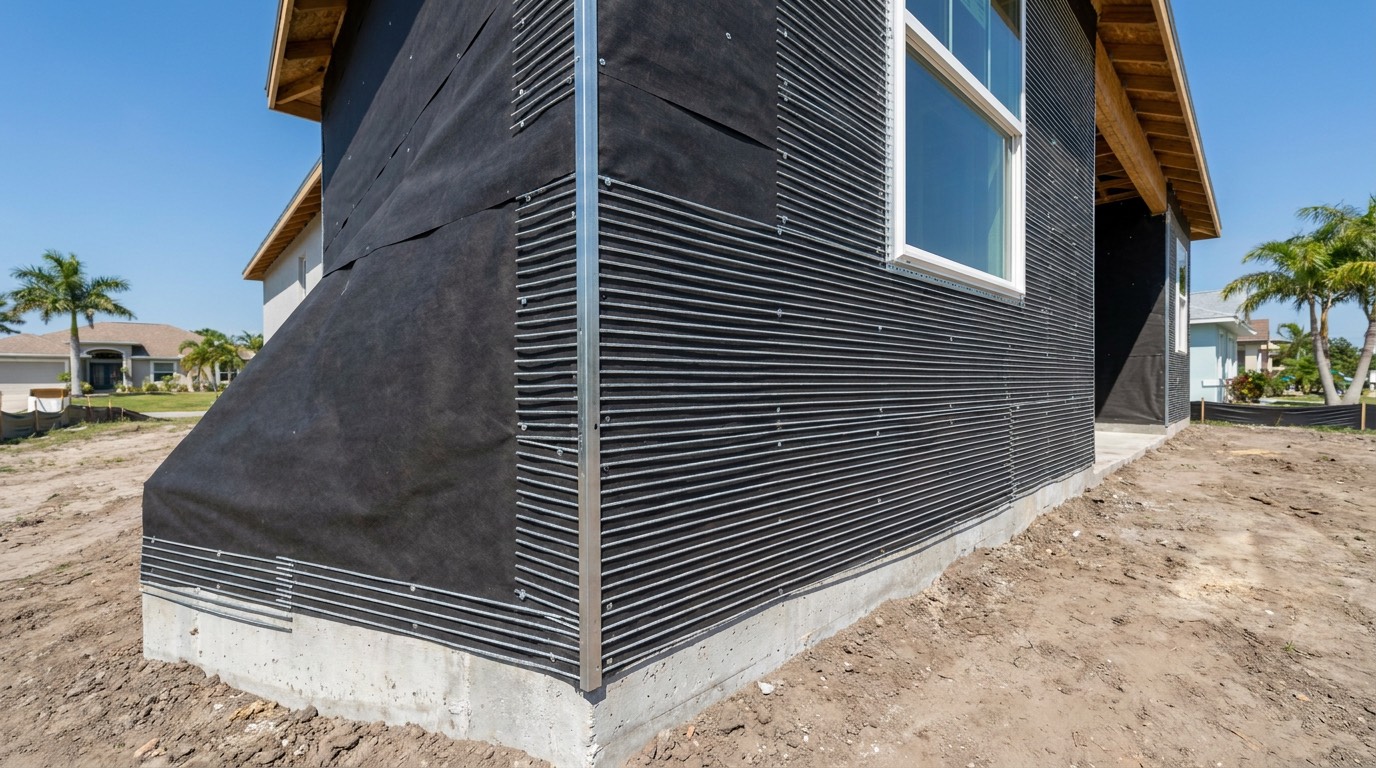
On a framed wall or a gable end, the stucco is not the water control layer. It is the sacrificial outer face. Behind it sits sheathing, a weather resistant barrier, then metal lath, then the plaster. The barrier is the layer actually keeping water out of the building.
Water that works through the stucco is supposed to hit that barrier, run down it, and leave at the bottom through the weep screed. Long-standing practice on lathed walls is two layers of barrier, because fresh stucco grips the first layer hard and the second stays free to shed water down and out.
When somebody says a stucco wall failed, what usually failed is that drainage path. Either it was never continuous, or it got punctured, or the water that entered had no open route back out of the assembly.
- The barrier lapped shingle style, upper layer over lower, so water runs down and out
- Continuity maintained around every opening and penetration, not just across the field
- The weep screed left open to air at the base of the wall
- Flashing that lands on top of the barrier rather than behind it
- No fastener or bracket driven through the plane without being sealed
Direct to block is a different animal
Most of the housing stock in St. Lucie and Martin County is concrete block, and stucco applied straight to block has no cavity, no lath and no barrier behind it. There is nothing to drain to. The wall manages water by mass. Block and plaster absorb it, hold it, and release it later.
That approach has held up here for decades, and it is not a defect. It does mean the failure pattern looks different. A block wall almost never leaks through the middle of an intact field. It leaks where the mass assembly gets interrupted.
The interruptions are the same short list every time. Openings. Penetrations. The line where block meets framing at a gable end. The tie beam. Anywhere the wall stops being a solid slab of cement and starts being an assembly of parts fitted together.
Window and door perimeters do most of the leaking
When a Treasure Coast stucco wall lets water in, the odds heavily favor an opening. The perimeter of a window is where several trades meet, where the sealant joint lives, where flashing either exists or does not, and where the stucco returns into the frame.
In a wind driven event, water sheets down the glass, hits the frame, and pools at the sill corners. If the bead there has released on one side, pressure across the wall walks that water straight through the gap. Most homeowners learn about it from a stain on an interior sill or a soft patch in the drywall return.
The fix is rarely exciting and it is almost never paint. Cut the old sealant out completely, prepare and back the joint properly, then lay in a real bead. If it still leaks after that, flashing behind the stucco is the next suspect, and seeing it means opening the wall at the perimeter.
Kick-out flashing, the small piece that does big damage
Where a sloped roof edge runs into a vertical wall, the last few inches of that intersection need a piece of metal that throws water out and away from the wall, ideally into the gutter. It is called a kick-out. It costs very little. It is missing on a lot of houses.
Without it, every rain on that roof plane sends a concentrated stream at one point on the wall, right at the base of the step flashing. On a two story where a lower roof runs into an upper wall, common on the newer stock in Tradition and St. Lucie West, that single detail can soak one wall section for years.
The signature is a vertical band of staining or algae below the roof line, sometimes a bulge, and often interior damage well below where the water actually got in. If a roof dies into a stucco wall anywhere on your house, look there first when a leak makes no sense.
Why a coating alone does not stop it
Elastomeric coatings do real work. They bridge hairline cracking, they shed water off the field of a wall, and on a chalky old finish they buy years. What they cannot do is fix an interface.
A coating lands on the face of the stucco. Wind driven rain that leaks is nearly always entering at a joint, a penetration, a flashing gap or an opening perimeter, which are exactly the places a roller cannot reach and a sprayed film cannot bridge. Coating a wall with a failed window seal gives you a good looking wall and the same leak.
There is a second issue. A heavy, low permeability coating on a wall that is already taking water from a hidden path slows the drying half of the equation. The wall still gets wet and now it stays wet longer. That is how a well meant paint job makes a moisture problem worse rather than better. Seal the interfaces first, then coat the field.
Related questions
Is stucco waterproof?
No, and it is not supposed to be. Cement plaster absorbs water in a storm and releases it afterward, which is why walls darken and then dry back out. Keeping water out of the building is the job of the barrier behind the lath on framed walls, and of mass plus sound joints and flashing on block walls.
Why does my wall only leak in certain storms?
Because wind direction decides which elevation gets loaded. A leak that needs both driving rain and wind pressure from one particular direction will sit quiet through ordinary afternoon storms and then show up once or twice a year. It is a common pattern near the water in Jensen Beach, Port Salerno and Fort Pierce.
Will elastomeric paint stop my leak?
Not if the water is entering at a joint, a window perimeter or a flashing gap, which is where it usually enters. Coatings work on the field of a wall and on hairline cracking. They cannot bridge an interface. Find and correct the entry point first, then coat, or you are paying to hide the symptom.
My house is block. Is there a barrier behind my stucco?
Usually not on the block itself. Stucco is typically applied directly to block with no cavity and no drainage layer, and the wall manages water by absorption. Framed portions of the same house, such as gable ends, second stories and additions, are a different assembly with lath and a barrier behind them.
How do you find where the water is getting in?
By working from most likely to least. Openings and penetrations first, then roof to wall intersections, then the field of the wall. Interior stain patterns, a moisture meter, and a controlled water test on one suspect area at a time will usually locate it. Guessing and sealing everything at once tells you nothing.
The stain is under my window, so the window is the leak, right?
Often, but not always. Water travels along framing, sheathing and the back of the stucco before it appears inside, so the stain can be well below and to one side of the real entry point. That is why the window perimeter gets checked first and the wall above it gets checked second.
More guides
All guides →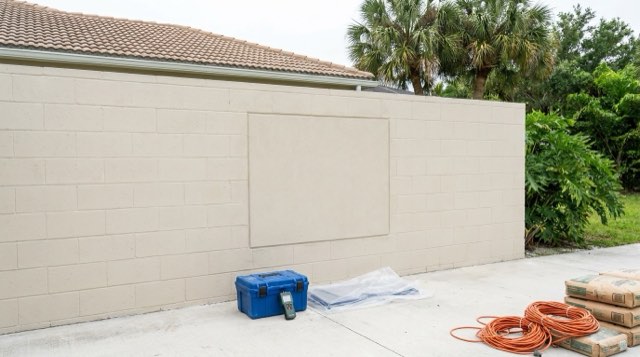 Storm season
Assessing Stucco Damage After a Storm
The morning after, a soaked wall looks worse than it is. Here is how to work out which elevation actually took the storm, separate fresh impact from cracking that was already there, and document it before anyone starts patching.
Read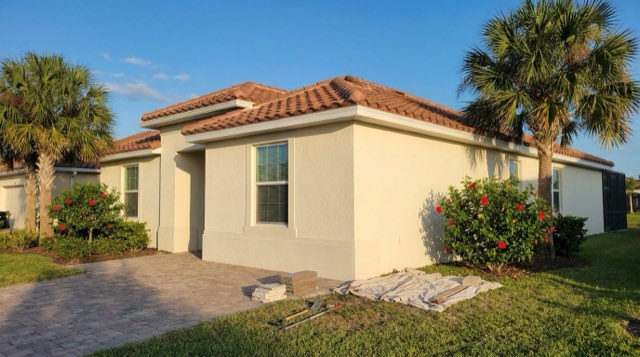 How it works
The Best Time of Year for Stucco Work on the Treasure Coast
There is no freeze shutdown in Florida, so stucco runs all twelve months. What actually moves the calendar here is the afternoon storm pattern, storm season staging, and how fast a wall can take its next coat.
Read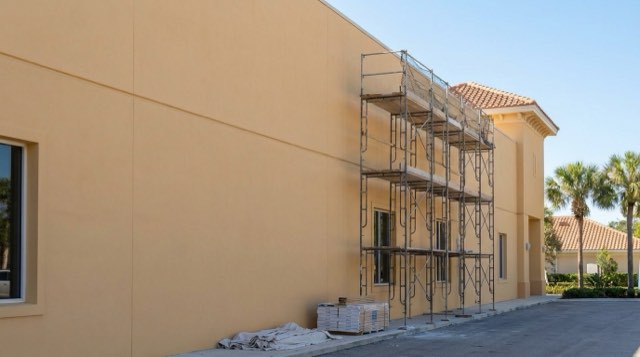 Diagnosis
Inspecting Commercial EIFS: Drainage vs Barrier Systems
EIFS is uncommon on Treasure Coast block construction, so finding it on your building tells you something before the inspection even starts. Here is how a manager or board works out which assembly they have, and what that changes.
Read Maintenance
Building a Facade Maintenance Plan for Commercial Stucco
Facade spending is either a planned line item or an emergency. On the Treasure Coast two calendars decide which one it becomes: the storm season and the occupancy year.
Read How it works
Assessing Stucco on a Coastal Condo Building
An island tower and a three story garden building both get called a condo, and they need different surveys. How exposure, access and the season decide what a board can actually learn.
ReadStraight answer on your wall.
Call, or send the form and we will get you a written price.