Why Stucco Cracks on Florida Block Homes, and Which Cracks Matter
Not every crack in a Florida stucco wall means trouble. Here is how to tell hairline shrinkage from a stair-step, a diagonal off a window corner, or a crack being pushed open by rust.
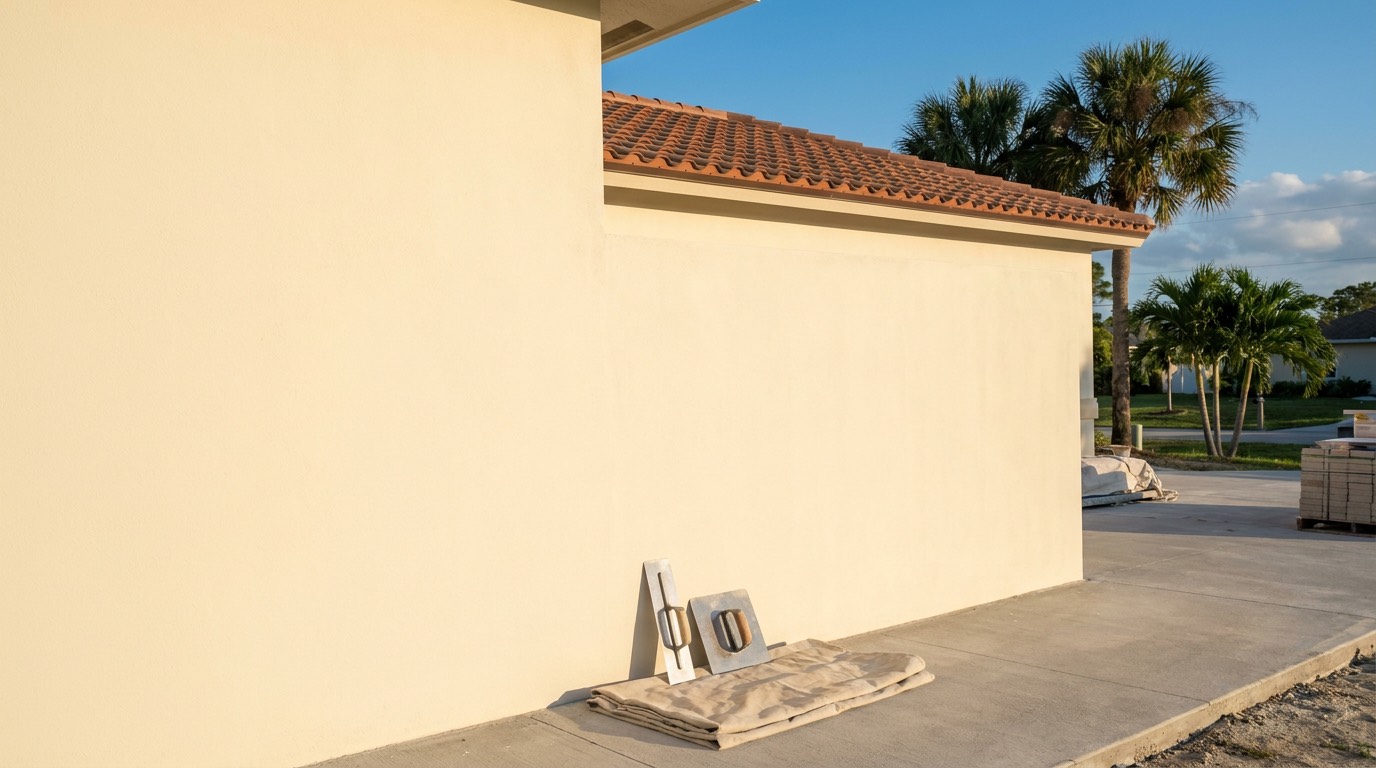
Stucco cracks because it is cement, and cement shrinks
Stucco is portland cement plaster. It goes on wet, it dries, and it shrinks while it cures. On a Port St. Lucie block home that shrinkage has to go somewhere, and it usually shows up as fine cracking in the flat field of a wall. That part is normal and it happens on well built houses.
The second driver is movement. Block, the framing that carries the roof, the lintels over the openings, and the stucco skin all expand at different rates. Put summer sun on a west facing wall in St. Lucie West, then a storm that cools that wall thirty degrees in ten minutes, and you have an assembly that moves every day of the year. So the question is never whether your wall has cracks. It is what kind, where they run, and whether something behind the stucco is moving that should not be.
- Curing shrinkage in the finish or brown coat
- Daily thermal movement, worst on south and west exposures
- Differential movement where block meets wood or steel framing
- Stress concentrating at the corners of windows and doors
- Settlement or foundation movement, which is uncommon but real
- Corroding metal inside the wall pushing the stucco apart
Hairline and map cracking, the common kind
Hairline cracks are thin enough that you have to stand within a few feet to see them. Map cracking, sometimes called alligatoring, is a web of them across a wall field. Both usually trace back to the finish or brown coat drying faster than it cured, or to a mix that carried more cement than it needed. Florida works against the plasterer here. A block wall in Tradition in July can be too hot to keep your hand on, and if material goes onto that surface and the water leaves before the cement hydrates, you get shrinkage cracking no matter how good the hand on the trowel was.
Hairline cracking on its own does not admit much water. Wind driven rain can push a little through, which is the honest reason we coat these walls rather than chase every line with filler. A quality elastomeric or a good acrylic finish bridges hairlines and keeps moving with the wall.
Want a price for your own wall?
Four quick questions and we come back with a written quote. Or call (772) 251-6654 if that is faster.
Request a quote
Four questions, about a minute. We'll call you back.
Stair-step cracks that follow the block joints
Look at the path the crack takes. If it runs sideways, then up, then sideways again in a staircase pattern, it is tracing the mortar joints of the concrete block behind the stucco. Block is laid in a running bond and a crack finds the weakest line, which is the mortar.
A stair-step usually means movement in the block wall itself, not just in the plaster skin. Sometimes that is a long wall built without a control joint. Sometimes it is one end of the wall settling.
The tell is whether the crack changes width along its run. One that stays the same hair width top to bottom is generally old movement that has stopped. One that is tight at one end and open at the other, or where one side sits higher than the other when you run a finger across it, means part of the wall has moved. That is a structural question, and an engineer should look at it before anybody patches stucco over it.
Diagonal cracks running out of window and door corners
A window is a hole in a wall, and stress concentrates at the corners of holes. A crack running up and away at roughly forty five degrees from an opening is the most common non-hairline crack we are called about here, and on its own it is normally not structural.
It still earns more attention than the same crack mid wall, for one reason. Location. Water entering a corner crack lands beside the window perimeter, where the sealant and flashing live, and that perimeter is already the most common leak point on a Florida house. The repair is routing the crack into a shallow V, filling it, meshing it, and blending the texture past the patch. Replace the sealant at the window while you are there, because filling a crack under an open joint is half a repair.
Horizontal cracks, and what they usually follow
Horizontal cracks deserve a closer look, because shrinkage does not usually produce a long level line. On a two story home, a horizontal crack where the second floor meets the first often marks differential movement between a framed floor system and the masonry below. On a single story block house, one near the top of the wall frequently follows the tie beam, and one under a window follows the sill or the lintel.
None of those is automatically serious, but none is simple shrinkage either. Each means something is moving at one specific plane. The horizontal crack we treat with most respect is the one that is not just open but pushed outward, where one side stands proud of the other. That wall is not separating from tension. Something behind it is getting bigger.
Rust jacking, the coastal special
Salt air reaches a long way in from the Atlantic and the Indian River Lagoon. Homes in Jensen Beach, Hobe Sound, Port Salerno, Vero Beach, and Sebastian sit in it year round. Unprotected steel inside a stucco wall eventually corrodes, and rust occupies several times the volume of the metal it came from.
That expansion pushes the stucco off the wall. The signature is a crack running unnaturally straight along an outside corner where the corner bead sits, a raised ridge you can feel, and orange staining weeping out of the line. On older frame and lath homes in Fort Pierce and Stuart, the same reaction runs along rusted wire lath and at the fasteners. Rust jacking does not stop on its own and it does not respond to caulk. The metal has to come out and be replaced, or the same crack reopens in a season or two, usually wider.
- Unnaturally straight cracks along outside corners, typically corner bead
- A ridge you can feel with a flat hand crossing the crack
- Orange or brown staining bleeding out of the crack line
- Small blisters or pops in a repeating row, following lath or fasteners
- Hollow sound within a few inches either side of the crack
Which cracks to fix, and which you can honestly just watch
Plenty of cracks can be monitored. If a crack is hairline, dry, stable, with no staining and no hollow sound around it, you are allowed to leave it alone. Sealing and coating it during your next paint cycle is usually all it will ever need.
Monitoring properly takes two minutes. Photograph the crack with a coin or a tape measure beside it, note the date, and take the same photo from the same spot in six months. Cracks that have finished moving look identical. Cracks still working are obvious the moment you compare. We open a wall when the evidence points behind the stucco rather than in it, and nobody should be talked into that because a hairline made them nervous.
- Watch it: hairline, stable, dry, solid sound, no staining nearby
- Seal and coat it: fine or map cracking across a wall field, on your normal paint cycle
- Repair it properly: diagonal corner cracks, or anything you can catch a fingernail in
- Open the wall: hollow sound, bulging, rust staining, or cracks that return in the same line
- Call an engineer first: stair-step cracking that is widening, or any crack with vertical offset
Related questions
Are hairline cracks in my stucco a problem?
Usually not on their own. Hairline shrinkage cracking is normal on cement plaster and is typically handled with a quality coating on your regular paint cycle. What changes the answer is what surrounds it. Hairlines with hollow sound, rust staining, or a bulge next to them are worth a closer look.
How wide does a crack have to be before it matters?
A practical line is about a sixteenth of an inch, or anything you can catch a fingernail on. Below that, most cracks coat over and stay closed. Above that they hold water long enough to matter. Pattern still beats width, though, and a narrow stair-step that is growing concerns us more than a wider static crack.
Why does my newer home in Tradition or St. Lucie West already have cracks?
New stucco keeps curing and shrinking for months after the crew leaves, so fine cracking in the first year or two on a newer block home is common and often not a defect. Watch for cracks that widen or arrive with staining, and check what your builder warranty covers on stucco before the term runs out.
Can I just caulk my stucco cracks?
For a narrow crack in a flat wall field it is a reasonable stopgap. The trouble is that caulk sits proud of the surface, collects dirt, and rarely matches the texture, so it often reads worse from the driveway than the crack did. It also does nothing about the cause when the crack is driven by rust or by movement.
Does a stucco crack mean my foundation is failing?
Rarely. Most stucco cracks are shrinkage, thermal movement, or stress at openings. Foundation movement has its own signature: stair-step cracking that widens toward one end, doors that stop latching cleanly, and cracks that return in the same line after a good repair. If you see that combination, an engineer is the right first call.
Should I repair cracks before painting the house?
Yes, and it is the cheapest time you will ever do it, since the prep is already happening and the crew is already on the wall. Coating over an unrepaired crack means it telegraphs back through the fresh paint, and then you are paying for access twice.
More guides
All guides → Storm season
How Wind-Driven Rain Gets Behind Florida Stucco
A stucco wall is meant to get wet. What matters is whether the water that gets past it can find its way back out. Here is the path wind-driven rain actually takes on a Treasure Coast house.
Read Storm season
Assessing Stucco Damage After a Storm
The morning after, a soaked wall looks worse than it is. Here is how to work out which elevation actually took the storm, separate fresh impact from cracking that was already there, and document it before anyone starts patching.
Read How it works
The Best Time of Year for Stucco Work on the Treasure Coast
There is no freeze shutdown in Florida, so stucco runs all twelve months. What actually moves the calendar here is the afternoon storm pattern, storm season staging, and how fast a wall can take its next coat.
Read Diagnosis
Inspecting Commercial EIFS: Drainage vs Barrier Systems
EIFS is uncommon on Treasure Coast block construction, so finding it on your building tells you something before the inspection even starts. Here is how a manager or board works out which assembly they have, and what that changes.
Read Maintenance
Building a Facade Maintenance Plan for Commercial Stucco
Facade spending is either a planned line item or an emergency. On the Treasure Coast two calendars decide which one it becomes: the storm season and the occupancy year.
ReadStraight answer on your wall.
Call, or send the form and we will get you a written price.